Best of the Triangle
GLOBAL PROVINCE - Home - About This Site - Agile Companies - Annual Reports - Best of Class - Best of theTriangle - Big Ideas - Brain Stem - Business Diary - Dunk's Dictums - Global Wit & Worldly Wisdom - Gods, Heroes, & Legends - Infinite Bookstore - Investor Digest - Letters from the Global Province - Other Global Sites - Poetry & Business - Scenes from the Global Province - A Stitch in Time - Two Rivers
By this we mean Raleigh, Durham, Chapel Hill, and vicinity. We will be covering gardens, plant nurseries, hotels, restaurants, and more as we have time. Culling the best from North Carolina’s capital region is a subtle task, because the “best” is not self-evident. The region’s most important venture-capitalists do not strut their stuff. Often the best restaurants are unknown to local critics. The nicest barber shop is always at the other end of town, the best auto-repairman is out in the woods, and a half-deserted town—called Bynum—of amusing sculptures is well apart from just about everything.
1-25 ·26+
When M Sushi opened, it was on its way to becoming the best restaurant in the Triangle. It has since fallen back a bit, and now is one of the 4 or 5 very good B restaurants in this region. There is no A restaurant. But it is awfully good and, we would say, one of just two superior Japanese restaurants here. Chef and Owner Michael Lee has a lot on his plate, having also put together a chicken affair (M Kokko) on the back side of M Sushi, and he has a taco restaurant (M Taco) and a Korean affair (M Kogi) in the works. He's a bit stretched.
The trick at M Sushi is to stick to the small plates and rolls, since they turn out better than more elaborate offerings. For instance, we would suggest the twisted mango, sawagani, and chawanmushi. Skip the edamame beans, which just don't make the grade.
You might as well drink the beer: he has a couple of good ones such as Orion from Okinawa. At the start he had a bar that mattered: it offered a gin drink that was superb, but that has disappeared. Now the liquor and such seem like an afterthought. There is wine and sake for those who are of a mind. M Sushi. 311 Holland Street (just off E. Chapel Hill Street) Durham, North Carolina 27701. 919-908-9266. http://msushidurham.com/ Reservations are a bit of a pain, since one is basically forced to use Open Table. For lunch, anyway, arrive late, say 1:45 PM, since this converted factory space gets both noisy and crowded, but is a delight as it empties out. With luck one can secure a table up front, near the few windows, so as to enjoy natural light. (8-2-17)
We recently took an insurance executive to Picnic. His hobby is eating barbecue, and he has sunk his teeth into barbecue beef and pork in 42 states. He allows that Picnic is right good eatin'. There are 3 partners, each with different talents. Ben does the cooking. Wyatt Dickson, of Pig Whistle Whole Hog Barbecue catering company, and farmer Ray Butler of Green Button Farm in Bahama are the rest of the team. They grow their own pork and smoke it, Berkshire as we remember. For what it is worth, it is on Time Magazine's list (8 places) of the Carolina joints where you should visit for barb pig. It offers beef as well, but we suggest you stick to the pork. The pork is lean (no indigestion) and the cole slaw is not over-sauced. Picnic. 1647 Cole Mill Road (at intersection with Rose of Sharon), Durham, North Carolina. 919-908-9128. http://www.picnicdurham.com/ (8-2-17)
150. Global Province Triangle Restaurant Directory
As we said in Triangular Eating, the Research Triangle does not have a surfeit of good restaurants. And it is terribly hard to find the few that show a little excellence.
Both failings probably stem from the same cause. This area of the country lacks a solid discriminating audience. The art critic, scholar, and museum director George Heard Hamilton was fond of saying that a great painting comes about for several reasons--good materials, a fine talent, etc. As importantly, he felt that if there were to be great art, there must be a great audience. The Research Triangle lacks a great audience when it comes to food. Richard Florida, who has written about how regions attract the best and brightest people, tends to think areas such as the Triangle fail to really soar and get the best people because they are culturally weak. The food does not reflect a strong, vibrant, and interesting culture.
We publish our restaurant directory because the local media--newspapers, live media, etc.--have failed to separate the wheat from the chaff and tend to salute almost every eatery that comes along. Yet oddly they often say nary a word about the best. It is for this reason that the best Vietnamese restaurant in the whole region--located in Durham--closed its doors. In fact, the Durham paper managed to pan it, while singing the praises of some abjectly poor Chinese dives in and about the area.
Go here to read our directory.
The handful of truly top drawer restaurants are as follows:
- Nana's. American Continental in Durham. Probably the best restaurant in the whole region, offering both good food and, unusually, good service.
- Tonali. Mexican but very much not Tex Mex in Durham.
- The Lantern. Chapel Hill. It has slipped but still has its moments. Sort of fusion. It has achieved a national reputation through clever PR. Probably the starters are the thing to eat.
- Carolina Inn for breakfast only. A very pretty room and comfortable gathering place. Conveniently near the heart of UNC.
Even very modest restaurants are rather overpriced. But here are a few that offer good value.
- Sandwhich in Chapel Hill. Sandwiches with a Moroccan touch.
- Twisted Noodles. Only eat at original outlet in Durham behind Sam's; Good Thai noodle soup. Chapel Hill branch leaves much to be desired.
- Mi Peru. New in Durham. The owners brought in their own barbecue spit from Peru. Absolutely great chicken. Take out for two will cost you eleven to twenty dollars.
- Nofo@thePig. Raleigh. Fun place. Modest price menu with Bloody Marys to boot. Sells knickknacks too.
(11-20-14)
Have the chicken. It is better than you will get at your customary outlets. The plantains and the beans are great, but be sure to use the mild hot sauce on the beans. “The owners imported a charcoal-burning rotisserie from Peru to make another of that country’s signature dishes, rotisserie-roasted chicken.” (Greg Cox, N and O). Monday-Sunday. Mi Peru. 4015 University Drive, NC 27707. 919-401-6432. (08-13-14)
The Black House is a great addition to the Triangle, but with considerable flaws in oureyes. Its management seems to be on the weak side. Food is slow to get to the table. One night when we had made a reservation, the manager gave our reserved table away to some earlier guest and stuck us out in the yard. Nobody came to tell us what was happening. We left. It pays to be a little pushy in order to get served. But certain of the entrees and starters are good, and it is a pleasant atmosphere. We found the octopus and prosciutto decent, and the hanger steak was quite edible. The vegetables need some work. This is a secret little delightful complex (restaurant, wine bar, and coffee house) on one side of the mall which is the New Hope Commons Shopping Center. Straw Valley Food and Drink and The Black House. 5420 Durham Chapel Hill Boulevard. Durham, NC 27707. 919-403-2233. (08-13-14)
147. Kiefer Landscaping and Nursery
We can find specimens here that simply are not available elsewhere. For instance, we laid our hands on cryptomeria yoshinos which have disappeared from the inventories of other providers. And they are in healthy shape. To boot, one can get very large ones (16 feet) if needed. Kiefer Landscaping was founded in 1984 by Mark A. Kiefer, a graduate of the Duke School of Forestry and Environmental Studies. Kiefer Landscaping and Nursery. 2450 South Alston Avenue. Durham, North Carolina 27713 919-213-7045. www.kieferlandscapin ginc.com (07-23-14)
146. Tony Avent’s Plant Delights
According to Wikipedia, “Owner Tony Avent with a lifelong love of plants, dreamed of owning a plant nursery.[8] His parents built him a greenhouse when he was 8 years old and as a child he grew and sold plants as a hobby. Avent studied Horticulture at North Carolina State University under the late renowned horticulturist JC Raulston. After college, he worked for the North Carolina State Fairgrounds as its Landscape Director.[9] While there, he purchased a home and property at 9241 Sauls Road in Raleigh. This parcel would eventually become Juniper Level Botanic Gardens and Plant Delights Nursery.
When Plant Delights Nursery was established in 1988, it was operated as a part-time operation in Avent's back yard. The business grew quickly and in 1994 Avent resigned his day job to focus on the nursery full-time. Avent and his wife, Anita Avent, direct the daily operations of both Plant Delights Nursery and Juniper Level Botanic Gardens.
From its initial production area of just one greenhouse, the business has grown to 30 greenhouses covering 22 acres.[10] As the business expanded, Avent purchased adjacent properties. The nursery conducts extensive field trials[11] in research beds at the Juniper Level Botanic Gardens before releasing new plants to the public.
Tony Avent collects rare and unusual plants from all over the world during his frequent plant hunting expeditions. These and plants from other prominent collectors such as Dan Hinkley, Darrell Probst, Barry Yinger, Ozzie Johnson, Hans Hansen, Alan Galloway and Bleddyn Wynn-Jones are trialed for several years in the nursery's field trial beds before being made available for sale. In addition, the nursery evaluates plants from plant breeders, botanic gardens, and plant collectors all over the world to determine their suitability for gardens in the southeastern United States. Tony Avent also conducts his own plant breeding programs with a special focus on Aroids, Crinum, Cyclamen, Hosta, Trillium and Zephyranthes.[12]
The original residence on the 9241 Sauls Road property was converted into the main business office and Avent moved into a house on an adjacent property in 1996. Today the nursery and botanic gardens employ more than two dozen full-time employees as well as many part-time and seasonal employees.[13] In addition, the botanic gardens employ a full-time staff, including a garden curator, along with volunteer workers who assist with garden upkeep and maintaining the research trial beds at Juniper Level Botanic Gardens
We are particularly fond of the cannas, but there are a host of choices for any taste. We have now worked closely with some staff members and find them genuinely helpful Somehow it is awfully appropriate for Tony Avent to lead a fine enterprise connected with the land, since his family has been connected to this part of the Carolina’s since the 1700’s. Snippets about the Avent Ferry and Avent Ferry Road in Raleigh and about the Avent family can be found here.
By far, this is the best espresso house in the Triangle but that comes with a whole bunch of caveats. Most of the servers are polite and dedicated to serving a good brew. That said, one or two amateurs are on the scene, such that one may encounter occasional rudeness and a little more frequently get a bad brew where the drink simultaneously turns out weak and bitter. A little extra dirt adheres to various surfaces, and the bathroom can give one occasional pause for thought. The Driade is tied into a local roaster: both the roaster and the Driade have inflated ideas about their quality which is good but certainly not great. The cigar stash has long since ceased to be notable. The rambling garden is actually a big success: it looks to be wild and disheveled but it is actually tastefully laced with handsome plants. The staff chooses the music which is somewhat offbeat but, in fact rather good. For an enterprise that is sort of communally run the Driade is actually quite good. Oh, service is generally slow, dotted with pauses for side conversations with customers, runs across the driveway for supplies, haphazard dish washing etc. Some of the drinks are a bit meager given the price, all stemming from the lack of good competition in the area. There is only one other decent purveyor in the area, and it is located over in Durham. Simply skip its sister caffe in Carrboro Open Eye which has all Driade’s faults and none of its virtues. Caffe Driade. http://caffedriade.com/ 1 1215-A E Franklin St, Chapel Hill, NC 27514 | 919.942.2333 (9-25-13)
Good bars are hard to come by anywhere. But the Triangle is a dry hole, in part because of North Carolina's liquor unfriendly laws. Nonetheless, the area is trying harder. We understand Whiskey in Durham has a good selection. Peccadillo in Carrboro is fun if you go early, before its nonsense crowd arrives. It is rather sterile. But the barkeeps are chipper, dressed in white duds. And the proprietor makes a fairly good effort to build an original and often tasteful stock at this wine bar. Know where you are going since there is no nameplate on the door. The light appetizer plates are respectable. Peccadillo. www.peccadillo.us/ 100 Brewer Lane Carrboro, NC 27510 (919) 351-9391. Here's a review that tries to decipher the sizzle.
(10/03/12)
There are speed traps all throughout the United States, cleverly designed to rope in unwary car drivers who are cruising along at a constant speed. The officials who design these traps like to perch them at the bottom of hills where the driver will forget to put on the brakes and where low limits will catch the unwary. Shamefully there are plenty in the Research Triangle and drivers should consult good websites to find out where they are located. Here, for instance, are a few in Chapel Hill, North Carolina found on the The National Speed Trap Exchange.
142. The Land of the Longleaf Pine
We just saw several stands of Longleaf Pines which are commemorated in the state toast below. Read more bout all this in a nice little longleaf essay.
Here's to the land of the long leaf pine,
The summer land where the sun doth shine,
Where the weak grow strong and the strong grow great,
Here's to "Down Home," the Old North State!
Here's to the land of the cotton bloom white,
Where the scuppernong perfumes the breeze at night,
Where the soft southern moss and jessamine mate,
'Neath the murmuring pines of the Old North State!
Here's to the land where the galax grows,
Where the rhododendron's rosette glows,
Where soars Mount Mitchell's summit great,
In the "Land of the Sky," in the Old North State!
Here's to the land where maidens are fair,
Where friends are true and cold hearts rare,
The near land, the dear land, whatever fate,
The blessed land, the best land, the Old North State!
“Creighton Lee Calhoun, Jr…has spent over 30 years collecting old Southern apple varieties in the hope of sustaining them.” New York Times, March 3, 2011, P.D8. “Mr. Calhoun is the author of a recently revised compendium of 1800 antique apple varieties, called “Old Southern Apples.” “He has given his collection to young growers like David C. Vernon, who now sells more than 400 heirloom apple varieties at Century Farm Orchards, in Reidsville, N.C., a farm that has been in his family since 1872.” Calhoun has also planted 800 trees at “Horne Creek Living Historical Farm in Pinnacle, North Carolina. Along the way, the Calhouns also uncovered “the National Agriculture Library, in Beltsville, Md., which has a little known collection of 3500 watercolors of apples and 100000 old nursery catalogs….”
Pittsboro, and for 20 miles around, is an epicenter for the heirloom movement, not only of plants, but also of animal species. Heirlooms and specialty agriculture is the main hope of the American small farmer for a living. And they are also our bulwark for biological diversity: the shrinking numbers of plant and animal varieties threatens the very existence of certain plants and animals.
The nurseries and equipment houses charge too much for arbors. Find a decent metal smith and fashion your own out of rebar. (3-29-11)
140. Greensboro’s Little Saigon
Many cities in the U.S. have sections known as Little Saigons, because they harbor a cluster of Vietnamese as well as other people hailing from Asia. This is certainly true of Charlotte, but the surprise is Greensboro. We don’t quite know what drew the Vietnamese here, and it is one of many eurekas in Greensboro, a city that it is easy to neglect. Winston-Salem to the West and Chapel Hill to the East seem so much more alluring. But this town hides its substantial pluses, and you have to dig to uncover them.
Little Saigon here is a stretch along Spring Garden Street, with elements around the corner on Market Street. There’s quite a strip of restaurants, including Pho Hien Vuong which serves hearty pho, ample and healthy if rather bland. This soup haven is quite popular and attracts a crowd of locals, probably because it is good, inexpensive, and lacks the spices and flavors of more interesting Vietnamese cuisine. It is at 4109-A Spring Garden Street, 1-336-294-55512. We would favor Saigon Cuisine Restaurant (liz connect to 171 in best of class) on High Point Road if one wanted a higher end adventure.
On Market is a more important resource. Super G Market is very much a huge super, featuring both Asian and Latin American vegetables and packaged products, simply unavailable in the Triad or Triangle. Moreover, it is the anchor tenant amidst a battery of Asian stores. There you will find, for instance, at least 5 types of cucumber. Some of the branded goods are not top end, but the vegetables are ample, extremely diverse, and priced for the prudent. Super G. 4927 West Market Street. Greensboro, NC 27407-1879. (336) 252-1055
Incidentally, for those who are interested in pho, there is a national directory –Pho Fever—which is quite helpful. http://www.phofever.com/ (3-16-11)
139. -new- Julian’s in Chapel Hill
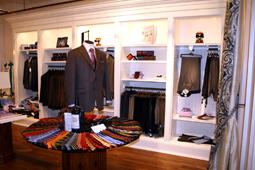 Buying clothing in the Triangle is not an easy game. Small store or large, much of the stock looks dated, something that is invisibly linked to the 1950s, but without retro charm. Franklin Street, which, after all, is the main drag for Carolina’s (UNC) students, offers little for undergraduates seeking a touch of class. From end to end it is shabby street, evidence of a town that is erratically governed and of a university that does not take its civic obligations seriously. The governance of the university itself is less than glowing.
A small town, without industry, Chapel Hill should be as charming as any college town in America, but much is in tatters, with splotches of banal, unsightly commercial building cropping up that underline the unseemly intrusion of under-developed developers in its affairs.
Then there is Julian’s. A family enterprise, it is the only store blessed with taste and panache from one end of Franklin to the other. One is greeted by a light, well-designed décor, a small but tasteful assortment of clothing dominated by Alexander Julian’s own wares, but meshed with an assortment of fine boutique brands such as Barbour coats from the UK and Carrot &Gibbs bowties from Colorado. A better than average professional tailor shapes the clothing to you. And yes, Alexander Julian might give his better customers an occasional something of note, such as a red wine he has had bottled in California. Almost to an inordinate degree, various permutations of Carolina pallid blue and white clothing permeate the wares on display.
But this is rather understandable since the backbone of the shop’s trade consists of old grads turning up in town for one thing and another. The brisk months for the enterprise begin in October, with an onslaught of business coinciding with football season, this burst of activity continuing right into Christmas. The shop, to some extent, reminds one of family enterprises around the Ivy League, such as Langrock and Ballot in Princeton, Chipp and J. Press in New Haven, many of which have now either disappeared or folded into larger companies. This store, of course, has a hint of casual Southern panache, its clothes perhaps not as full and substantial looking as existed in the old Ivy League. It is a bit closer to the garment stores in Princeton, less so to the offerings in New Haven and Cambridge. The comfortable ambience of the store does not emerge on its website, so don’t pay it much heed.
This is a family enterprise, and that is what makes it fine. If Franklin Street is ever to recover, it will require a host of such family affairs, rather than the mediocre chain stores that pepper the street. Back 10 years ago, Julian’s had been sliding, a little tatty, rather unfocused. But in 2007 it moved across the street to larger quarters, with son and notable clothier Alexander Julian taking over the business. It is the most notable improvement on Franklin, though there are a couple of restaurants, as one moves west, that are modestly hopeful. The deep roots of the Julians in Chapel Hill and in its commerce are nicely commemorated in one blog on Ivy League style. Julians. 135 East Franklin Street Chapel Hill NC 27514 tel 919-942-4563; fax 919-942-4568. www.julianstyle.com/ (01-26-11)
Peter Renfro has yet another location, but much closer to town. He’s in the shopping center with the Fresh Market in it, near 15-501 and 54. We learn that this is called Glenwood Square, and it’s in behind the Exxon Station. He’s a nice guy, so if you want to wrap and ship something, you should take it to him. This is a new name for his store—a smart idea. Before it was called Carolina Packaging. He happens to be interested in music, so you will find some cds for sale there, but that’s really a sideline. Incidentally, he founded ProgDay in 1995, “the longest running progressive rock event in the world,” so he is a man of parts. It’s fair to say that while making a living, he has been making Chapel Hill nicer. Incidentally, you can drop your UPS, FedEx, and mail packages with him, and they will get where they are going. http://www.packitshipitchapelhill.com/. Pack It! Ship It! 1202 Raleigh Road. Chapel Hill, North Carolina 27517. 919-968-1181 (09-29-10)
We have eaten here 3 or 4 times now, and it is always a success. The crowd is very middle class genteel mixed with deliverymen and cops. None of the loud 30’s types drinking too much that we expected. As in much of the Carolinas, it serves too much friend food. But there’s an increasing amount of grilled fish—trout, mahi, and the like. All done very well with excellent mixed vegetable accompaniments. There are too many regional brewery beers that are not very good, but one or two imports to get you by. Some soft drinks from a New Jersey maker which is better than most. It’s a relaxing place—inside and out. There’s some financial relationship with Q-Shack next door, which we do not recommend. http://thefishshackdurham.com/ 2512 University Drive. Durham, North Carolina. 27707-2152 919-401-4665. (09-29-10)
136. GP's Triangle Restaurant Listing
It’s hard to know where to eat around the Triangle. The local newspapers and directories don’t get it right. To our surprise, even national publications such as the New York Times get it wrong. Half its choices are plain bad: so many of the good places are missing. Go here to see our latest list. We’ll keep working on it. (08-18-10)
3 Cups, recently re-incarnated in Chapel Hill, is a wonderful addition to the town, as long as you know about all the caveats. It first opened in the ill-fated Courtyard on West Franklin Street which has hosted a number of food enterprises, most unsuccessful. We had given up on 3 Cups there: we had a depressingly bad cup of coffee, and it had an ill-chosen assortment of teas and coffees, later supplemented by a limited wine selection. It was the brainchild of a founder of Wellspring, the local organic store that Whole Foods supplanted. There was no reason to visit again.
The one truly great enterprise in the Courtyard died many, many years ago: it was a cigar store where the humidor sported a truly fresh selection. It had even run afoul of Chapel Hill’s no smoking laws, but the very powerful NC Agricultural Commissioner of that time made the local commissars in Chapel Hill government relent and allow smoking in the cigar shop.
Anyway, 3 Cups has re-opened near the old Visart space on Elliott, just a few doors down from the ABC store. Half the store is now devoted to wine, a very sensible move, especially since its wine department is headed up by Jay Murrie, the onetime wine impresario at Southern Season, and the wine department even today is that store’s real cash cow. The front half of 3 Cups serves tea and coffee—both for sale to those who make it at home and for consumers who wanted a cuppa joe on the spot. Once again, this is an unremarkable endeavor.
Finally, in recent months, it has gone into the espresso business, and by gosh, it makes the espresso right. It is probably the only enterprise in this part of the Triangle that turns out decent espresso. Don’t take the word ‘espresso’ to heart, since one’s cup is slow to come, even when there is a lot of staff present. And the cash register wait can be extremely frustrating.
But when the store’s not crowded, and the right people are behind the counter, it’s a great place to get an express and have a sit down. Most of the staff is very pleasant and quite obliging. Chapel Hill—and the Triangle in general—lack decorous, pleasant public spaces where citizens can repair for leisure. Perhaps the only really pleasant restaurant space in town is housed in the Carolina Club, but that is only available to UNC alumni. It is a town full of cramped structures, and it is chewing up its open areas with poorly zoned, over-crowded developments. So 3 Cups, whatever its faults, is a significant addition.
The nitpicks about 3 Cups go on and on. We will list a few, but one should visit anyway. Here are some caveat emptors. The décor is fussy and the owner has slapped the silly logo on everything in sight. There is lots of other excessive signage which makes this rather small store seem crowded and cluttered. Even though students sit around and use up too much sitting room, there’s no wireless, which, apparently, was available in the former store and is found at other coffee stops around. The wine is a mixed bag, and we generally recommend against the economy buys: they are not well chosen. If one goes up- market, there are some decent choices. For instance, the Arbois is quite a treat. The hours are a little whimsical, and the store may be shut down during Saturday of a holiday weekend. But, all said, it’s the best place around to have a good espresso in often pleasant surroundings served by a mostly genial staff. 3 Cups. 227 South Elliot Road. Chapel Hill North Carolina 27514. 919-968-8993 (01-06-10)
For years we’ve eaten in competent, middling restaurants in Greensboro that never disappoint, but which hardly soar. They’re several notches up from Greensboro’s infamous lunch counter days, but hardly enough to draw tourists to this town. There are a number of newer ones we mean to try but never quite get to it. But a colleague just lured us to Table 16. Graham Heaton, the chef owner, frequently changes his menu, and is clearly up for adventure. For an appetizer we had ahi tuna and then a chicken liver entrée, both of which were more than competently prepared. One fellow who joined us for lunch was particularly passionate about his veal tenderloin tips. On the other hand, the chap who had a Berkshire Pork Sandwich found it good, but nothing to write home about. Berkshire, incidentally, is the heirloom pork everybody uses, but, in fact, it is not one of the more tasty, commonly coming up a little dry. We notice some skill in presentation of the dishes, which are nice to contemplate. With some items he’s trying a bit too hard, sandwiching in too many ingredients, not yet having shucked the elaborateness that cooking schools and the new cuisine inflict on young cooks. We are particularly fond of his ice cream—in this case, a silver corn cream and then a blueberry, both of which could be nicely served without any accompaniment. He’s from Nags Head, as we remember, and his wife from the Triad: our hope in time is that his studious use of local ingredients will be matched by an equal fondness for North Carolina motifs. Our waiter was both amiable and competent and hardworking—an unlikely combination is so many local restaurants. Table 16 is part of the South Elm District, which is enjoying a tenuous revival, but which could in time become quite attractive. As near as we can tell, this is about the best restaurant in town, though we have several more to try. Table 16 Restaurant 600 South Elm Street. Greensboro, NC 27406. 336-279-8525. Res: table16@bellsouth.net Lunch: 11:30-2:30 PM, Tues-Sat Dinner: 5:30-9:30 PM, Tues-Sat.(08-12-09)
133. -new- Cypress on the Hill
We learn that Cypress opened in February 2009. It took over the space occupied by The Trail Shop, once the best camping store in the region, which has decamped or shut down or something. Alex Gallis, chef and owner, has done a reasonably pleasant adaptation of the space, and the kitchen and the back dining room are pleasing to the eye. With one panel of the decorator-type lighting overhead turned off, soothing shadows and a soft mood descend on the dining space. The music speakers are not well chosen, nor is the music, but it is only slightly bothersome. Gallis has an ambitious and changing menu, dotted with some real successes along with some strike outs. We had, for instance, local farm tomatoes, lamb chops, and buttermilk ice cream for dessert—all were terrific. Our companion’s halibut was undercooked, her panna cotta a little tasteless. The espresso did not make it, but that’s a common complaint in the Triangle. But let us say stoutly, this is a restaurant worth revisiting frequently. Its successes are very good. Gallis is a local, but he’s cooked around the South, and now knows quite a bit. We envy him his former life as a self-confessed ski bum. Think out your reservations, as we are told there are times when there is no room at the inn. He and his GM have worked together at a couple of restaurants, which means that both the front and back of the house work reasonably well. The cypress, incidentally, is his favorite tree, and the ‘hill’ in the name refers simply to Chapel Hill. It’s our understanding that the menu changes regularly, but we found the PDF menu file on the Cypress website to be unreadable. The parking lot is small, but there is also concierge service. With the addition of the Cypress, West Franklin now has 4 noteworthy A- restaurants, two on each side of the street, where one can have a great meal, if only one is aware of the shortcomings. Cypress on the Hill. 308 West Franklin Street. Chapel Hill, NC 27516-2521 T: 919.537.8817 Evenings Only 5:30-10:30PM, Monday to Friday. www.cypressonthehill.com (08-12-09)
132. Tonali
Tonali is quite a step up. As Latin Americans achieve critical mass in the Research Triangle, they are putting quite a stamp on the food. We now count at least two upper end Mexican restaurants that get well beyond tacos and hot sauce. At Tonali, we can recommend virtually anything, having enjoyed mussels, lamb tacos, grouper tacos, a wonderful pork chop, etc. The small tortillas are rather special. Try the flan for dessert. Senor Andre Macias hails from a Guanajuato, a state in central Mexico blessed with very rich silver mines, though, as we remember, he has added flavors to his home cuisine that he learned in French and Japanese restaurants. An artist, his pictures line the walls of the restaurant, which is both comfortable and uncommonly pleasing to the eye.
“According to the religion of the Mexicas -- the ancient South American civilization known as the Aztecs -- the universe is run on an energy called Tonali. Roughly described as ‘animating spirit,’ Tonali comes from the word tona, meaning ‘to make heat or sun.’ Throughout Aztec religion there is a great emphasis on motion, and motion is driven by Tonali.” Tonali. 3842 Shannon Road. Durham, North Carolina 27707. http://uniqueorn.com/tonali/about.shtml 919-489-8000. Mon-Thu 11am-2:30pm and 5:30-9pm, Fri 11am-2:30pm and 5:30-10pm, Sat 5:30-10pm. (03-18-09)
Chef Macias has taken Monday away from his diners, but added in a delicious Saturday brunch. We can vouch for the huevos en rabo de mestizas (eggs poached in a chile tomato broth) and the quaintly named huevos divorciados (eggs served over charro beans with green tomatillo sauce and sale tapatia). (08-12-09)
131. Toast—Paninoteca
Toast fashions itself to be an authentic Italian sandwich shop. Well, sort of. As you come under the railroad tracks on Chapel Hill and then rise into Five Points, it’s on the right—terribly easy to miss. Probably you can call its fare a fancy open-face sandwich, mostly without meat, with an assortment of other provocative appetizers. We found the “merguez sausage, chick peas, roasted tomato” and the “cured salmon, watercress, pickled red onion, lemon aioli” to be quite good, and some appetizers to be better than passable. The wait staff was uncommonly friendly and pointed out where we could find more parking (beside the store and next to the Arts Council). Toast is gourmet enough, but it does not swallow your pocketbook. It is open to 3 on Saturday, and to 8 during the week. Toast. 345 Main Street. Durham, North Carolina 27701. 919-683-2183. http://toast-fivepoints.com/index.html A couple of blocks down the street one can find Revolution which has been the occasion of a fair amount of chatter, but it is so new that we are waiting a bit before eating there, so that it can shake out the wrinkles. With an espresso wine bar going in next door to Toast, we can say that Durham food, particularly downtown, is getting a bit more interesting. (02-04-09)
130. Pumpkins on a Bridge
Should you have out-of-town visitors, it is not
always easy to put together a round of activities in the Research
Triangle that will keep them entranced for more than a couple of days.
Some residents even keep a list so as to avoid last minute planning
panic. This lack of delights and cultural infrastructure has kept the
Triangle from reaching critical mass---an impediment to economic growth
and a barrier to drawing high-tech knowledge workers to this
area. That is why the Research Triangle has never quite measured
up to its promise---as a high technology powerhouse.
It’s still true that North Carolina’s real strength lies in its smaller
towns, its cities never quite measuring up. Poor town planning
throughout the Triangle has exacerbated the problem since the
development is diffused, just like Los Angeles, the area never
achieving the densities that make for great urban spaces. That
said, it pays to take a look at lonely towns in order to find
interesting things to see and do.
Such is Bynum—on the way down to Pittsboro. There you will find
the folksie art of Clyde Jones. We’ve attended a pretty good pig
roast along the way. The old bridge into town is closed, but you can
walk out on it. Toby Considine, a resident and keeper of the blog
New Daedalus, tells us it may still sport 80 pumpkins on the bridge for
Halloween, enough to convince you that it is only Carolina’s haunted
ghost towns that harbor any real interest. Many towns used to put
out pumpkins, but new bridges along high speed routes just don’t get
along with pumpkins very well. Considine writes: “I live in
an shuttered mill town; the mill closed nearly 40 years ago. Many of
the places my children explored while growing up were forbidden relics.
They would creep up the rotting stairs of the county’s first cinema, no
bigger than many home theatres, to view the still-open projectionist’s
log. They would hunt snakes and crawfish under the old general store.”
(01-21-09)
129. Mint
Not to be confused with the many other Mint restaurants
around the Triangle and around the nation. “Manager Rupinder Singh said
Mint is a family business; his father, Deljit Singh, is the owner.” Chapel Hill News, September 21,
2008. “The family comes from the Punjab region of Northern
India,” and this northern tilt characterizes the food. This
is one of the very few possibilities for decent Indian food in the
whole area, though, to our chagrin, the dreaded, common buffet is the
lunchtime offering. We find the smaller dishes to be a wiser choice,
the larger entres too filling and perhaps too overcooked for some
Western tastes. Last time we simply had a plate of
cauliflower, which was excellent. And we recommend the Indian
beers, perhaps the Taj Mahal, though we shy away from the Kingfisher.
Nice, simple ambiance, and it even has one of the few decent restaurant
bars in town. Lunch: Mon-Fri, 11am-2:30pm; Sat-Sun, noon-2:30p.m.
Dinner: Mon-Fri, 5-10p.m., closing later on Sat-Sun. Mint.
504 W. Franklin Street. Chapel Hill, NC 27516. Telephone: 919-
929-6188. (1/6/09)
128. Neal’s
Deli
This new cubbyhole in Carrboro is a winner. Make
no mistake about it: it is a sandwich place with website rhetoric that
pretends to be a bit more. But the sandwiches are good and are
not the over-wrought affairs that some other eateries wanting to charge
high prices have devised. It is especially welcome since the town
lost Maggie’s, a really top-drawer sandwich place, some years ago, and
it has been replaced by a very middling Japanese restaurant. We
now usually eat whatever Neal’s vegetables are specials for the
day—three making a delicious and healthful meal. The place is
small, so you are wise to come in about 1:30 pm for lunch when you will
easily find a place to sit down and eat. Park across the street
since dents in the tarmac on the Neal’s side may give your car a
jolt. Matt Neal, the owner, is the son of deceased chef Bill
Neal, the locally renowned eminence behind Crook’s Corner and
some other eateries that were all the rage years ago. In general
the Neals have gotten a fair amount of publicity for their food doings
over the years, much of it even warranted, though there is a bit of a
tendency to pretend that food is more than it is. Neal’s Deli. 100 East
Main Street. Carrboro, North Carolina 27510. Monday-Friday 11 am to 7
pm. Saturday 11 am to 4pm. Website: www.nealsdeli.com. Telephone:
919-967-2185. (12/17/08)
127.
Stone Bros. & Byrd
On one occasion we were after the right sort of hose, and found that
this old standby stocks Swan. More recently, we found some
righteous bamboo to prop the plants, since we were unwilling to put up
with the green plastique that the Lowe’s and Home Depot’s of the world
want to dish out:
Stone Bros. & Byrd opened its doors in 1914 with the mission to serve the needs of the Durham area’s small farmers. Seed, fertilizer and small machinery were sold and often bartered, and credit was extended to provide farmers time to sell their crops before payment was due. Remembering the old days, at the age of 83 Mr. H. R. Byrd in 1977 said, “We sold wagons and buggies, harness, mowing machines, churns, stoves, harrows and a lot of supplies for the garden and farm. We would swap merchandise for corn, wheat and chickens. We handled a world of country meat, wheat, oats and eggs.” The business served a need in the Durham community and it prospered. The owners worked hard and reaped modest rewards. (From StoneBrothers.com.)
You owe it to yourself—and to posterity—to shop at Stone Bros. We ourselves have to look into some additional bird feeders. Stone Bros. & Byrd. Website: http://www.stonebrothers.com. 700 Washington St., Durham, North Carolina 27701. Telephone: 919-682-1311. Email: info@stonebrothers.com. (10/8/08)126. Public Hardware
A store is probably not worth going to unless you
immediately want to go back for the most specious of reasons. We
lit on Public because, through the grapevine, we learned that it
stocked one of the truly heavy-duty wheelbarrows. And we were not
disappointed, the warehouseman having to go down to the sub-basement to
get the Jackson super-model. Somehow it’s appealing that it comes
in a handsome blue, instead of red. Public’s big, seems quite
disorganized though somebody knows where everything is, and all the
help has the time of day to discuss the Almanac calendar, to figure out
how to put the wheelbarrow into the Roadmaster, and to discuss the
handy penlights nobody else seems to stock. It’s been around
since 1924, and apparently has a great neon sign that we must go see
some night. There are shelves and barrels of everything, so most
likely you will find here everything Home Depot and your chain hardware
store doesn’t even know exists. If you are a newbie-type person,
don’t even go here. This is a quarter mile off the main section
of downtown. The deserted streets, the warehouses, the
unforgiving sunlight make you feel like you have driven back into time
and are in some town out West. Its original location figured in
the 1988 movie Bull Durham: the best thing Durham has going for it is
still nostalgia. Public Hardware, 505 North Mangum Street, PO Box
127, Durham, North Carolina 27702. Telephone: 919-688-4321.
(9/24/08)
125. Vivace
Vivace is a big surprise, since it is part of a small
chain, and we did not hold out much hope for it. It’s part of the Urban Food Group,
whose others properties—Frazier’s and Porter’s City Tavern—we have not
tried. But it has some considerable virtues. The trick is
to sit at the banquette tables in the bar and look out into the
sunlight—proof that this is best visited at lunchtime. The wines
are indifferent or worse, and the bar staff often does not know too
much about wine. But we had a very respectable mojito on one
visit. Poke around the menu a bit and pick something
inventive. For instance, the meats and cheeses complemented with
chestnut honey, citrus marmellata, and pear mostarda are first class
and a bit unusual. Or the chicken, marrow, and vegetable
soup. We and our guests have all had good luck with the
paninis. And there are some happy desserts. Vivace, 4209
Lassiter Mill Road, Suite 115, Raleigh, North Carolina 27609.
919-787-7747. Just off Six Forks in North Hills Shopping Center.
(7/30/08)
124.
Wilmington and Its Eats
Wilmington Restaurants and Such. Wilmington should be North
Carolina’s biggest, best, and most interesting city. Because it
has not lived up to its promise, the best ranking probably
belongs to Asheville, while the power center of the state has migrated
to the Raleigh-Durham region, as Charlotte slowly gets eclipsed.
Interestingly, North Carolina does not really have a successful city,
its towns really comprising its soul. A devastating failure at
the civic planning and political level has led to sprawl in every
region and a lack of the urban density that leads to interest, great
commercial development, and street knowledge. Wilmington
exemplifies this stunted phenomenon: it is now a city of perhaps
100,000 that has spread out in every direction. There is has been
a partial refurbishment of the downtown, but its rejuvenation is
halting, and it is punctuated by crime and a sense of stultification.
It is hard to believe that this was the state’s largest city before the turn of the 20th century. But in 1898 an insurrection inflicted a blight from which the city has not yet recovered. Net, net, the city is a retirement location and a small tourist mecca, and enjoys as well a reputation as a second city for film with low costs in which to make movies and other productions. There’s even a Wilmington Regional Film Commission, which hopes to turn the city into a celluloid capital. Great numbers of people have retired from the North here, and they are supported by the usual clutch of shopping centers with middlebrow restaurants, furniture shops, and the like. The hotels are rather faltering, and the smart visitor will look for a house to rent in order to better enjoy a stay. This city is not quite wired together, and it is amusing and quaint because of its lapses, fun if you can take the flaws in stride.
This introduction sets the stage for its restaurants, which are good, not great, but often a bit of fun and slightly eccentric. While the substance may be average, local restaurateurs do have a little showbiz in their hearts. As good as it gets is Deluxe, on the main drag; it offers quite an array of dishes, a Wilmington casual atmosphere, and a fairly decent crowd of diners. Notice that the cooking gets a little elaborate—with too many curlicues and some misbegotten ingredients perhaps—but it tastes pretty good, and you will say this is a nice relaxed atmosphere fairly near the shore. The over-complication is curious, almost a throwback to previous eras, when people equated cuisine with gilding the lily. Deluxe, 114 Market Street, Wilmington, North Carolina 28401-4442. Website: www.deluxenc.com. Telephone: 910 251-0333. Deluxe, incidentally, is one of two restaurants downtown that one can regard as pretty decent. Dixie Grill, which many use for breakfast, is right next door.
Somebody in Wilmington has gotten the idea that sushi is the au courant thing to serve, so you see it offered everywhere. A risky idea for the customer. But you can go Oriental in a reasonably successful manner—out a ways—at Indochine which is faux Vietnamese and Thai. It does a big business. Start off in the Saigon Martini Lounge, which is often not at all crowded where you can have a cocktail and feel the neon. Then move into the restaurant and it is surprisingly good. There is only one pho on the menu, for instance, but it was tasty and filling. Indochine, Market St. at Forest Hills, 7 Wayne Drive. Wilmington, North Carolina. Telephone: 910-251-9229. Website: www.indochinewilmington.com.
For fish, visit Opus. Some decorator got a hold of the place, so the furnishings are a little strange. The fish stew (mysteriously called saffron braised seafood) is worth the price of admission, and everything else is surprisingly well prepared. It is in Lumina Station, one of the shopping centers on the way out to Wrightsville, which helps northern retirees avoid the downtown. Chef-owner Stephen Hilla has cooked in a few restaurants with some panache, and a bit of this has rubbed off on the food. Opus, 1900 Eastwood Rd., Suite 48, Wilmington, North Carolina 24403. Telephone: 910-256-1254. Website: www.opus-restaurant.com.
For lunch, try Lumina Station again. Brasserie du Soleil. The key is that you can eat just outside in the courtyard, and your repast seems leisurely. You can have a decent salad, an appetizer plate, or a sandwich with a glass of wine or a beer—not eating too much and not getting too badly clipped on your check. Brasserie du Soleil, 1908 Eastwood Rd., Wilmington, North Carolina 28403. Telephone: 910-256-2226. Website: www.brasseriedusoleil.com. As near as we can tell, the owners have the formula down and have a clutch of similar restaurants around Wilmington which we have not tried. (12/5/07)123.
The Go-To Guy for Technology News
Rick Smith majored in history and education back home in Indiana.
Having given up playing football in high school, he started
keeping scores for the teams. Then he reported them to local
media. Eventually this led to a career in journalism, and he
worked at a raft of papers across America in Michigan, Missouri, New
York, and Texas. Then he moved to the News and Observer
and a long career in the Research Triangle.
As the Triangle burgeoned, he made the leap into technology—often as an employee of WRAL. He’s worked for many Triangle publications, and even today does technology news for Metro, the best magazine in the area.
Now he heads Local Tech Wire, WRAL’s Internet vehicle for technology reporting. As well, he is Business Editor for WRAL. He is the co-author of The Internet Strategic Plan, published in 1997 by John Wiley. He is on top of more technology stories in the Triangle than the venture capitalists who like to think they have the area covered. (9/19/07) 122.
The
Goathouse Gallery & Gardens
Talented foreigners from all the world are discovering the Carolina
Piedmont, buying enough land to matter, and bringing enchantment to
it. In Stokes County, we know of an Englishman who has created an
illustrious henhouse and has found a decorative breed to match.
As we have said elsewhere, just out of Chapel Hill, there is a grove
of camellias that is truly magical, created by a Japanese professor
at UNC Chapel Hill. Several potters have moved in, but none more
imaginatively than Siglinda Scarpa, who has a
deeper understanding of domesticity than the average potter, and shapes
her environs and her pots in a way that exudes domestic
tranquility. Her shapes are more organic than most, reflecting a
view of how the pots will be used, how they can imitate and harmonize
with the verdure all around, and how the clays must be blended so as to
suit the application for which the pot is intended. You will
visit her as well just to see her plantings, and to visit with her
cornucopia of animals—chickens, geese, goats, cats, and ad infinitum.
Notice that her paths flow in the round bordered by fences virtually
woven out of stems and branches. Should you attend one of her special
events, say a tea in September 2007, Ms. Scarpa will prove that her
pots are imbued with special flavor, perhaps cooking a chicken at 500
degrees adorned with some of the organic vegetables she grows.
The Goathouse Gallery, 680 Alton Alston Rd., Pittsboro, North Carolina
27312. Telephone: 919-542-6815. Website: www.siglindascarpa.com.
(9/12/07)
121.
Noble’s Grill
We’ve only been to Noble’s Winston establishment. But we’re told
his Highpoint eatery is just as reliable by Triad denizens who care
about food. And he seems to be breaking out in Charlotte with a
restaurant, bakery, and Rooster’s Wood-Fired Kitchen, an effort to come
in at a lower price point. We’re given to understand Jim Noble
once had an establishment in Greensboro, but we gather it must have
been shuttered. We have received no response to our inquiries, so
your guess is as good as ours.
The website is complex, clunky, hard to navigate, and a bit too rhapsodic. In fact, if we visited it alone, we would not try his restaurants. But we have eaten several lunches at Winston, found the food reliable if not inspired. More importantly, the atmosphere is pleasant, and the wait staff has been well mannered and not too pushy. There’s one or two Samuel Smiths on the menu. And, if you are crossing the state, it’s nice to know that the Winston site is right off of Rte 40.
As we remember, Noble graduated from NC State, intending to be a furniture designer, but migrating to food soon enough. Clearly he combines entrepreneurial flair with some feel for mainstream palatable food. It’s easy to forget that he’s around, but he’s a solid bet in a Triad where middlebrow fare is always better than things that pretend to be better. Noble’s Grille, 380 Knollwood St., Winston-Salem, North Carolina 27103. Telephone: 1-336-777-8477. Website: www.chefjimnoble.com/NGsite/home.html. (9/5/07) 120.
Herons at the Umstead
Herons Restaurant at the Umstead is a disappointment, but it has its
virtues. The same holds true for the new Umstead Hotel where it
is housed. It’s a good site, the owners had enough money to get
it right, and there is a wide open slot in the Raleigh-Durham
marketplace for a truly upscale hotel with luxury appointments, a very
fine menu, and esthetic atmosphere. The restaurant and the hotel
have aspirations, but they don’t make it into the winner’s
circle. But we shall return to the hotel, for it is as good as it
gets round these parts, to quote the line from the Jack Nicholson
movie. Basically the architecture, interior design, and
landscaping of both are humdrum. The planting of major, long term
hardwoods will help a lot on the outside: a French designer will have
to redo the interior. The marketing staff takes a lot of pride in
the raft of all-Carolina paintings. The problem is that they turn
out to be mediocre. The menu at the restaurant is not inspired,
and is a little meager besides. In the end, the fairly high
tariff is simply not warranted.
119.
LocoPops
You will have to pick your way through the flavors at LocoPops, a
Mexican-style Popsicle shop with exotic flavors, some of which make it,
some of which don’t. But they are quite refreshing. The
founder was Sumner Bicknell. She and her partner Connie Semans
are apparently a couple of middle-aged ladies with a good idea.
The pops have gone like gangbusters.
The reviews say they are akin to paletas, Mexican frozen treats on a stick. Should you want to properly get into their origin, you can read about La Super Michoacana in Austin, Mexican popsicles historically being related to the state of Michoacan. “Part of the allure of paletas over regular American Popsicles is the fresh-fruit flavors.”
Various comrades have enjoyed the strawberries and cream, cookies and cream, mango with chile, orange guava, and a couple of others. The college kids like them, and they are sold at various spots on the Duke Campus. LocoPops. 2600 Hillsborough RdDurham, NC 27705. Telephone: (919) 286-3500. 431 W Franklin St., Chapel Hill, NC 27516. Telephone: (919)286-3500. (7/25/07)
118.
Eateries:
A Few New Maybes
Metro, March 2007, pp.70-73 provides a reasonably select list of
restaurants for the Triangle. The trouble with most of the local
food listings is that they are indiscriminate, singing the praises of
the good, the bad, and the indifferent. Yes, there are some
losers in this list as well, but all the restaurants mentioned have
culinary pretensions at any rate. We would give a try anyway to
Panciuto in Hillsborough; An and Herons in Cary; Glasshalfull in
Carrboro; and 18 Seaboard, Jibarra, South, Vivace, Saint-Jacques—all in
Raleigh. Customer beware, however, since we have not really
vetted any of these hopefuls. We have since been to Glasshalfull:
you can skip it. (5/23/07)
117.
Chapel Hill, 1795—1975
M. Ruth Little (and Diane Lea who assisted not a little) should be
given Purple Hearts, the Croix de Guerre, or some other salutes for
bravery. They were foursquare behind
The Town and Gown Architecture of Chapel Hill, North Carolina, 1795-1975.
The truth is that there is no Chapel Hill architecture of special note,
but there is a great deal of valuable local history to be garnered from
such an account, and they have got at it. Further, an examination
of this book reveals the deep impact of the Civil War on the South that
is so pervasive that it permeates life in the South even now 140 years
later.
Arthur Schlesinger, the influential American historian (heavy on Jackson and FDR), recently passed away. All the obits fail to mention that he did a little monograph on writing local history which, at one point anyway, he took to be rather important. Schlesinger, as you may remember, ran around with the Kennedys, and, in his later years, focused on grand themes, not paying too much attention to what was happening on his New York doorstep. The New York Times has the same problem: it is so busy being cosmic that it never quite traffics in the streets of Manhattan and does not have an organic relationship with New York City. But as global forces wash across the earth, we learn that it is more important than ever to have a sense of place, of particularity. One gains from one’s home and one’s town if they look like somewhere, rather than everywhere. That makes the local history of these ladies important.
Correctly, you will notice the slipcover of this book shows domestic architecture, the Horace Williams House on Franklin (although sadly there is no explaining caption). Chapel Hill is a small town, and that’s where its virtues lie. More thoughtful civic planning figures in North Carolina say that the state is all about small towns—which are crumbling incidentally—and they wonder what will replace them. North Carolina, Chapel Hill being an instance, has dealt most unsuccessfully with urbanization, and it has failed to produce a truly thriving, viable, esthetic city. To read this book is to remember that there was a South before the New South, well before the modern all look-alike North Carolina sprawl which today is defacing an innately pretty state.
Small towns have such a hold on the imagination that large buildings in Chapel Hill and elsewhere tend to look clunky. One extremely savvy North Carolinian real estate entrepreneur says you can get a $300,000 house built but don’t try for much more. The locals, he says, can handle that much, but, beyond that, they will take your money—be it $600,000 or $1,000,000—and turn it into a lesser house. A warren of small rooms and lesser appointments.
The centerpiece of the book for us are the times that are taken to be most mournful. We would point the reader to “The Dark Interlude of War and Reconstruction, 1861-1895” and “Democracy Cries Out for Beauty to Give It Backbone, 1896-1915.” It is here that we see Senlac, the Horace Williams House, Baskerville-Kenette House, and more come into being. As well, given the heritage of war and other financial constraints, there is a stately, measured pace to building during those years which, temporarily anyway, prevented the town from doing too much with too little—a tendency which results in ticky tacky. Ironically, the eras that some regard as austere may have been the highpoint of the town’s existence.
In the later stages of the book you see the growth of the university, which has been undistinguished and simply has brought great crowding to the town. More enlightened state government would have dispersed UNC-Chapel Hill’s schools and activities to other campuses in the state—for the benefit of all. UNC-Chapel Hill has not been a good local citizen, and it has expanded rudely into more parts of the town and has been responsible for all sorts of overbuilding which the town cannot support and which is eroding its character. Now a university PAC is trying to pull UNC-Chapel Hill out of the university system, and this promises to make this institution even more of a rogue.
The passion for the new within North Carolina is such that many are in a rush to literally abolish the past, pretend that it never existed. A visitor to North Carolina twenty years back remarked on her visits to several towns where she grew intrigued with the abundance of vacant parking lots. In so many places, local powers that be had put historical markers announcing what used to be there—all other traces having disappeared. She found that the state was littered with signs that commemorated buildings that used to be. Charlie Rose, who has the chat show on PBS, once did a special program on North Carolina architecting, but never got into what the wrecker’s ball has done to the skyline.
A couple of Chapel Hill’s most beautiful spots—at the university—do preserve some history stretching back 100 or 150 years. They are remarkable, not for their architecture but for the lack of it. One is the Old Chapel Hill Cemetery, which is wonderful, even if the grave markers have suffered some depredations from students. It hearkens back to 1776: at one time or another it has been under the charge of both the town and the university.
Just as worthy is the Coker Arboretum. Designed by Professor William Coker in 1903, it has a variety of species that can only be matched by the JC Raulston Arborteum at North Carolina State. His love of East Asian species makes it one of the most cosmopolitan spots on campus. Ironically, the Coker much surpasses the North Carolina Botanical Garden, of which it is now appended. It is so valuable that the university should give it a leader of its own—with separate funding. What all this teaches us is that nature’s architecture, not man’s, is the key part of the Carolina experience. (5/9/07)
116.
Boleros Café
Boleros has successfully replaced the rather weak Mexican restaurant at
this location. The black beans and rice, the sweet bananas, and
several of the Cuban beef dishes such as Ropa Vieja and Churrasco
Andino make it a fulfilling stop. And it’s the restaurant you
will find open around town when the others are closed, staying open to
8 pm on Sunday. The staff is universally friendly. Now for
the bumbles. The Cubano Sandwich needs to be skipped: it is dry
and lacking ingredients. Service takes a long time and customers
are served out of order, so it pays to be firm. Now and again,
the kitchen will run out of dishes. We don’t know if the Hatuey Beer
will ever make it onto the menu, and you will learn that it is
pseudo-Cuban anyhow.
As befits a café named Boleros, there is spirited recorded cubana music in the background, although on occasion it will compete with the TV over the bar. Bolero is a dance tradition, dying out in Cuba, which continues strongly in Cuban outposts such as Miami. One could wish for prettier appointments which are sort of Latin beach subdivision. But at least there is a place to sit down.
Boleros is a Chapel Hill outpost of a Wilmington restaurant opened by Carlos Perez in 2004 of the same name, both of which have many of the same virtues, and the same flaws. Boleros Café. 1404 East Franklin St., Chapel Hill, NC 27514. Telephone: (919) 942-6664. (4/25/07) 115.
Jibarra (Norte Raleigh)
North Raleigh is surprising us, with Fins and now
Jibarra. This high-end Mexican restaurant is one of many
treats North Carolina's growing Spanish population has
introduced. For more on Jibarra, visit here.
114.
Rue Cler
Chris Stinnett
and John Vandergrift, the current owners of Pops, put this affair
together, and we like it better. Call it French café: we
had steak frites and croque monsieur on our first outing, and twas all
quite satisfactory and nicely simple. That goes with the Spartan
walls, and a wait staff that does not hustle you about wine or most
anything else. The presence of this eatery is more evidence that
the gentrification of downtown Durham is succeeding, even as town
planners and developers annihilate the outer district, mowing down
every shrub in sight to enable undistinguished sprawl. If you
were to move to Durham, you should live downtown, except that it has
not mastered its crime problems. The bakery next door is less
successful so we moved on to a more distinguished coffee house and
patisserie in Brightleaf Square. However, we thought the bread
pretty good, even if the tab is too high. You will have to pick
your way through the menu, since many selections are just fine, and
others are less than meets the eye. The blurb makes clear that
the owners had Rue Cler market on the Ile in mind when they named the
restaurant: that is something that they may someday hope to
emulate. Rue Cler. 401 East Chapel Hill Street (adjacent to
the post office), Durham, North Carolina 27701. Restaurant:
919-682-8844. Bakery Cafe: 919-682-6879. Website: www.ruecler-durham.com.
The restaurant staff will give you poor directions on how to reach it:
take 147 south, getting off at the Chapel Hill Street exit. Turn
east towards town, and you will strike it a couple of blocks past the
center of town, a mile or so from Rte. 147. (2/28/07)
113. Independent
The Independent has
always been a mixed bag, something you could skip and your week would
not suffer. But for that matter, the dailies and the magazines
throughout the Triangle are nothing to shout about, often missing local
stories of real interest and using too much rewrite material from the
wire services and pr people. For instance, absolutely none of the
publications have explored the ruinous development policies of local
government(s), which, with the tacit support of the State of North
Carolina, are creating urban sprawl with scattershot roads and housing
that are designed to raise pollution levels, level the foliage and the
environment, lead to sudden stormwater flooding, and triple
increasingly frustrating traffic snarls. Air pollution and
illnesses that are associated with bad air are much on the rise.
But the Independent is gradually picking up. Its cover graphics are much improved, and its advertising base seems to be swelling. Though its reviews are no better than in the other sheets, an occasional intelligent column crops up: its wine beat is worth a read. Now and again, something important appears in its pages. For instance, Bob Geary’s “Missing the Train,” September 20, 2006, pp. 14-17 deserves a read, since it contrasts the more successful efforts of the Charlotte Transit System with the utter inertia of the Triangle Transit Authority—weakness which really must be laid at the feet on an inert state government.
North Carolina, of course, is very much about small towns, the historic source of its civic strength. In general it lacks an example of successful urbanization. Ruinous urban development is the greatest threat to its well-being in the years ahead, since it is losing its small town identity. The very fragility of its media is just one aspect of the hollowing out of its strong, small town character. (1/17/07) 112. Milltown
Often the
specials are better. Such as the Cubano we had last week.
But then the German Sausage we just had was perfectly delightful with
the dry sauerkraut which went down easily. But, of course, there
are a fair number of losers—the prime rib sandwich, the overdone meager
hamburger—so you will have to pick your way through the menu. The
mussels, surprisingly, were respectable, even though shellfish leaves
something to be desired in these parts. You can eat in or out
comfortably: the atmosphere is redecorated funky and a lot of
fun. It buys its bread from the only good baker in the whole
region. There are quite a few reviews out which do not pay enough
attention to the beers (apparently 150 varieties), including some U.S.
wheat beer regionals, a range of English beers such as Newscastle, ESB,
Young’s, but a few you don’t know, and certainly some Belgian that we
intend to try again. Pop the Cap legislation that got through in
August 2006 raised the alcohol-content limit for beer and other malt
beverages sold in North Carolina from 6 percent alcohol by volume to 15
percent, clearing the way for a whole new world of beers. Give a
try to the Avery White Rascal. We’ve only done lunch but the
crowd is young and decorous, and it’s a non-hassle, almost secreted
place to visit, like Hernando’s Hideaway. At the end of the day
you will come here because of its relaxed atmosphere and very willing
help. It’s meant to look like a Carolina pub, but the chow is better
than bar food, and the help tries darn hard. The day bartender,
we think his name is Steve, is a winner. Milltown. 307 E.
Main St. Carrboro, NC, (919) 968-2460. Mon. 5pm-2am, Tue.-Fri.
11am-2am, Sat. 9am-2am. (12/20/06)
111.
Get Thee to Chimney Rock
Last month the
Morse family put Chimney Rock Park up for
sale. It “has expanded to 1,000 acres and includes the 400-foot
Hickory Nut Falls,” but many fear it will now be turned into a
development or vacation land. Senator Walter Dalton of
Rutherfortton has raised $20 million from the state and the Nature
Conservancy for its buyout, but the family has placed it with
Southeby’s with a $55 million price tag. (11/1/06)
110. Pottery
Country II
We have previously commented on Mark Hewitt, situated, if
you like, at the outer perimeter of North Carolina’s pottery
country. As you get closer to Seagrove, you will encounter a
native sensibility shown by a host of Carolinians, with perhaps 5-7 %
of their work having some merit. We ourselves are taken by
Ben Owen III, of a family with a little
lineage in the business. You will find Chinese pots with
turquoise glazes made by family generations before him, as well as
Ben’s own
Japanese-influenced pots when you pay him a visit. It is
interesting that, in one way or another, the pots of the Carolina
region reach out into the country and the world for their process and
inspiration. (10/25/06)
109. Pottery
Country I
Pottery Country North Carolina covers a lot of time and styles.
As potter Jack Troy says, “If America has a pottery state, it must be
North Carolina.” You have to be patient, because there is an
awful lot of dross as you turn about the Piedmont and further, looking
for a well-wrought urn. In Seagrove, you will find the North Carolina
Pottery Center, which, at any rate, is testimony to the fact that
Carolinians are very serious and diligent about their pursuit of craft
arts. For quite a different reason, we find Mark Hewitt to provide
a proper introduction to the clay belt. He and his English tribe
(apprentices) have come and set down at one side of Pittsboro—an
amiable drive from anywhere in the region. He is following in his
countrymen’s footsteps, since settlers from Great Britain came to North
Carolina and
took up pottery in the eighteenth century. The current lot
are pretty civilized folks and you will find his digs to be a handsome
recycling of some farm buildings which, we imagine, had gone to pot
before he arrived. You will enjoy his pigs, which virtually
amount to pets. It’s a polite and kempt atmosphere—just one
indication of what farm country North Carolina could become if
high-value activities are woven into the fields. As we study his
pots, we find them to be tentative, perhaps the work of a man out of
England and not thoroughly settled in America. But we much admire the
fact that he is not just capable of working up a good fire, but has
enough fire in his belly to enjoy commercial success and a growing
reputation. W.M.Hewitt Pottery, 424 Johnny Burke Road, Pittsboro,
NC 27312. Telephone: 919-542-2371. Email:
hewittpottery@mindspring.com. North Carolina Pottery Center,
250 East Avenue, Seagrove, NC 27341. Telephone: 919-873-8430.
(10/11/06)
108. East
Carolina Wisdom
Steve Logan just made the New York Times, but not for his
coaching. Now he is a kibitzer. A successful coach at East
Carolina University, he is now the “host of a weekday show on WDNC-AM
in Raleigh.” He “is part of a long line of coaches to parlay
their experience into some form of broadcast work,” including Jackie
Sherrill of Mississippi State and Terry Bowden of Auburn. We are
a little impressed because he’s taken a stand against the baying wolves
who cried for and got the head of Chuck Amato of North Carolina State,
who was a great, great coach and who should never have been
fired. That said, we would rather listen to manic Terry Bradshaw,
an ex-footballer who is off the wall and who is a whole lot of fun when
he talks football or anything else. It’s a bit ironic to have a
great football commentator in the Triangle, where football has been
lackluster for a while. (10/4/06)
108.
“Tango is Love”
Apparently the
Triangle has become a tango hot spot. “Jason Laughlin got his
start from Rusty Lofton … one of the first to bring authentic Argentine
tango to the Triangle.” See “Tango is Love,” Independent,
July 12, 2006, pp.23-24. Jason Laughlin and Gulden Ozen
“celebrated their wedding with a milonga, or social dance, that lasted
until 4 a.m.” “Their teaching business, Tangophilia, has been
instrumental in building a thriving community of Argentine social tango
across the Triangle….” Tangophilia, 5814 Henner Pl,
Durham, NC 27713. Telephone: 919-361-5145 or 919-423-7681.
Fax: 413-487-7571. (8/16/06)
107.
Jujube
Jujube, though only open
a short while, has quickly become the best restaurant in Chapel Hill,
taking over from the Lantern, which was tops for a while but then fell
off the mountain. Importantly, Charlie Deal, chef and owner,
knows food and knows something about harmony. Oddly, we had
avoided it because we had heard that it was part of a local chain of
restaurants that don’t cut it. Virtually all the food is good, so
one does not have to pick and choose. With perhaps one exception,
the wait staff is pleasant and has special interests such as poetry and
music, or exploration in South America, or photography. The
design is as good as it gets in the area, things are not noisy, and one
is not jammed up against other customers. So it is a restful
stop. We have taken to eating the soba, which we find to be better than
that served at the Japanese restaurants in the Triangle. Deal
comes out of California cooking, and his food is modified Asian.
Things get a bit out of hand when the owner is not present: a waiter
gets loud and even sings off chord, the kitchen doors are left open,
etc. When it’s not too hot, it’s pleasant to sit outside, though
some umbrellas should be installed to protect patrons from the
elements. We intend to try one of his special dinners and a dim
sum gathering as well. Jujube. 1201-M Raleigh Road at
Highway 54 (Glen Lennox Shopping Center), Chapel Hill, NC 27514.
Telephone: 919-960-0555. Lunch Mon.-Fri., 11:30-2:30; dinner
Mon.-Sat., 5:00-10:00. Dim Sum, Lunch on Sat. and Sun.
(8/2/06)
106. Where to
Eat
Every
so often somebody at Duke, usually a professor, will do selective
reviews of restaurants. The actual reviews are never inspired,
but the lists are pretty good. Professor
Jeffrey Schwarcz is a case in point. He has a few losers, but
it’s generally a reliable list—and is a much better guide than that you
will find in any of the newspapers or magazines locally. And yes,
he is missing a few of the best. (7/19/06)
105. DAN
Dan Orr became head of DAN (i.e., Divers Alert Network)
in November 2005, but had come aboard in 1991 as it began its
high-growth phase. Since 1991, it has added considerably both to
its membership and its staff. He lives and breathes scuba diving,
which is reassuring, since it puts an experienced hand in charge of the
store. In fact, 4 Diving Hall of Famers are on staff. He
spent years teaching diving safety at Wright
State University, which itself seems to have had an interesting
history, particularly under its first president Brage Golding. We
have always found, incidentally, that Ohio offers some of the most
interesting private and public education in the country. He went
on to Florida State University, perhaps the leading institution in the
country for scientific diving, bringing some safety training rigor to
all its research investigations. To boot, he did a stint as a
Navy diver, which brings to mind one of our favorite movies,
Men of Honor.
Founded in 1980, DAN was at first just a hotline organization which divers could call on for diving health and safety issues, particularly to locate decompression chambers which are much used in diving mishaps. Dr. Peter Bennett, a hyperbarics expert from England recruited by Duke, set it in motion in 1982 and shepherded the organization to greatness. Various kinds of insurance came available in 1987, and diver safety training was added in 1991, both events kicking the organization into high gear. Incidentally, many who are not active divers join just to access the travel insurance.
Hidden away on Colony Road, just off the 15-501 Bypass, DAN is a fine, dedicated organization that’s mainly known in the diving community; as large as it is, it is a somewhat anonymous quantity in the Triangle. Today it reaches about half of its market, and it will have to add to its array of products and services to guarantee future growth. In fact, the organization, as can be seen on its website, has a 1950’s feel to it, which is not all bad. That is, the values are in the right place: everybody works for everybody, not for oneself.
There is now a confederation of DAN organizations, called International DAN. Tthe 5 DANS, only tied together by their common goals, meet yearly to coordinate their approaches to scuba safety. In our view, you join DAN for one principal reason: the people are plain nice. Divers Alert Network. 6 West Colony Place. Durham, North Carolina 27705. Tel: 800-446-2671 or 919-684-2948.
Those interested in diving safety should peek around the web, where the resources are ample. Family Doctor’s Scuba Diving Safety is not too bad. The Naval Safety Center (which is www.safetycenter.navy.mil/afloat/diving/default.htm, though the site wasn’t working when we posted) attempts to stay abreast of the field. Don’t ask us why but we find Doc’s Diving Medicine Home Page a bit amusing. As usual, Wikipedia has something useful to say: it has an overview of scuba diving which the beginner will find helpful. (5/24/06) 104.
David Barnette—Lacock’s
The other day we were in to see David Barnette, Master
Cobbler at Lacock’s Shoe Store and Shoe Repair, “a Chapel Hill Tradtion
Since 1916.” “Tradtion” is what you get from tradition when you
have been walking around too long. We suffered from “Tradtion”
since our shoes were plumb worn out and David told us to de-accession
them. Anyway, that’s where you want to get your shoes repaired in
the Triangle. The Chapel Hill News, September 3, 2005,
has gotten half his story: “The family-run Lacock’s Shoe Store
& Shoe Repair has been in business for about 90 years. W.O.
Lacock started it in 1916 at 143 E. Franklin St. He left it to
his sons when he died in 1973, and today the store is run by Robert Dew
and his wife, Kimi, Lacock’s grandaughter. The family moved the
store in 1990 to its current location at Village Plaza on South Elliott
Road.” By the way, if the store gets renamed, we suspect it will
be called Dew Drop In.
103.
Triad Restaurant Directory
TriadDiner.Com
provides as good a directory of Winston-Salem, Greensboro, and
Highpoint restaurants as you will find. While not discriminating,
it does leave out some of the flotsam and jetsam that crops up on most
comprehensive lists. But several of the best simply are not here:
Green Valley Grill at O’Henry Hotel is not on the list, though it’s as
good as it gets in all 3 cities. But the list is a good place to
start if this is your first adventure in the region. North
Carolina is sorely in need of a first class directory of hotels and
restaurants: it would be a boost for commerce in several ways.
(3/29/06)
102. The
Family Vacation—Hatteras
Bruce Courson of the Sandwich
Glass Museum tells us that the family vacation is a-dying.
His and other regional museums have seen attendance figures falter,
since mom and pop and the kids are no longer motoring out on blue
highways to catch the charm of local delights. Instead they whiz
by jet airplane to a self-contained spa that has little to do with the
community where it is located for their fast-forward, it’s-already-over
holiday.
But there are still a few who amble about the land, in leisurely fashion, getting to know their country, their families, and their own very selves very much better by taking enough time for leisure’s benefits to be absorbed. We suspect, for instance, that Grant Carter, by birth Canadian but surely a North American, is almost more at home in Cape Hatteras than he is in Ontario. He’s been hanging his hat there forever and knows every nook and cranny of Hatteras as well as his daughter knows the competitive ski slopes of Canada. He shares with us here “Hatteras Fever,” written some years ago, but it could be about next summer.
The banks of Carolina are renowned in history and amongst vacationers. Erosion and hurricanes are making tremendous inroads there but they cannot erase the memories. It’s always a question wherever one lives—do you go to the shore or to the mountains? We ourselves are torn, in that end opting for the Blue Ridge which is so cooling and protected. But then there’s the shore and the Carolina Beach Music that lures one down to the water.
Most recently, Carter, with a pause in his hectic schedule, is off to ski and traverse in British Columbia, Canada’s most exceptional province.
101.
WXYC (89.3)
As near as we can tell, WXYC is the best broadcasting
outfit in the Triangle, whether you are talking about radio or
television. Most of the stations and most of the publications for
that matter seem to hearken back to the 1950s. Public TV in the
area should be more of a catalyst but it is lost in the university’s
spiderweb. This somnolence probably accounts for the fact that
the Research Triangle has never completely jelled: without a very live
culture, the most interesting talent will not migrate into the
Carolinas. Or at least this is the underlying assumption of
Richard Florida’s book The Creative Class,
which looks into why talented knowledge workers cluster in one
part of the country or another. He feels such talent is the sine
qua non of future growth.
100. Liberty
Oak
More than a few
business folks in downtown Greensboro go here for a casual lunch and
light fare. For us, it’s a Saturday lunch recommendation, when
you are in old clothes anyway, can’t find a lot of places open, and
want easy enough parking right downtown. We notice that there
will be goodly portions. We went for a Nicoise salad which was
not artfully made but plenty good, with a decent size rare chunk of
tuna and splashes of capers atop a plate of greens. We had as
well a Czech lager, which is to say that the proprietors try for a bit
of beer variety. This fun restaurant is of a piece with several
Greensboro eateries—some local color with a bit of twist to the
decoration, reasonable prices, and ample, uncomplicated food served
with dispatch and within pretension where you may bump into a few of
the folks you know around town. There’s also plenty of space so
you do not feel cramped, all adding up to an easy experience not
available in other metropolitan areas of North Carolina. To get a
preview of its flavor, visit
www.libertyoakrestaurant.com. Liberty Oak Restaurant and
Bar. 100-D W Washington St., Greensboro, NC 27401-2703.
Telephone: 336-273-7057. (3/1/06)
99. 1703
It’s
not that easy to find the better restaurants in Winston-Salem, and
Winston-Salem’s sister city Greensboro has a leg up in the cuisine
department. But, one step at a time, the town is coming into its
own. We have not noticed that 1703 is on many lips, but it is as
pleasant as it gets. And the food has gotten better since we
first started eating there: the menus are better than the ones shown on
the Internet. On our last visit we had flounder, and there is a
surprising array of fish (salmon, grouper, sea bass, etc) on the dinner
menu and not that much meat. So one is in line for some healthy,
tasteful eating. It has not been crowded, and the waitress is
uncommonly pleasant. A pleasant beer from Belgium, probably a
Klinkaert, is available. We first met Joe Curran, chef and owner,
when he was catering a business event. Once upon a time, we
understand, he worked as a private chef. 1703 Restaurant. 1703
Robinhood Road (just off Reynolda), Winston Salem, North
Carolina. 336-725-5767. (2/22/06)
98.
The Best Moravian Cookie
Old Salem in Winston is the delightful Moravian community than reminds
us that so many fled Europe for America to enjoy a gentle life
surrounded by tolerance. But it is just south of town where the
best Moravian cookies originate. The only handmade Moravian
cookies come from Mrs. Hanes,
this old Moravian family putting forth 100,000 pounds or perhaps
10,000,000 cookies a year. They pour out to all 50 states and
overseas, with California, Florida, and New York accounting for a big
chunk of the business. We have only had the thin, elegant, ginger
crisps—which are actually the traditional Moravian cookies. It
has the same simplicity to it as one senses in the Moravians. But
Bertha Crouch Foltz, the founder of Hanes, invented the Moravian Sugar
Cookie to expand her product line. Its various iterations (sugar,
lemon, butterscotch, chocolate, and black walnut) have added zest to
sales. Mona Hanes Templin, her granddaughter, is now chief
executive and, we suspect, quality control chief, chief bottle washer,
and several other things. The plant and retail store is still in
the middle of grandfather’s cow pasture, the whole enterprise having
been founded to supplement the farm’s income. She tells us she is
particularly passionate about the black walnut cookie, which we are
lusting to try. The chief executive is terribly good natured and
gives full credit to everyone in the business. Mocha Hanes (the
dog) is head of security and is on the Board of Directors. One
can follow the progress of the Hanes family in the Family
Letter, which appears on the website each year.
97.
Thai Café
We owe this find to Daniel, one of the owners Tyler’s
Taproom, the popular pub stop in the American Tobacco District in
Durham, right next to the Bulls ballpark. It has also been
recommended to us by the staffs of other local restaurants. The
Thai Café, down the street from Nana’s, is the best new offering
in the whole Triangle in many a moon. Its virtues are many.
On a Saturday afternoon the owners will be playing opera, listening in
on the old Texaco hour which Chevron now is too chintzy to fund.
The prints on the wall, with scenes of Thailand, are handsomely
displayed, reminding one of a Thai restaurant in another Southern city
that flashes a continuous slide show on the wall that takes you through
the delights of that country. A waiter is uncommonly polite,
actually knows the food, and hastens to fill one’s glass, bring extra
seasonings, or get food and check to the table with dispatch. A
rather beleaguered strip mall space has been brought to life, and a
handsome bar looks to be on the way.
96. -new-
The Nasher Museum
Duke’s Nasher Museum of Art opened in
October 2005, a worthy replacement for the rather tired Duke University
Museum of Art, which has been shuttered. Even 3 months later,
this new museum has not found its sea legs, but it is still very much
worth visiting. Duke lacks much in the way of serious
architecture, ultimately crimping the visual education of its
students. With its several flaws, the Nasher can claim to be
visually interesting. At the moment, anyway, it is the building
alone that deserves serious attention, since the content of the
exhibits and the quality of their presentation are less than
gratifying. It is encouraging, moreover, that Duke has put up a
real museum since it had much earlier turned down the Ackland
Collection (in an acrimonious lawsuit) which went to UNC Chapel Hill.
Incidentally, for some serious thinking about the importance of
architecture in the life of a university, we would suggest a peek at a
2003 interview of
Professor Emeritus Richard Lee Francis, who details the development
of Western Washington University in Bellingham.
The Nasher architect, Rafael Vinoloy, hails from Argentina, though born in Uruquay. He has settled in New York City and has made a stir with projects around the world. We notice that what distinguishes his projects is their enclosure of a grand interior space, a goodly contribution in a time where public spaces and civic atmospheres are far and few between. That is what’s great about the Nasher, with its 13,000 square foot great hall of steel and glass.
We will be featuring a great deal more thought about museum architecture on the Global Province. Museums, for better or worse, are probably the one place where noble things are happening in architecture throughout the United States and around the world. As we have said elsewhere, this is a little ironic since people in the U.S. are taking more of their entertainments at home, and the museums may lack the audiences and the revenues to satisfy their vaulting ambitions.
It’s odd but museums tend to be great on the outside (Philip Johnson) or the inside (Louis Kahn) and never the twain shall (apparently) meet. Vinoloy is an inside man. The outside of the Nasher is undistinguished, the stone is off color for the surroundings, and the building has not been surrounded by great, expansive plantings which would create a little excitement around the humdrum exterior. Humorously enough, the museum and one external sculpture remind one a little of Northpark, the rather stylish 1960s mall Nasher created to the north of Park Cities in Dallas. Even today it puts the larger malls, farther out, to shame. Staring out the entranceway of the Nasher, one’s eyes butt up against a touch of natural splendor: the saplings give us a hint of what the Nasher could come to be if taken in hand.
The Nasher needs serious management. The collections and the appointments are hit and miss. The museum will have to find a clear focus and theme where it does not look intellectually threadbare. Nasher’s own collection is on exhibit, and it is nothing to write home about. All the right artists are there—but not the right sculptures. It’s a lot of bits and pieces poorly displayed. There’s an odd item or two of Henry Moore that remind one of the late great professor of modern art George Heard Hamilton. He had a keen eye and, on occasion, a wicked tongue. There is, or was anyway, a largish Henry Moore to be the back of the Yale Art Gallery. One sunlit day in New Haven (an unusual experience in itself), Hamilton pointed to the Moore and simply said that it was nice enough but not monumental enough in concept to be so large. Likewise, we saw nothing monumental in the Nasher Collection, though we liked a New Guinea Basket Mask on display there which had been used by Moore in one of his studies circa 1968-69. The menu in the café is equally scatterbrained, though one can squeeze out a repast. The best seating is there, since good furniture and other tasteful appointments, which would be a complement to the great central space, have not yet arrived. Nasher Museum of Art. 2001 Campus Drive. Durham, North Carolina 27705. 919-684-5135. We hope a grand piano with a player join this space soon: Nasher early used live musicians to brighten up Northpark. (2/8/06) 96.
Merlion Restaurant
Now there are a couple of reasons for visiting Southern Village, a
somewhat overbuilt but moderately pleasant development, just outside
Chapel Hill on 15-501. Its village center is distinctively more
pleasant than the assemblage at Meadowmont, and a few
things—the Lumina movie theater, the travel bookshop, etc.—are worth a
passing visit. Oddly it lacks a decent supermarket.
Now we have just eaten Singapore at the relatively new Merlion. It is more than decent and fairly priced. Open for lunch and dinner 7 days a week it qualifies as something of a find. Of the several dishes we tried, the Hokkien Noodles were best: egg and rice noodles with shrimp, calamari, bean sprouts, chive and egg. Chili sambal to heighten the sensation. While some of the flavors found in Singapore dishes are missing here, there is enough taste and enough freshness to merit frequent visits. Incidentally, the table water is perfectly drinkable for some odd reason, and it does not suffer from the rash of chemical tastes that characterizes the normal run of water from OWASA. For bemusement, you should try the very overpriced but quite good Morimoto Soba Ale which came out in Spring 2003 and is named after one of the Iron Chefs, Masahara Morimoto.
Singapore cuisine deserves some study, because it is a fusion of many ethnic groups and, as such, is probably the most interesting tapestry in a rather regimented society. While Merlion barely touches on this diversity, hints of Thai and Chinese and Indian can be found about its menu. We wish, of course, that there was a merlion or two (a creature with the head of a lion and the body of a fish, a common statuary in Singapore) outside the restaurant to enhance the fantasy and make one dream of southeast Asia. Reasonable attempts to create a touch of Singapore can be found at one end of the main dining room, but this is diluted by the noisy din that arises from a ceiling lacking in sound-absorber tiles. So it’s a pleasant atmosphere, but hardly magical. The bar, to the back, is terribly ordinary and unfortunately you can see its big color TV even when seated in the dining room. Merlion is at 410 Market Street, Suite 320, Chapel Hill, NC 27516. 919-933-1188. (1/25/06) 95.
Walker Percy Collection
The Wilson
Library at the University of North Carolina at Chapel Hill has a
wonderful Walker Percy
Collection. From Alabama, Percy schooled at UNC and then went
north to become a doctor. But his first attempts at serious
writing went into Carolina Magazine, including his first
published work, “The Willard Huntington Wright Murder Case.” He
and his family donated his papers to the Wilson Rare Books Collection.
See more about Percy at the The Walker Percy Project.
(1/11/06)
94. Fireplace Editions
You have a surprise in store for you here. Fireplace Editions is a
long straggle out of Chapel Hill on a back road near the Governors
Club, and you will fear you are going a long ways for very little.
To boot, its current website is very unprepossessing, the
photography having the flat feeling you encounter in run of the mill
catalogs. Sometime, in the distant past, this
hide-its-considerable-light-under-a-bushel affair had
a more engaging site you should visit, and you will begin to get
the real idea. It’s out in a log cabin, and there’s something a
bit out of the ordinary going on in that shop. Danne and Rebecca
Carnes not only have a range of tasteful fireplace accessories, but
they have serious stoves, grills, and the like. We had occasion
to see there, for instance, an Aga range and an assortment of
Tulikivi stone fireplaces, bakeovens, and stoves from
Finland. Years ago, we learned that the Finns invent it
(architecture, saunas, glass, fabric, even fireplaces) and then the
Swedes sell it, and a sincere baker should explore outdoor Tulikivi as
a proper means for preparing wood-fired bread. The shop, unlike
so many in this neck of the woods, is not at all stark, but a
comfortable place to spend an hour.
The Barnes are serious fireplace people. You will discover them petitioning the Chapel Hill Town Council for some flexibility so that they can carry on their business properly. More importantly, they are devoted members of the Masonry Heater Association of North America, and you will find them depicted on the MHA website. The MHA membership list provides you with a pretty good rundown of who really is in the game in this country, and it even includes a few international members. Should you be interested, browse the MHA website which gets into sustainability, energy alternatives, the technology surrounding masonry, etc. Fireplace Editions. 1035 Mount Carmel Church Road, Chapel Hill, North Carolina 27517. Telephone: 919-968-8101. Fax: 919-869-8353.
To explore the range of possibilities surrounding fireplaces, you can visit various websites that have a range of tidbits about fireplaces. One is sort of a blog called Fireplace Lowdown. This is not hugely stylish but it will give you a few ideas. We liked better a commercial website in England called Twentieth Century Fires located in Manchester, apparently in Yorkshire. There are a fair number of useful links here: we think it is proper for anyone thinking fireplaces to think Art Deco which is well represented. (12/14/05) 93.
The Weymouth Center for the Arts and Humanities
It is promising that the Hall of Fame for North Carolina’s
literary notables, meetings of the Poetry Society, chamber concerts,
and a host of other events where artists strut their stuff takes place
well away from Duke, UNC-Chapel Hill, and the Research Triangle
generally. To boot, it’s a garden and conservation center as
well. It’s the wonderful paradox of the South that its
educational facilities, particularly in the primary grades, are hardly
adequate, but that its gothic imagination, nonetheless, gives birth to
the finest of stories and regional poetry, often outclassing the rest
of the country. Pork and pigs figure prominently, incidentally,
in Carolina literature, and some professor has written about all this.
The Weymouth is at Southern Pines and is simply lovely—a proper
home for the lyric South, antithesis of the New South.
92. Chai's Noodle Bar
On
one side of the Duke campus, Chai’s is good for a quick bite if you are
in the neighborhood. Heavy on the noodles, it is Asian based and
average prepared, attracting a heavy student population. The
proprietor, Jimmy Chhay, figured his patrons could handle “Chai” better
than the actual spelling of his name. The best bet amongst our dishes
was a salad. Probably its big strength is that it is a
well-designed, pleasant space in a newish condominium building.
Strangely enough, all the parking is out back and it is an
ill-conceived walk up to the restaurant and the other retail
spaces. There is an elevator customers can use, but it’s at the
wrong end of the building. Call ahead for the hours which, we
think, are subject to change. We found the bathroom a bit
cluttered, the music at the end of lunch rather tempestuous, etc.
That all said, this is much better than the average luncheria around
college campuses. Chai’s Noodle Bar and Bistro. 2816 Erwin
Terrace, Durham, North Carolina 27705. Telephone:
919-309-4864. Web: www.chai-noodles.com.
Incidentally, everybody in North Carolina is learning that they are in
the “Asian” business, and the “bistro” business, so you will find Asian
fusion restaurants in the strangest places, such as Goldsboro.
(11/23/05)
91.
L. R. Fortney’s Visual Garden
We gather L. R. Fortney was a Duke University physics
teacher in the late 1990s. But we like what he did out of
school. His Visual Garden site will overwhelm you: it is
saturated with beautiful shots
of flowers to include many varieties of clematis and iris.
But you are also well served to follow him on his travels and fishing
trips which you can find on his homepage.
If we understand correctly, he is author of a textbook,
Principles of Electronics: Analog and Digital.
Sadly we learn on the same site that the Big C got him, and you will
find some detailed commentary
about his prostate cancer:
On March 7, 1999, Lloyd Fortney died. He had noticed bruising the week before, and it was determined that he had Disseminated Intravascular Coagulation (DIC) caused by the metastatic cancer. He was hospitalized on March 3 and treated for DIC, but the treatment was not effective. His health declined rapidly in the two days before he died; a brain hemorrhage was the final cause of death. (11/16/05)
90.
Blue Heron Farm Intentional Community
We seem to keep discovering that the real pockets of
idealism around the Research Triangle lie just to the west of Chapel
Hill and Durham, around Hillsborough, Pittsboro, etc. Here you
will find an organic farm fashioned by a truly dedicated lady from the
North. Over there will be a heritage apple grower. By and
by you will strike a domesticated animal group working to preserve
diversity, which seeks to recognize and propagate the chickens and cows
and pigs that are being driven out of existence by the monoculture
factory animal production enterprises that dot the Carolinas.
Lately we have wandered onto Blue Heron Farm, which is a properly idealistic spot down the road in Pittsboro. You can find a full statement of its history, process, and goals on its website and even brief bios of the denizens. It is currently making a harder push into solar, wind energy, and even, we think, a little biomass. It is very thoughtful about its building techniques, which you can find described and pictured on the site. This is no small matter, since the Triangle is now being over-developed without proper codes: greenery is being razed which will eventually create flood conditions, and the houses, even in the more expensive developments, are so shoddily put together that they will form rapidly decaying slums in the future. This community places a high premium on consensus decision-making and mutual responsibilities. As all in America, it is trying to figure out a financially prudent way to proceed with its goals, while being mindful of the economic bumps it the road ahead that will arise because of dwindling energy resources and a poor national economic model.
There were once lots of utopian communities in the U.S., often formed around splinter religions. We presume that this community is part of a larger “intentional” community movement that has grown up here and abroad. Often they have wonderful names; we are quite taken with one in Austria called Lebensraum. For more on Utopia, see http://users.erols.com/jonwill/utopialist.htm#ORGANIZATIONS, www.personal.rdg.ac.uk/~lhsjamse/utopias.htm, and www.euro.net/mark-space/Utopia.html. (10/26/05)
89. Nurseries
Trinity
Park Neighborhood Association provides some useful references on its
site for those trying to get their properties in order (http://trinitypark.org/tpnainfo/info/resources/lplants.html).
We particularly recommend its list of unusual, rare, and native
plants. But its lists of plumbing, hardware, and lighting links
also occasionally prove useful. You will also find more detail on
some of the plant sources we have found useful in this area of the
country in other citations on Best of Triangle. (10/12/05)
88. Sportscards
Plus Coins
If your kids
are rabid sports enthusiasts and collect trading cards on their
favorite players, you will find that the cards are harder to come
by. Excessive rents and spotty revenues have driven shop after
shop to the wall. In Durham-Chapel Hill, there are basically now
only two shops, one on Roxboro and this friendly little clutter shop on
Guess Road, just to the north of I-85. The owner Barry Ciociola
who hails from Queens, as we remember, wandered into the card business
by accident, his interests originally lying elsewhere. But on a
Saturday morning you can find him sorting through cards, trying to
assemble categories for customers to peruse. Sportscards Plus
Coins. 3315 Guess Road. Durham, North Carolina 27705.
Telephone: 919-477-9703. Email: Notgeld@aol.com. By the way,
you will find a host of interesting little enterprises in the
nondescript strip malls along Guess: there is a bead shop next door,
for instance. As often as not, the people at the counter are
owners, are enthusiastic about what they are doing despite the meager
financial returns, and, we find, they are a bit nicer than the people
who staff the everyday shops. (10/12/05)
87. Martin
Eakes
Martin
Eakes of Durham is a national force for the good in the mortgage
lending business. He leads the Center for Community Self-Help,
along with its tributaries the Self-Help Credit Union and Self-Help
Ventures Fund, which help minorities and poor people, both with home
ownership and with business formation. He has gone on to extend
lending nationally to those who cannot obtain conventional loans, with
the help of the Ford Foudation. See
www.self-help.org/aboutus/index.asp. In 2002 he also created
the Center for Responsible Lending to campaign against abusive lending
practices (www.responsiblelending.org).
See the Wall Street Journal, July 12, 2005, pp. C1 and
C3. For a fuller picture of his evolution, see
www.pbs.org/capital/stories/martin-eakes-print.html. (10/5/05)
86. Hobbit Garden
The Hobbit Garden is the compulsion, creation, and masterpiece of
Willie Pilkington and John Dilley, who started it in downtown Raleigh
in 1980 and translated it to the burbs in 1995 in the Sauls Farm area,
expanding from the original 1/3 of an acre and 2,000 plants to 1
¾ acres and an ever expanding inventory (http://home.att.net/~hobbitgarden).
It is right down the street from Plant Delights Nursery, which
also merits your attention, and Juniper Level Botanic Garden is in the
neighborhood as well. Appropriately Mr. Pilkington is a North
Carolina native, while Mr. Dilley hails from Ohio, where he acquired a
formal landscaping education. You can read of the national appreciation
it has achieved in “A Lush Garden
of Delights, Eager to Share Its Secrets,” New York Times,
June 21, 2005, which is reproduced at
www.hort.cornell.edu/LHBGC/baileyan0805.html.
We
visited the Hobbit with an especial interest in seeing its varietals,
particularly their interesting shapes or coloration, and we were not
disappointed. Our notes were patchy and we are most grateful to
Messrs. Dilley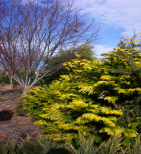 and Pilkington
for helping us out with much of the nomenclature, which was a job and
one half for them. We were taken with the “Ironclad Hybrids”: Native
American Catawba Rhodendrons crossed with Chinese species; the
Yakushimanum Rhodendron from Japan, with dark green foliage and
bell-shaped flowers; the tall “Paperback Maple” from China, which has
beautiful peeling bark; and the evergreen “Green Spire” from Japan,
which exhibits interesting new growth. We were particularly
struck by the gold-tipped Chameacyparis nookatensis “Variegata” which
will work well in several settings, and were overwhelmed by the Fantasy
crepe myrtle that came from what is today the Raulston Arboretum.
When you visit, pay special attention to the Oakleaf hydrangea
(Hydrangea quercifolio “Angola Prison”), which is simply not available
elsewhere. From a cutting brought from Angola Prison in
Louisiana, it has large leaves, cinnamon colored bark, and very ample
beautiful white flowers. This listing just barely introduces you
to some of what you will find throughout the clever little environments
created within the garden. Nonetheless, we wanted to give you
some sense of what is to be seen, since most of the articles about
Hobbit lack enough specifics. Hobbit Garden. 9400 Sauls
Road. Raleigh, NC 27603. Telephone: 919.772.6761. Email: hobbitgarden@att.net.
(9/7/05)
and Pilkington
for helping us out with much of the nomenclature, which was a job and
one half for them. We were taken with the “Ironclad Hybrids”: Native
American Catawba Rhodendrons crossed with Chinese species; the
Yakushimanum Rhodendron from Japan, with dark green foliage and
bell-shaped flowers; the tall “Paperback Maple” from China, which has
beautiful peeling bark; and the evergreen “Green Spire” from Japan,
which exhibits interesting new growth. We were particularly
struck by the gold-tipped Chameacyparis nookatensis “Variegata” which
will work well in several settings, and were overwhelmed by the Fantasy
crepe myrtle that came from what is today the Raulston Arboretum.
When you visit, pay special attention to the Oakleaf hydrangea
(Hydrangea quercifolio “Angola Prison”), which is simply not available
elsewhere. From a cutting brought from Angola Prison in
Louisiana, it has large leaves, cinnamon colored bark, and very ample
beautiful white flowers. This listing just barely introduces you
to some of what you will find throughout the clever little environments
created within the garden. Nonetheless, we wanted to give you
some sense of what is to be seen, since most of the articles about
Hobbit lack enough specifics. Hobbit Garden. 9400 Sauls
Road. Raleigh, NC 27603. Telephone: 919.772.6761. Email: hobbitgarden@att.net.
(9/7/05)
86.
A Gardening Cornucopia
There are two
reasons for visiting the Wild Gardener (www.thewildgardener.com).
If you are just getting started in gardening, there is a pretty rich
list of places to write for seeds, plants, etc. The resources are
pretty good. While the erratic keeper of this site, up in
Asheville, is a little self indulgent with weedy prose, he is
nonetheless a pretty good plant illustrator who merits your attention.
His name is Peter Loewer. See http://littleton
collection.com/peter_loewer.htm.
If you will scroll down to
the bottom of his home page you will find links to other botanical
illustration—on fruit, ferns, mosses, etc. We particularly like
the pictures from a trip to Scotland (www.thewildgardener.com/index
_files/8scots.html.)
(8/10/05)
85. Earthfare
Earthfare
(www.earthfare.com),
headquartered in Asheville, has now opened in Chapel Hill (June 15 with
Raleigh to follow soon), providing an organic alternative for those
tired of the national giant Whole Foods. In Chapel Hill, it has
opened in the old Southern Season space. Already it has quite a
following, and it certainly has a more peaceful atmosphere than its
competitor. Shoppers will notice, however, that it charges, in
our eyes, the same outlandish prices as all the other organic outlets.
In other words, there is no compelling reason to visit except to
escape from Whole Foods. Harris Teeter is getting bigger in
organics, and also demands top prices for such products. For a
moment, this competition brought forth some decent prices on
fresh salmon at both stores, but they have since gotten over their
fleeting experiment with value pricing. For somewhat better
produce than is available in the markets at mildly better prices,
shoppers would do well to contact several local organic growers in the
Triangle. (7/13/05)
84. Most
Original Sandwich Shop—Chapel Hill
Sandwhich is the latest arrival in West End Courtyard, the Franklin
Street enclave which aspires to be Chapel Hill’s next foodie
destination. (See 3 Cups: Coffee, Tea and
Chocolate for the 21st Century.) Like its name,
Sandwhich offers a cleverly tweaked menu of familiar ingredients given
just enough nouvelle spin to lift them out of the mundane into the
original. It’s a laid back shop with a slightly industrial
flair—exposed heating ducts, open kitchen and formica-topped
tables—that’s already attracting a crowd.
We’ve enjoyed the warm roasted eggplant sandwich, which layers fire-roasted eggplant and red peppers with tangy oven-dried tomatoes, goat cheese and garlic confit. Smoked salmon on ciabatta gets an eye-opening dash of wasabi and shaved red onions along with expected cream cheese, while homemade roast beef gets a simultaneous kick from chipotle hot sauce and a cool down from creamy coleslaw. Prosciutto di Parma takes a star turn twice daily: As Breakfast di Parma, it appears in a decidedly upscale breakfast sandwich with creamy gorgonzola butter on a baguette. Later in the day, it steps into a more classic role with fresh mozzarella, enlivened with mint, arugula and lemon vinaigrette.
Summery specials make good use of Farmer’s Market produce. There’s a warm green pea-mint soup with ginger crème fraiche, local tomato salad with Celebrity Dairy goat cheese and basil pot de crème. Moroccan mint tea, made with green tea and lots of fresh mint, is the perfect cooler on steamy days.
Janet Elbetri, the cheerful co-owner (with her husband Hich, also the chef), once worked for Valrhona, the premium French chocolate company. Naturally, Sandwhich’s dessert menu includes Most Excellent Brownies made with Valrhona and the cleverly named Anti-Depressant Chocolate Chip Cookies (with happiness-inducing pumpkin and sunflower seeds). Elbetri also consults with 3 Cups owner Lex Alexander on his high end selection of chocolate bars and offers an occasional chocolate seminar.
Contact: Sandwhich, West End Courtyard, 431 West Franklin Street, Suite 18, Chapel Hill, NC 27516. Telephone: 919-929-2114.
83.
Durham as Fat Farm
Durham is
achieving some renown as a place where all those who have lost hope can
go to shed pounds. According to Stephanie Saul in “Penny-Wise,
Not Pound-Foolish” (New York Times, May 19, 2005, pp. C1 and
C13), “Durham has been known for weight loss ever since the Rice Diet
was founded here in the 1930’s. … Dieters pump more than
$51 million a year into the local economy, according to the city’s
Convention and Visitor Bureau,” which brags about the size of this
stream of revenue, ranking it as important as convention
revenues. The compulsively overweight come from far and wide to
visit heavily merchandised diet programs, one at the Duke Diet and
Fitness Center (www.cfl.duke.edu/
(alenm32gasbdtqfpwqrg1355)/dfc/home/index.aspx),
Structure House (www.structure
house.com), and
the Rice Diet Program, which dates back to the thirties (www.ricediet
program.com/index.php).
It is highly appropriate that Durham serve as a center for obesity
control, since the South suffers from considerable overweight and an
unbalanced diet. The collateral economic fallout is great with
nearby shoe stores, motels and hotels, Southpoint, and other locales
all sharing in the diet dollars. The Duke University Hospital
System, which is heavily driven by its quest for dollars, shares in the
booty, its plastic surgeons doing a handsome business as well.
Some observers have reported to us that these programs are not as well
controlled as they might be, with the focus on revenues getting in the
way of some appropriate safeguards. Caveat emptor.
(6/8/05)
82. Star Lu
Located on the
ground floor in the back of the office building, this site has housed
some weaker emporiums before. There’s work to be done on Star
Lu’s food (there was much too much fried stuff on the menu at a recent
lunch) and its rather amateurish service. That said, the quarters
are very well designed, good looking and restful. A good place to hide
out in Durham. The Raleigh News and Observer waxes poetic over
this eatery, but we would say make haste slowly. There’s some
retreading needed here. (See
http://triangle.com/dining/restaurantreview/story/2088488p-8467055c.html.)
A sort of fun local blogger also can’t say enough good things
about it (http://archerpelican.typepad.
com/tap/2005/02/restaurant_star.html).
What’s more
interesting is that a local team—David Ripperton, a Carrboro
architect, and Sunderland Engineering (http://sunderl
andeng.com) put
the thing together—and that merits some attention. Most of the
restaurants about are too crowded, poorly lighted, and exquisitely
uncomfortable. More on Ripperton at
http://dnra.net/portfolio.htm: he appears to have some talent for
interiors. Restaurant Starlu. 3211 Shannon Road. Suite 106 (back
of the building). Durham, N.C. 27707. Telephone:
919-489-1500. Website: www.starlu.com.
(5/18/05)
81. Helping Wounded Birds
If you see a
bird down and wounded, call the Piedmont Wildlife Center, a nice bunch
of people, for help. Unfortunately the Police at 911 don’t know
what to do. The Humane Society, if you can reach it, will only
refer you to Piedmont. Call 919-572-9453, which is really
Piedmont’s bird infirmary, and they will talk you through the problem.
Either they will instruct you on how to care for the bird or ask you to
bring it in. If you want to contribute to this worthwhile
organization—either time or money—call the administrative office at
919-968-8557. It’s located at 605A NC Highway 54 West. Chapel
Hill, North Carolina 27516. Website:
www.piedmontwildlifecenter.org. The organization is led by
two wildlife veterinarians. Here are some “patients” they’ve
helped:
www.piedmontwildlifecenter.org/
web_patients/index.htm.
(5/11/05)
80. Birding in North Carolina
A wonderful surprise for any newcomer to North Carolina is
the very diverse, numerous bird population that endures, despite urban
sprawl and overbuilding, pesticides, and all the other things that
might make short work of wildlife. As well, there is an avid
population of birders that is on the look out for bird immigrants: they
cluster in societies with a considerable history. To find out
about Carolina bird clubs, see Will Cook’s marvelous website, which
includes a fairly comprehensive list of them
(www.carolinanature.com/
carolinabirdclubs.html).
Cook’s site also includes his own
wonderful pictures of local fauna and flora, a list of Carolina
birds, links to a cornucopia of related groups, and much more.
Now the Triangle’s only bird society, the Chapel Hill Bird Club,
founded in the 1930s, has a rich history that can be found on its own
pages (http://chbc.carolinanature.
com) and which
is also included on Cook’s site.
If
you are not sated with the information provided by Mr. Cook, take a
look at Pete Thayer’s Birding.com,
which covers the whole field of birding with special sections on each
state plus hot spots for the rest of the world. Thayer is an
ex-money manager who has gone over the hill, literally, to pursue his
true passion, and his website will lead you to a host of birding
locations. His section on North Carolina can be found at www.birding.com/
wheretobird/NorthCarolina.asp.
And finally, the Audubon
Society, which you can find in our Global Province Network (www.globalprovince.com/network.htm)
is quite active in North Carolina. (4/13/05)
79. Pre-Care
Connie
and Bob Schaap have been taking care of newborns for 28 busy
years, 17 of those in Cary. Meanwhile, they have brought up three
children of their own, now out in the world with their own successful
careers. Bob for the longest while also was a general manager in
retail for Hills Department Stores, Office Depot, and Sam’s (Wal-Mart’s
warehouse store). They limit themselves to five children under care,
ranging from newborns to 18 months in age. Licensed by the State
of North Carolina, they have a house amongst the greenery along North
Harrison Avenue, not far from SAS Institute, on 3 acres of land, about
one mile from I-40. We have not used their services but have
become well acquainted with them and their reliability through some of
their other activities. Connie hails from Mississippi, and Bob is
from the Netherlands. Connie’s Private Home Daycare. 1399 N
Harrison Ave, Cary NC 27513. 919-677-0096. (3/16/05)
78.
3 Cups: Coffee, Tea and Chocolate for the Twenty-First Century
This sleek new coffee house, located in the Courtyard off
Franklin Street in Chapel Hill, may be the most un-wired java spot in
town. The mellow space is flooded with sunshine that lights up
rosy brick walls and pale wood floors, and bounces off gleaming
canisters of rare coffee and tea. Cool jazz and the faint aroma
of freshly roasted beans stir the senses, inviting one to linger
dreamily over an oversized cup of an exotic brew.
3 Cups encapsulates the trend toward artisanal, single origin coffee, tea and chocolate. What you will not find here are frappucinos, pre-mixed chais, or any of the other blended drinks that have become the mainstay of Starbucks and its ilk. Instead, this local store aims to connect its customers to the wider world, by way of high quality growers who produce single estate crops.
As with wine, “terroir” or “taste of place” is key: unblended, unadulterated products that actually taste of the region, or indeed, the very farms, on which they are grown. At 3 Cups one can drink a cup of Kenyan Neyri, produced by the Ichamara coop and sold as special lot #3405 at Kenya’s annual coffee auctions. When it comes to flavor, parallels with the wine world are inescapable. According to roaster Peter Gulliano’s tasting notes, this “plush, deep and complex coffee,” which balances “brightness” with “hints of raspberry and plum,” is considered “the equivalent of a great French Grand Cru wine.”
A recent tea tasting, led by consultant Kevin Knox, displayed the extraordinary nuances of flavor in high quality, single origin teas. The six teas ranged from Gyokuro “Pearl Dew,” a clean, grassy-tasting green tea, to Hao Ya A Keemun, a tannic black tea from China with undertones of incense. In between was our favorite, Royal Golden Yunnan, which tasted of smoky leather and elusive hints of apricot, a tea coveted by professionals for its gutsy flavors.
3 Cups buys coffees and teas in small lots on a seasonal basis. That means that the cup you loved one month may not be available the next. But that’s part of the fun: having the finest coffee or tea at its peak, sort of like eating strawberries in May rather than January. Every Friday afternoon, the store offers the week’s best beans, freshly roasted that morning. Single origin chocolate bars are also available, including Michel Cluziel’s Premier Cru Plantation from Venezuela: It is very dark, bittersweet and slightly fruity, one of the best in world.
3 Cups is the brainchild of Lex Alexander. The soft-spoken Wellspring co-founder now heads Rooster Ventures, a small business incubator which aims to transform the 400 block of West Franklin into a foodie destination. Opening April 1st is Sandwhich, an upscale sandwich shop; on the drawing board are wine, cheese and flower shops. Contact: 3 Cups, 431 West Franklin Street, Chapel Hill. 919.968.8993. (3/9/05)
77.
Computer Repairs
The repair
will get done, at a reasonable price, in a reasonable period of time,
courteously. The Durham shop, just down the frontage road off of
Westgate Drive that eventually leads you to Office Depot and Sam’s at
South Square, spares you conversations with typical counter clerks who
do not know what they are doing. Instead you will deal with some
Pakistani gentlemen who have been at it a while. We don’t know a
thing about its Raleigh store. These are not miracle workers, but
they can devise workmanlike solutions to normal computer problems.
Computer Services of Carolina. 4125 Chapel Hill
Boulevard, Durham, North Carolina 27713. Telephone: 919-489-5252.
2827 Jones Franklin, Raleigh, North Carolina 27606. Telephone:
919-854-1105. Website:
www.gotocsc.com. It’s these small, hidden shops around the
Triangle where craftsmanlike things get done in rebellion against the
lick and a promise patchwork prevalent at the chains. (2/9/05)
76. Autism
Unknown
In “What Goes
Wrong,” Carolina Alumni Review, January-February 2005, pp.
40-47, we essentially learn that we do not know what goes wrong in the
brain to put young children in the grip of autism. Two years ago
the National Institutes of Health granted $19 million to set up the
first two Studies to Advance Autism Reseach and Treatment research
centers at UNC-Chapel Hill and at Yale, with six more on the way.
Kevin Pelphrey, a development neuroscientist at UNC, says, “We don’t
now really anything about the brain in autism. There is just a
lifetime of research to do.” Carolina’s efforts in this area date
back in 1972 when its TEACCH program (Treatment and Education of
Autistic and related Communication handicapped Children) started up
under founder Eric Schopler, though his research started with a 1966
Child Reseach Project. “Carolina also will participate in the
international Autism Genome Project,” a big-scale hunt for the genes at
the root of autism. Of interest here, of course, is the
interdisciplinary blending of psychologists with genetic
researchers to make advances in both the understanding of and treatment
of the disease. “Children with autism may appear to have the same
behaviors … but it’s likely that the multiple genes that may cause
autism in one child are not the same ones that cause autism in
another.” Since UNC and Duke, to varying degrees, are achieving a
fair amount of knowledge about child development disorders due to
generous federal funding, it is to be hoped that some of this knowledge
might be better disseminated throughout the education and health
systems of North Carolina, which are only modestly connected to these
discovery machines. There has not been an appropriate “trickle
down” effect from the North Carolina research community into the
population as a whole, a missed opportunity that much penalizes the
state. It is not often noted that the Research Triangle has put
together certain pockets of excellence in the arena of child
development disorders which, if better coordinated, could be a
tremendous drawing card for the area. (2/9/05)
75.
Magnificent Obsession
James Belknap of Raleigh, who teaches at St. Mary’s School
in Raleigh, probably has the best obsession of anyone in the
Triangle. He’s got the “list disease” and put it to good use both
in his doctoral thesis and now in a book entitled
The List: The Uses and Pleasures of Cataloguing.
None other than Yale professor Harold Bloom is fascinated by Belknap
and his mania. (Read about Bloom in “Bloom—In Praise of
Divorce.”) The book is mostly about “literary lists found in
the 19th century” works of notables such as Ralph Waldo Emerson and
Walt Whitman. To learn what he has wrought in his book, we
recommend a review of his thesis in The Chronicle of Higher
Education (http://chronicle.com/free/v48/i05/05a02801.htm,
September 28, 2001). Lists are everywhere in literature, he
notes, and the best ones are conceived in a way that furthers the
viewpoint or theme of the works in which they are found. Belknap
refers to an earlier work, Francis Spufford’s
Chatto Book of Cabbages and Kings: Literary Lists (1989), as
one source of inspiration.
Belknap and his wife Nadia, a French instructor, are quite the catch for St. Mary’s. He got his B.A. from Michigan, and then his M.A., M. Phil, and Ph.D. from Yale, which also published his book Both Duke and UNC, where the English departments need some recharging, would do well to make him an occasional lecturer. We wonder if, in another life, Belknap was Martin Luther who pinned his list of theses on a door in Germany and set off one of the storms of the Protestant Reformation. (1/26/05)
74. Saks Fifth First
Saks has
jumped into the Triangle with a store that in fell one swoop took over
the lead as the number one women’s shop in the region, with no
close seconds nibbling at its heels. One patron says,
“It’s small but terribly well edited.” You can now find Armani,
but also Blu Marine. Footwear by Maestro Manolo Blahnik, the
prodigy from the Canary Islands, (www.hellomagazine.com/profiles/manoloblahnik/
), whose shoes have achieved notoriety on Sex and the City,
decorate its shelves, as does the work of Ireland’s Simon Pearce whose
glassware is spectacular (see www.simonpearce.com).
As an extra element of dash, Saks has recruited one Mohammed
Ali—not the boxer—as its manager. He does have a sense of humor about
his name, and he added color to the store’s debut. (See
http://abclocal.go.com/wtvd/news/080404_NW_saksstore.html).
Saks Fifth Avenue. Triangle Town Center. 7706 Old
Wake Forest Road. Raleigh, North Carolina 27316. Tel:
919-792-9100. The location is rather obtuse, but the goods are
there if you are willing to go an extra mile.
73.
Hog Heaven: Pork Sausage from Cane Creek
When we pulled
up to the paddocks at Cane Creek Farm, we first saw Lucille, a
sublimely happy, three-week-old, russet-haired piglet, scampering
freely in the grass, snuffling for acorns. An elderly white cat
lolling nearby appeared to be her sole companion. Then we noticed
scores of contented pigs in all sizes, shapes and colors—red, black,
cream and brown, spots, stripes, bands and solids, and every imaginable
combination thereof. Not to mention a troop of blue-eyed dwarf
Nigerian goats, a broody flock of fluffy white Polish silkies, a Blue
Cochin rooster, more cats, and assorted miniature donkeys.
It is tempting to think of Cane Creek as a sort of Noah’s Ark of
heritage farm animals, and of owner Eliza Maclean as their uber-Mom.
Maclean, a willowy 39-year old who attended high school on
Philadelphia’s Main Line and studied cancer in fish as a Duke grad
student, found her true passion when she stumbled into a job as herd
manager for pigs at North Carolina A&T. “I loved it.
Within a week I knew I had found what I wanted to do,” she
recalls. “Pigs are funny and smart, and I find them fascinating.
It takes a creative approach to work with them, and I like the
challenge. I’m very good at furrowing and I love that,
genetically, you never know what you will get when you cross-breed
them.”
For a year and a half, Maclean has been raising her own pigs on Cane
Creek’s 11 acres, while also working as North Carolina rep for Niman
Ranch. She knows each of her 175 pigs by name. There is,
for example, Clyde, a contemplative, 700-pound, two-year-old with
bristly dark hair. Tiny Lucille was the sole survivor of a litter
born the same night a hurricane roared by the farm; Maclean found her
hypothermic under water, but managed to revive her. Like Clyde,
most are Farmers Hybrid, a cross of five traditional breeds.
(MacLean has added Tamworth, another venerable breed, into her custom
mix.) She feeds them high quality soybean meal, corn, acorns,
peanuts and barley, as well as end-of-season tomato, watermelon and
okra plants from her organic garden. Right now, she says, they
are snacking on leftover Halloween pumpkins.
MacLean had a recent moment of fame when Peter Kaminsky, writing in The
New York Times (“On the Trail of Fine Ham: First Plant an Acorn,”
October 6, 2004, p. D11) mentioned her as one of a few farmers who are
raising Ossabaw pigs. These black-and white-spotted pigs,
distinguished by their elegantly tapered snouts, long legs and
barrel-shaped bodies, are descended from Iberian hogs left on Ossabaw
Island off the Georgia coast by Spanish explorers in the 16th century.
The thing about Ossabaws is their meat, which is to ordinary pork
as earthy black truffles are to cultivated white mushrooms: Kaminsky
waxed rhapsodic about the “long-cured, translucently pink Iberico ham,
glistening with droplets of amber fat” he tasted in Spain: “The
flavor—salty, sweet, nutty, slightly funky—was as complex as a mature
pinot noir.” Miraculously, Iberian pork is also much higher in
monounsaturated fats than any other meat, leading Spaniards to call it
the “four footed olive tree.”
In two shakes of a piglet’s curly tail, Alice Waters paid a visit to
see Maclean’s Ossabaws and a couple of weeks later, Maclean found
herself on a plane heading for the Slow Food Conference in Turin,
Italy, where she talked hogs with, among others, the Prince of Wales’
farm manager. Back at Cane Creek, the phone hasn’t stopped
ringing, with Daniel Bouloud and chefs at Il Buco and Savoy in New York
clamoring for as much Ossabaw as she can send them. Locally, you
may be able to taste it at The Lantern in Chapel Hill,
or Magnolia Grill in Durham. (In case you’ve been napping,
“artisanal pork” is hot; see “Pork Futures,” Food and Wine,
November 2004, pp. 188-195, 230-232.)
We ourselves are waiting for an Ossabaw shoulder, or if we get lucky, a
tenderloin. In the meantime, we can attest that Cane Creek’s
ground pork sausage is superb, full of flavor, rich but not fatty, and
lightly spiked with just the right amount of peppery spice. Meaty
ribs from a Farmer’s Hybrid hog, were enormous and slightly feral
tasting—the sort of flavor that existed, we would guess, before pork
was bred to taste like chicken. We rubbed them with Al-Andalousi, a
medieval Spanish spice mixture we found in Paris (See GoumanyaT
et Son Royaume and Spice Shop in our
newsletter, SpiceLines),
cooked them slowly in the oven, and added a dash of chili
pepper-flavored vinegar just before serving.
Contact: Eliza Maclean, Cane Creek Farm, Telephone: 336-376-0811 (leave
a message). Email: edmaclean@bellsouth.net.
72. Wasabi
We wound up at
this restaurant because of a technology manager of Korean background we
met on one of those slow commuter flights down from Boston. He
vouched for this restaurant, and he was right. The quarters are
attractive, unusually so for the Triangle, where Japanese eateries are
often cramped. So it has more flair than others in Raleigh,
Chapel Hill, etc, and the presentation of the food has youthful
panache. The sushi was, indeed, fresh, and the Thai food provides
interesting counterpoint, though some of the Thai ingredients are
inappropriately sweet. It is just off 64, and we can now say that
the two best Japanese luncheon spots in the region are just seconds off
this artery. Wasabi in MacGregor Village. 107 Edinburgh
South, Suite 135. Cary, North Carolina 27511. Telephone:
919-460-7980. Fax: 919-460-7982.
71.
Best Bison Burger By Golly
Well, Ted’s, the brainchild of Ted Turner, actually
serves the only bison or buffalo burger. He got into the restaurant
business, apparently, with the thought that if there were enough demand
for buffalo meat, it would guarantee the buffalo’s place in
America. Sort of a strange environmentalism, if you like: using
consumption to preserve an animal. Anyhow, it’s
not that easy to find a good burger in the Triangle, and here you will
find as good a buffalo or beef burger as is available in North
Carolina. And, given the state’s strange laws, you can actually
get your burger rare here, since the restaurant grinds its own meat and
is allowed to serve a bleeding burger, while other establishments have
to cook all the taste out of their meat. The chain buys
pedestrian tomatoes and desperate iceberg lettuce, so just take your
burger straight. The music is a tad too loud, and the booths are
too small, but this is a friendly enough place to eat, and it gets you
away from the congestion and tattiness of South Point, across the
street. For more on the whole Ted’s shooting match, see
www.tedsmontanagrill.com. Ted’s Montana Grill, 6911
Fayetteville Road, Suite 102 (just off I-40), Durham, North Carolina
27713, 919-572-1210. There’s also one in Raleigh, as Ted
looks to put his marker across the United States, having started up the
chain in Atlanta. As we mentioned on Wit and Wisdom,
Ted may be running out of things to say, so these restaurants might
just be his last hurrah. To learn all about the ostensible
nutritional virtues of bison from St. Ted, read
www.tedturner.com/download/
montanagrill/TedsMontanaGrillBisonFacts.pdf.
70. Charlotte Restaurants and Hotels
At a later date (see updates below), we will sift
through the Charlotte restaurants and give you a more exact feel as to
where you should eat. That said, the list provided on Charlotte
Shout 2003 gives you some fairly safe bets (www.charlotteshout.com/culinary/restaurants.htm).
At one time or another, we have heard fairly kind words said about
Sonoma (a little steep, but national reputation), Bistro 100, and
Upstream. And while we are at it, people vouch for the Park Hotel
(good neighborhood, smallish rooms) and Ballantyne Resort (www.ballantyne
resort.com).
Incidentally, we have tapped into the wisdom of Todd Cromer on
North Carolina restaurants, and we find him to be a worthy
touchstone. You can find him many days at the 411 restaurant in
Chapel Hill.
Update: More Maybe
Restaurants
On a recent trip to Charlotte, we dined for a couple of hours at
Bonterra. This bears no relation to the California organic
vineyard, and the waiter was in fact disparaging of that winery.
Our companion picked this spot for its meat, and his choice was
justified. Our Niman’s pork chop was truly thick: clearly it was
brought in from out of state since Niman’s has given up operating in
North Carolina because of slaughter problems. His filet mignon
was first class though he found the accompaniments dubious. We
shared a flight of four Shirazes which is a fun experience since you
get to compare and contrast the several houses one knows
about—Penfolds, etc. We found a Fox Creek—or was it Fox Gordon
Reserve—to be the best horse in the paddock. Probably it was Fox
Creek “Short Glove.” Service was mixed and even diffident.
The food came to the table very, very slowly, and the desserts
obviously came from across town. A vanilla soufflé for
dessert was a worthwhile experiment which two should share since other
desserts were not remarkable. The price tag was decent, and the
ambiance good, except that some of the customers are permitted to be
rather loud. This blowsy behavior is strange, since most of the
patrons are decorous, perhaps a bit dull, and appropriately
dressed. It is situated in a well-remodeled church that had
previously hosted 3 denominations since its creation circa 1900.
Bonterra, 1829 Cleveland Ave. at East Worthington Ave., Charlotte North
Carolina 28203. Telephone: 704-333-9463 and 704-333-2433.
Website: www.bonterradining.com.
A few more eateries have come up that we’ve heard might be decent, but we have not investigated them yet. They are:
LeVecchia’s Seafood Grille, 225 East 6th St., Charlotte NC 28202. Telephone: 704-370-6776. Website: www.lavecchias.com/home.htm.
Patou Bistro and Bar, 1315 East Boulevard, Charlotte, NC 28203. Telephone: 704-376-2233. Website: www.patoubistro.com/index_files/Page526.htm. (3/14/07)
69. Wolfe Again in Asheville
Wolfe’s Old Kentucky Home, the boarding house where
he grew up, was severely damaged by arson in 1998. Now it’s open
to tourists after a $2.5 million restoration. See The Wall
Street Journal, May 26, 2004, p. D12. If you are into Wolfe,
be sure to visit the website of the Thomas Wolfe Society which has a
review and meets at many of the locales (Ashville, Chapel Hill, etc.)
associated with Wolfe: www.thomaswolfe.org.
For more on the home itself, go to www.wolfememorial.com.
68.
Carolina Connoisseur
Also known as Carolina’s Best at www.carolinasbest.com.
This is a start up still finding its way that will prove helpful to
those seeking treats around the Carolinas that may not be mentioned
other places. Alan Maurer and Renee Wright, writers who have a
history writing about entertainment, food, hotels, and such around the
Carolinas, have just started up this site. Maurer discovers an unknown
vest pocket Zen garden, Grace’s Garden, in an equally unknown Durham
Central Park—all of which are works in progress. He discovered
all this while out on a walkabout. This is a quiet place to get
away and promises in time to be a burgeoning arts district. Ms.
Wright picks out the sights in Myrtle Beach for you. See
www.carolinaconnoisseur.com/AmazingGrace.htm. Oddly
enough, offbeat entertainments for families, academics, and knowledge
workers are not very well covered by journalists in the Triangle.
67. In the Sauce
Greg Leman, who shut the doors of his software
house Metagenix in 2003, has staged a saucy recovery of the
non-alcoholic kind. In stores and from his website he is offering
marinade, salsas, and the like. His new company is called The
Carolina Sauce Company (www.carolinasauce.com).
He outsources the manufacture and has taken delivery of 120 cases or so
at his home. A hunter, he developed his own sauces for wild game,
then tuned up the formula at ice hockey games where he offered samples
to attendees. The fun thing he has done on his site is to
establish a customer forum where people can get into all their
eccentricities about food, ranging even into tailgating, recipes, and
cigars. (See www.
carolinasauce.com/phpBB2/index.php.)
He has branched out far
beyond his own sauces, suggesting that he is applying the experience
from his computer retailing days to the world of hot food. Read more
about Greg Leman in Allan Maurer’s article on Local Tech Wire (www.localtechwire.com/article.cfm?u=7300),
the most au courant publication on techies in the
Carolinas.
66.
Where Beer Fanciers Congregate
UNC’s Carolina
Club at Chapel Hill (the eating establishment of its alumni
association) has hidden its beer light under a bushel. The
pleasant place to dine there is in the Grill, a too small room which we
understand will be expanded in the future with the addition of a
terrace. And, lo and behold, you will discover that its beer
menu, though somewhat reduced, still has in excess of 40 selections,
and selections worth having. We’re always partial to Samuel
Smith, but we suggest you step out and try several entries, some of
which will be new to your taste. (See www.carolina-club.com.)
It’s a bit of a struggle to get into the Club at the moment, even if
you are a member of long standing. You work your way in from the
Bell Tower on Stadium. Call the Club to find out how the parking
works.
Update: Asian Twist. The Carolina Club is ever deepening its beer menu which needs more brews from outside the United States. Lately it put two Asian beers into its stock, Singha from Thailand and Sapporo from Japan. This is most commendable, and we hope we will also see additions from other areas of the world.
A while back UNC snatched away the parking lot where users of the club put their cars while visiting. Only the most valiant supporters have bothered to come in for lunch for months, since the lack of spaces and construction blockages made the trip painful. In January 2005 or so, we hear, a 700-car garage is to open adjacent to the Club. (1/26/05)
65. Finding a Mortgage
Arch Williams, chief executive of ALH Capital, comes from a long line
of Carolinians who have lived in and about the Triangle. He
himself grew up in Wilson but now resides in Cary. He’s the only
Marine pilot we know who watched Madonna videos with Islamic Bedouins
while trying to convince them to keep their goat herds away from the
advancing U.S. forces in the first Gulf War. Of a family that has
lived and breathed the mortgage business, he has worked in several
aspects of the mortgage industry. Besides the fact that he really knows
the business, one goes to him to get a mortgage simply because he is
inordinately ethical and because he and his people are awfully
nice. Those hunting a mortgage should call the main Raleigh-Cary
office at 919-851-9944 or reach an affiliate office at Devon Mortgage
in Durham (919-401-4700), Chatham Mortgage in Pittsboro (919-542-4222),
or Pinehurst Mortgage in Pinehurst (910-255-0700). ALH
Capital. 7406 Chapel Hill Road, Suite K. Raleigh, NC 27607.
64. Grayson's Cafe
Grayson’s is distinguished by
serving fairly simple fare at reasonable prices and by the fact that
Mrs. Grayson is a one-time Miss North Carolina who apparently sings a
bit on Friday and Saturday nights to add some extra spice to the
food. Probably you will eat a salad or wrap for lunch. Lo
and behold, breakfast is also available. It’s the simplicity of
the place that’s most appealing, including its quiet ambience. It
needs better signage, so you may just drive right by if you are not
watching. You can fax in a take out menu with your choices—for
any meal. Grayson’s Café. 2300 Chapel Hill
Road. Durham, near Lakewood, just a few blocks off Business
15-501. Telephone: 919-403-9220. Website: www.graysonscafe.com.
63.
Professor Skender
C.J. Skender is taken to be one of the best professors
at Duke and certainly one of its most eccentric. His antics bring
a little color to his dry coursefare—accounting—and reputedly he is
much celebrated by the students who know him. Duke Magazine
(March-April 2004, pp.23-4) comments on his obsessions and
showbiz:
“Beginning with the socks and under-apparel alphabetized in his top drawer, Skender dressed himself according to a schedule determined weeks in advance: charcoal suit, yellow shirt, tropical-fish suspenders (pair 242, ‘Blue Lagoon,’ out of 300), and, because it was a Tuesday, a peach necktie—a necktie, not a bowtie, which he wears only on Mondays, Thursdays, and Saturdays.
At 10:53, two minutes before the official start of class, he initiated yet another ritual: a mental warm-up of movie-quotes and song-lyric trivia for candy-bar prizes. … Akin to his passion for order is his near-fanatical love of pop songs and movies.”
62.
Champion Swim Coach for Kids
Our colleague
Randy Roeing writes to tell us of a top-ranked swimming coach for kids
in the Durham area. Families from across the country now
come to him for guidance:
"Though kids are more likely to be hoping for a snow day than thinking
about water sports, we must give you a heads up to a local
up-and-coming swim coach, Ivo Benov. Ivo (pronounced Eye-voo and short
for Ivaylo), who started his swim team in September 2002 but has
already begun to attract swimmers from across the country. We
don't yet believe he's attracted any from his home country Bulgaria,
but give him time. From young to old, from experienced to
beginners, Ivo's Sprint Team has a squad that will meet your needs.
Ivo blends his educational background in Exercise Science, his
experience as a college breaststroker, and the latest in video
technology to provide a well-rounded program for the beginner to the
competitive swimmer. Ivo's a reputation for getting along well
with kids, and he's always willing to engage in a conversation on the
art and science of swimming. He's located right in the heart of
Durham at the Durham Downtown YMCA. Contact him at either 919-423-9678
or at ltbenov@duke.edu.
61. Chapel
Hill's Comfortable Neighborhoods
Tom Heffner,
who is a real estate appraiser, developer, and investor long active in
Chapel Hill, remarks that some of the neighborhoods worth a special
look for homebuyers are The Historic District (downtown), Chesley, The
Reserve, Creek Wood, and the Oaks, all of which have shown good
appreciation and resale value and retain enough ground cover and
foliage to delight the eye. Sandy Hale, a Prudential agent in
Chapel Hill and a resident of the Oaks, has for years kept tabs on the
steady progress shown there. We have used her data to show the
growth in average selling price per square foot throughout the Oaks.
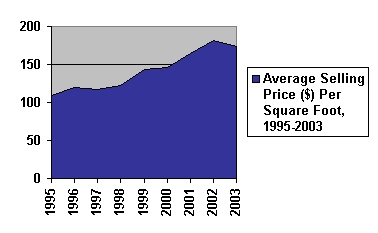
60.
American Livestock Breeds Conservancy
Right at the
Traffic Circle in Pittsboro, North Carolina, you can pay a short visit
to ALBC (www.albc-usa.org)
and learn a whole lot. We previously talked about the Conservancy
in our December 3, 2003 Global Province letter, “Turkey Restoration;
Green Renewal.” There are at least two reasons for visiting:
to learn more about several wonderful breeds of cattle, goats, horses,
pigs, sheep, turkeys, chickens, etc. that face extinction if we cannot
get behind biodiversity; and to understand that the one-breed animals
that factory farming now espouses are lacking in many ways and could
be, in fact, wiped out at the drop of a hat because of their thin
genetic background. You can visit ALBC’s website to learn of the
breeds it is trying to protect, to see censuses in process, etc.
But you might stop at its office to buy nifty t-shirts for the kids or
to purchase a publication. The folks there might tell you where
in the country you come face to face with rare breeds such as Lake Farm
Park in Cleveland or Sedgwick County Zoo in Wichita (www.scz.org/involved/rlist.html)
or where you find rare breed foods such as Flying Pigs Farm (www.flyingpigsfarm.
com/Our_Pigs.html).
American Livestock Breeds Conservancy. Pittsboro, North Carolina
27312. Telephone: 919-542-5704.
59.
Skateparks: Best Babysitting Deal
Skateparks, where your kids can skate or skateboard, have
grown apace in the Triangle, keeping up with a surge in interest
nationally in this activity. The owners of these parks are
sticklers for order and safety, barring both alcohol and drugs.
Some parents drop their kids off for much of the day, knowing that they
will get ample exercise under good supervision. The local market
leader is Ryan’s World, owned by the Noel family, which has parks
in Chapel Hill (100 North Park Drive, 929-9031) and Raleigh (1613
Green Street, 828-0874). Read about the growth of the sport
locally in The News and Observer, August 9, 2003, pp. C1 and
C4.
58. The Friendly Garden
Center
Mike Wilson just has a little garden center that you could
skip right by. Don’t. He’s on 15-501, right beside Wendy’s,
diagonally and spiritually opposite Lowe’s. There’s not a lot
there, but it may be just what you need. He knows all about grass
seed, and stocks high quality varieties: we thought we had the
best, and he got us to go one better. He features Felco, which
makes the pruner and other garden tools you should be using.
And, besides being helpful, he will call a spade a spade when it
comes to gardening. Wilson’s Lawn and Garden Center. 15-501
North. Chapel Hill, North Carolina 27515. Telephone:
919-942-3914.
57. Oishii
Complex, hot Japanese dishes are simply a problem
throughout the region, and Oishii has not escaped this local
curse. So stick to the sushi, particularly the assorted rolls, as
well as a few of the other appetizers such as the edaname. They
will not disappoint. One would hope this might attract other
reliable restaurants to Timberlyne shopping center. One does notice
more Japanese customers here than at some of the other sushi locales in
town. Oishii. 1129-M Weaver Dairy Road. Chapel Hill,
N.C. 27514. Telephone: 919-932-7002. Fax:
919-932-7003.
56. Coffee
& Crepes
You are probably tired of the chain expresso houses
now, and you have certainly learned to never, never eat their
pastry, which is universally bad. A welcome respite is to be had
at the Crossroads Shopping Center in Cary amongst the tier of
undernourished food places in the middle area. Just down from
Kashin, which is a very respectable sushi parlor, Coffee & Crepes
has a decent cuppa and, once in a while, it’s fun to have a crepe which
is largish (to justify the price) but freshly made and good enough to
share with the dog so you don’t stuff yourself. That the people
are nice is another plus. Coffee & Crepes. 315
Crossroads Boulevard. Cary, North Carolina 27511.
Telephone: 919-233-0288.
55. Durham
Radiology Trumps Duke
While Duke’s troubled Medical Center has been able to
capture a national reputation and a highly inflated cover article in Time
magazine, its delivery of medical services is spotty, and one is well
advised to pick and choose amongst its array of offerings. In “We
Get Our Head Examined,” Nancy Keates of the Wall Street Journal
(November 21,2003, pp. W1 and W8) makes clear that one would be advised
to look elsewhere in the Triangle if you need an MRI of your
brain. At Duke, “while the pictures were OK, the technician
hurried us, and the experts said the report skipped over some
possibilities suggested by the image.” She found that Duke
charged a whopping $2611, and the experts say that the film may not
have been as clear as digital images used by hospital
radiologist.” A short distance away, at Durham Radiology, she got
the work done for $1140 and found the work to be of a higher quality,
and so it gets the local trophy for excellence until something betters
pops up. Clearly patients should shop around for medical
competency.
54. Tsunami
This sushi cum noodle bar seems to have the
freshest fish in the triangle, and that adds up to a considerable
endorsement, since the quality of the fish is the most important aspect
of good sushi. Mirugai and several other items that are available
here are commonly absent without explanation at other
restaurants. Additionally, it is open seven (7) days a
week. We are bemused that it appears to be run by 3 women, one
being the owner and one being the sushi chef, the first time, we think,
we have ever encountered a lady sushanista. We have encountered
nothing bad on the sushi menu, even though the cutting skills, here as
elsewhere in the region, leave a little to be desired. That
slightly affects both the taste and the esthetic. As elsewhere,
the hot food is passable but certainly not exceptional. The
edaname (boiled soy beans) are fresher than most, but served hot and
without the usual garnish of salt grains. The address as given is
a bit confusing: it is in the shopping center housing the Mardi
Gras bowling alley, almost at the intersection of 54 and 40.
Tsunami Sushi & Noodles. 6118B Farrington Road, Chapel Hill,
North Carolina 27517. Telephone: 919-403-5800.
Fax: 919-493-8842.
53. Penang in the Triangle
There
seem to be a bunch of Penang restaurants around the country,
perhaps 4 or so in New York City alone. Now it has come to Chapel
Hill, just up Franklin Street from 411. The service and cuisine
is still mixed, but worth the visit. It is definitely related to
the restaurant of the same name in New York’s SoHo district. What
you must do is sit at the slightly more elegant tables in the bar area,
or perhaps down by the sushi bar, in order to get away from the madding
crowd. We would have the soup again, but will have to search
further on the amazingly extensive menu (Malaysian, Thai, Japanese,
etc) in order to find the 4 or 5 things we should have again and
again. But it’s nice to be in a large open space since there’s a
tendency to overcrowd and subdivide in all the eateries about the
Triangle. Why did it locate here? We learn from one sister
working in the restaurant that another sister had settled down north of
Durham and had long dreamed of a local Penang. Fortunately this
is part of a larger trend: more Asian restaurants have opened in
the area over the last 3 years, and there are still others to come.
Penang. 431 West Franklin Street (in the old Pyewacket
location). Chapel Hill, North Carolina 27516.
Telephone: (919) 933-2288. Fax: (919) 933-3133.
52. The Not Really Barbeque
Joint
This
restaurant has not been much noticed, and the local writers have
made much too much out of the barbecue which, frankly, is rather bland,
but probably suits the kids who pour in from the high school down the
way. The mystery, however, is this interesting restaurant with a
varied menu in Chapel Hill is still a secret, but so are a host
of the other better eateries around the Triangle. In any event,
after you have passed on the barbecue, do the ribs, or the duck, or the
crab cakes, or the wahoo, or the Redneck Pastrami. We can’t think
of anything not to like. Two Carolinians who are the founders
went away to see the world and came back with a lot of cooking
knowledge that landed here. To go along with your spicy food, the
boys in the back will put on Reggae and everything else, their
collection of CDs being extensive and impressive. The restaurant
décor is whimsical, but comfortable enough, not crowded, and not
overlighted. Barbecue Joint., 630 Weaver Dairy Road, Chapel Hill,
North Carolina 27514. Telephone: (919) 932-7504.
51. Amazing
For
the 3d year in a row Vickie and David McKee have turned a 14 acre patch
of their cornfields at Cedar Creek Farm into a maze that one can
visit. “McKee had read about a corn maze in Canada where the
owners not only earned money from admission charges as well as from
sale of corn that comprised the maze.” Theirs is located in
Rougemont north of Hillsborough. The maze is open afternoons on
Friday, Saturday, and Sunday. Chapel Hill News, September 3,
2003, pp. C1 and C6. See
www.mckeecedarcreekfarm.com. Cedar Creek Farm. 5011
Kriger Road. Rougement, North Carolina 27512. Telephone:
(919) 732-8075.
Update: Once again, for the 9th year in a row, the CFSA (Carolina Farm Stewardship Association, www.stewardsoftheland.org) is holding its Piedmont Farm Tour that takes you to 25 or so small farms plus assorted extras such as a visit to Central Carolina Community College to learn about its sustainable farming program. Obviously this is focused on organic agriculture, and for 2004, takes place May 1 and May 2. You may have to call 919-542-2402 to find out more, since the website occasionally is down for maintenance.
Update: More
Farm Tourism
As farm income declines, North Carolina farmers and their advocates are
becoming more and more innovative about finding a little revenue.
The state government now has an agritourism office, and it has already
listed dairy farms, corn mazes, and an ostrich farm on its new
website. See
http://www.ncagr.com/agritourism/ and
www.ncagr.com/ncproducts/CatSubDirectory.asp?CatNum=1011. The
name is a little unfortunate, sounding, indeed, like a Cold War
propaganda office. Basically the agritourism office provides
lists without interpretation, so you will have to look elsewhere to
find out if any one farm is worth a visit.
50. If You
Love Your Dog
You will have
to have this. Mandy Roeing got started sketching dogs when times
were slow at the Cary vet where she started working two years
ago. Then a veterinarian  commissioned a
large size portrait of her own dog, and the rest, as they say, is
history. The customers saw her work and wanted their dogs
memorialized. And Ms. Roeing put out a little brochure whereupon
she was in business. She works from photographs, since her
subjects, no matter how vain, will not sit still for their
portraits. She does soft pastels, although she will work in
pencil and charcoal for those who want a black and white
rendering. You may reach her at m_roeing@yahoo.com.
commissioned a
large size portrait of her own dog, and the rest, as they say, is
history. The customers saw her work and wanted their dogs
memorialized. And Ms. Roeing put out a little brochure whereupon
she was in business. She works from photographs, since her
subjects, no matter how vain, will not sit still for their
portraits. She does soft pastels, although she will work in
pencil and charcoal for those who want a black and white
rendering. You may reach her at m_roeing@yahoo.com.
49. Cafe Bistro
We took forever to go to Southpoint Mall of Durham,
and longer yet to go to Nordstrom’s. There was no rush. The
store is spacious and pleasantly lighted, but it has an eerie, empty
feeling, and the merchandise, at the bottom of high end, seems to have
been selected by a computer off in the state of Washington. This
is a standard department store with upscale prices in an age when
department stores are in decline: It needs, along with
Southpoint, to figure out its 2003 identity. It should be further
along in its development, having opened in March 2002. Both the
Mall and the store are nice enough, but they’re lacking in meaningful
content and compelling identity.
But up on the second floor, tucked into the back, is Cafe Bistro, which is a silly redundant name for a restaurant. This eatery is just right, with quirks. Oddly, one orders at the cash register and pays up front. Then you pick a table and a pleasant enough server goes through your whole order again, maybe to assure you that he or she got the order straight. That said, the decor is both comfortable and colorful, the ambiance permits quiet conversation away from one’s neighbors, and the food is both modestly priced and artfully tasty. It’s not fantastic, but it is darn good for a mall, and much above anything offered in the Food (read fastgrease) Court. And, in a town that likes to shut up on Sunday, it’s open when you need it. We have liked the nicoise salad with salmon and the Asian Salad Pizza. The place seems unmanaged, but somehow it all happens. We notice that it has not been reviewed much: consequently you always can get a seat and may even have the place to yourself on occasion. The editor of Duke’s Magazine dismissed it with very few words in an article on Southpoint. We dwell on the restaurant, because we think Nordstrom’s management could leverage it and contribute mightily to the store’s merchandising. In former days, we remember how Stanley Marcus would bustle through the restaurant at his store in North Park (Dallas), greeting us with more than cheer and asking whether everything was going okay. Cafe Bistro at Nordstrom. The Streets at Southpoint. Durham, North Carolina. Telephone (919) 806-3700.
48.
NOFO Market and Café
NOFO, on the
first floor, sports an assortment of household unnecessaries and
domestic clutter that might bail you out if you need a quick, whimsical
gift for a forgiving hostess. Upstairs there is a spotty
delicatessen. But what the place is all about is
downstairs. There’s the café which amounts to a very
pleasant sandwich shop with bar. So you might have a shrimp
B.L.T., a salad sampler, or the grilled chicken Thai wrap.
There’s a decent assortment of brunch eggs and salads. This is a
pleasant surprise to come upon at Five Points, with a bright, spritely
atmosphere and very willing help. The designers of the space
redid a former Piggly Wiggly store; hence, this is called NOFO at the
Pig. For more on the design, see
www.steinerschelfe.com/commercial1.html. NOFO. 2014
Fairview Road, Raleigh, NC 27608. Telephone:
919-821-1240. Website: www.nofo.com.
There’s another NOFO in Wilmington, which we have not visited.
47. Critters
People from
all over the world have made their way down to Bynum to see the strange
critters of folk artist Clyde Jones. They’re sort of creatures
made out of everything that you come upon as a surprise when you are
ambling down the rambling drive which is the town’s main street.
And then if you turn off to Clyde’s house, you will find a thicket of
them that add up to a menagerie that would truly startle true livestock
if there were any left in the neighborhood. Bynum is a bit past
Fearrington Village which you can make part of your trip as you work
your way down 15-501 from Chapel Hill in the direction of
Pittsboro. Do get some extra directions when you are on your way,
because the bridge near town is out, and you have to take an earlier
fork to make it into Bynum. Many of North Carolina’s best sights
are well off the beaten track, not even on Blue Highways, but out on
those thin-line grey roads. Incidentally, there is now an annual
Clydefest in Chatham County (the second just took place) that
celebrates his work and that of fellow folk workers. Here are a
couple of websites that will give you a preview:
www.roadsideamerica.com/attract/NCBYNjones.html and
www.carrboro.com/clydejones.html.
46.
Best Homemade Dumplings
It
used to be that the Asian food providers in the Triangle got pretty
good dumplings from Chinatown in New York, but it’s hard to find good
out-of-town fare now. So Raymond Leung has now taken to making
his own, and on the right day of the week you may find shrimp and pork
dumplings plus other varieties in his case. You will find other
things to your taste—an occasional greeting card, perhaps daikon
radishes or other vegetables, the hot red sauce that lends additional
body to Vietnamese pho (soup) and other Asian specialties. The
Classic Silver Wok. 7 Mariakakis Plaza (Fordham Boulevard between
Eastgate and Elliott Road). Chapel Hill, N.C. 27514.
919-933-2423.
Addendum: Call ahead about the dumplings because they’re popular and may be out of stock on occasion. The owner will tell you when he is going to make some more. Likewise, give him a call when you are up for fresh Vancouver crab, a special treat that he makes available in season. We just had a pepper crab dish that truly came to life because of the quality of his crab.
45. Wellness
Centers
Thank goodness.
Wellness centers are on the rise. “Rex Healthcare is building a
new facility in Garner. FirstHealth of Pinehurst has built seven
Wellness Centers across southeastern North Carolina. Fayetteville
features a mammoth 65,000-square-foot facility. And UNC
Healthcare in Chapel Hill just opened its Wellness Center in
Meadowmont.” (See Rick Smith, “Keeping the Boom in Baby Boomers,”
Metro Magazine, March 2003, pp. 27-29). Also
mentioned are other Rex Centers in Raleigh and Cary, Wakemed
Healthworks in Raleigh, the Duke Center for the Living, and the Anahata
Healing Center in Cary. The health clubs have been inadequate,
and these larger facilities are not just for twenty and thirty
somethings to put on muscle, but have programs to deal with stress,
heart-disease recovery, etc. The fees are often reasonable, and
there’s enough space to genuinely deal with health. This is
critical in a South that has too much fat in its food, suffers from
widespread obesity, and has heart disease statistics that are not to be
envied. If we remember rightly, Charlotte was given an F fitness
grade by one annual magazine survey.
The UNC facility is a clear improvement over Duke’s Center, and it is the best thing about Meadowmont, a crowded new development off route 54 in Chapel Hill. There is a little stinting inside—no steam facility that we have spied, a pitiful coffee shop, etc. But it is tastefully designed and it is a comfortable space in which to move around. What’s missing is an outdoor track and a proper surrounding environment, since real estate developers tend to find land too precious to provide the outdoor gardening and athletic amenities that would lead to a first-class fitness environment. The gold standard for this sort of thing is the Cooper Aerobics Center in Dallas, which has a collection of related facilities and which has driven its fitness ethic deeply into the Dallas community.
The UNC Wellness Center is going the way of all flesh—decaying. For starters, UNC middle managers appear to be selling too many memberships, so you can arrive in the late afternoon and have a tough time finding a parking place. Or struggle to get on the running machines. Or discover that the yoga classes are stuffed to the gills. The counters on some of the machines never quite get repaired. The worst offense is clutter: what started as a serene, calm facility is now papered with throwaway newspapers, a plethora of signs, unnecessary displays. Both customers and staff carry on long, loud conversations in the exercise space, not being told to do their gossiping elsewhere. On a recent day, 5 staffers were gathered by the treadmills, frolicking away, untroubled by work. The swim commonly has an excess of chlorine. In general, this is still a fine facility, but it is simply badly managed, mirroring the larger problems in the UNC system.
A very big positive. At least a few members of the massage staff know what they are doing and afford good value for the money. Get a rubdown soon. (08-26-09)
44. The Library: Best
Public Space in Chapel Hill
In spite of a whole litany of
despites, the Chapel Hill Library is the most pleasant, most
attractive, most restful public space in Chapel Hill. The
despites include: the Library was originally intended to be
48,000 square feet, but lack of money knocked it back to 27,000.
Happily, perhaps, its books are much over-used with the highest
turnover rate of any library in the state. You would expect the reading
room to be over-crowded, but it does not seem jammed. The
collections are undistinguished and thin, and it is woefully short of
online computer stations and other such equipment. Put all that
aside: it is a wonderful space. Moreover, the staff of the
Library is a wonderful complement—polite, efficient, and inclined to
service.
Set on top of a hill, nestled in 34 acres bought from the Pritchard
family, it is a nice place to contemplate, and a spot where you
can rise above it all. Clearly it should be called the Pritchard
Library to signify its strength, which is locale, locale, and locale.
The building, designed by a Chapel Hill firm, packs a lot into a small
space, achieves excellence by openness and transparency which allows
one to see the greenery (and sometimes the deer) outside. Two
conference rooms downstairs provide first-come, first-serve space for
local groups to hold meetings. Built it 1994, it has served the
community well and needs more of a budget. Its services are
skewed toward children, and it will be interesting to see if it can do
more for the adult community as well. Today, for instance, you
will find one book on Finland, a rudimentary text in the children’s
section.
In general the civic structures as well as the university buildings
about town are not pleasing to the eye and are not conceived with a
view to harmony. In general they are cramped, have poorly
designed or no parking spaces, and are sub-divided so as to impede free
flow within the structure. We cannot think of one new building at
UNC that would meet with Thomas Jefferson’s approval. The land in
Chapel Hill is generally over-used and under-maintained; the
landscaping is done by minds that secretly abhor vegetation and
trees. There is talk of doing this and that in the park around
the Library. Let us hope that planners understand less is
more: leave well enough alone. Chapel Hill Public Library,
100 Library Drive, Chapel Hill, North Carolina. Telephone: (919)
968-2777.
43. Wonderful
Pied Piper of the Piedmont
Despite North Carolina’s manufacturing decline and insidious
unemployment rates, Dr. James F. Smith at UNC’s Business School is
relentlessly upbeat, as perhaps he should be as chief economist for the
Society of Industrial and Office Realtors. The last Business
Forecast we have from him tells us a Double Dip in the Economy is
impossible, manufacturing is gaining strength, etc. He clearly is
the region’s foremost optimist. Even if you do find his
predictions a bit heady, he is worth an occasional look for his
off-hand remarks about the longer-term structural changes in the
economy. For instance, in a recent Vancouver talk, he notes that
agricultural employment, some 60% of the workforce in 1900, now only
accounts for 2.5%. Manufacturing employment has sunk from 30% of
the total in 1970 to 12.7% today. With higher output in each
area, this suggests huge productivity improvements that are only now
seeping into the white collar arena.
"The reluctance to publicize good news on the U.S. economy except when it is blatantly obvious to one and all has always puzzled me," says Smith. "However, it has been true throughout my 30-year career as an economic forecaster and continues to this very day." Even as businessmen tell us one grim tale after another, Dr. Smith and a legion of economists tell us that it’s not as bad as we think. It just goes to prove that businessmen and academics and working stiffs simply breathe different air.
You can subscribe to Dr. Smith's quarterly newsletter by calling Ms. Kara Adams at The Kenan Institute of Private Enterprise. Telephone: (919) 962-2753.
42.
Apt Names
At
least in North Carolina, the name for local ball clubs will actually
tell you a lot. The Asheville Citizen-Times (http://citizen-times.com)
devotes a whole page of its Sunday paper to The Asheville Tourists; it
is entitled “Tourist Stop.” The legendary Durham team is called
the Bulls, emblematic of some bulls that graced some tobacco packages
perhaps, but more likely related to the hot air generated by the many
academic institutions and legislators located in the area. We are
planning to delve more deeply into the genesis of the Warthogs in
Winston-Salem and the Bats in Greensboro. Suffice to say, the
Tourists moniker does tell you what Asheville is all about.
Asheville, you should know, is situated in Buncombe County, named after
a revolutionary hero. We understand that Buncombe gave birth to
the word “bunkum” or “bunk” for short, which suggests that the bull is
not confined to Durham. In any event, minor league baseball
North-Carolina-style is simply great fun, one of the pleasures here
that whole families can truly enjoy at reasonable cost.
41.
Almost Best Restaurants
Bryan
Miller, one-time restaurant critic for the New York Times and
now at Citysearch.com,
is living proof of the Times Dilemma. Once upon a time
the Times had a great food and restaurant critic named Craig
Claiborne, but it has found nobody to take his place, virtually all his
successors lacking his taste and eye for food. Miller recently
did a flattering article about "North Carolina ... Cooking" (well, the
title is deceiving since it is really about the Triangle. Oops,
not really. Read further: it is about Chapel Hill and
Durham. See the New York Times, June 25, 2002, pp. 8
and 18.). At any rate, he misses the really best, but does manage
to capture a host of the very respectable establishments, include Allen
& Son Barbeque, Mama Dip’s Kitchen, Magnolia Grill, Fishmonger’s
Restaurant and Oyster Bar, Pop’s, Fearrington House Restaurant and
Country Inn, and Crook’s Corner.
40. Most
Exotic Bazaar in the Triangle
There it is, an aging blue and white train depot, once
a portal to distant cities. Today, though, the old depot is
more like an exotic bazaar somewhere on the Great Silk Route, a
cavernous treasure house filled with tribal rugs, Ali Baba-esque oil
jars and Moroccan lanterns. Rugs are the focus at Nomadic
Trading Co., from fine old kilims to new, vegetally dyed Turkish
carpets in soft, antique designs. Recently we watched a British
couple hover over two rugs, in the end choosing a handsome kilim
from Afghanistan, with geometric motifs in shades of brown and cream
that would be perfectly at home in the most sophisticated minimalist
setting. Not that we were immune, of course. A few weeks
earlier, a vibrant early 20th-century Aydin kilim from Azerbajan
radiated such joy from its wild crimson, celadon and orange patterns
that we were virtually powerless to resist its call. It now
resides in the Global Province domain, bringing smiles on even the
gloomiest mornings..
The guide to all these wonders is Demir Williford, who founded Nomadic Trading Co. a decade ago with his brother, Cem. Williford, who recently lectured at the North Carolina Museum of Art during the Empire of the Sultans exhibit, says that he only buys rugs with "cultural signifiance," carpets that "convey the spirit of traditional weaving, that have some connection to the life of the person who wove them." (To see more stunning antique kilms, some of which must be shipped from Turkey, go to www.nomadictrading.com.) Like any good merchant, Williford has other temptations as well: old laquer spice boxes from Pakistan, pierced metal lanterns from Turkey, bright red mirrored furniture from the the Swat Valley. One of the enormous oil jars would make a magical fountain in a woodland garden. Contact: Nomadic Trading Co., 201 East Main Street, Carrboro, NC 27510. Telephone: 919-929-2744. Fax: 919-828-3731. Website: www.nomadictrading.com.
39.
Sandhills Horticulture Gardens
We
would venture to say, what with Duke Gardens and the J. C. Raulston
Arboretum at North Carolina State University, that academic North
Carolina can legitimately claim some pre-eminence in horticulture and
related fields. A North Carolina state professor has, for
instance, recently proven that an ingredient of tomatoes offers great
resistance to insects, and this discovery will soon be
commercialized. Surprised we were on a recent trip to Pinehurst
to find another gem of a garden at Sandhills Community College, another
great aspect of Pinehurst not featured in the promotional
literature. The college was only founded in 1963, and the gardens
came into being in 1978. What a shock to learn that the Ebersole
Holly Garden is the largest “accessible” (whatever that means) holly
collection on the East Coast. While you are there, also peek at
the college, which has lanes named after important figures in the arts
and sciences such as Einstein. See
www.sandhills.cc.nc.us and
www.sandhills.cc.nc.us/lsg/hord.html.
38.
Best Spa Getaway within Driving Distance
A
few weeks ago, when the fabric of life was a little more frayed than
usual, we slipped into the car and drove to Pinehurst. Not for
golf, but for massage. The new copper-turreted Spa, open just a
few months, is a sybaritic alternative to chipping up sand in the
rough. We were tempted by the Sculpting Seagrove Clay Wrap and
the Mountain Laurel Body Polish, but in the end, opted for the Hot
Stone Massage, in which smooth black stones, first hot and then cold,
were positioned along the spine, inducing a state of deep bliss.
We also enjoyed the 30-minute Signature Swedish massage, although our
request for a same sex masseuse for our teenage daughter was not
honored. The staff is friendly and there are appealing extras,
such as the strawberry smoothies that were served while we returning to
consciousness in the women’s lounge area. The handsome
wood-paneled dressing rooms have all the fluffy white towels that
one could possibly desire, but, curiously, lack doors that might
provide the requisite privacy. Contact: The Spa at
Pinehurst. 1 Carolina Vista Dr., P.O. Box 4000, Village of
Pinehurst, NC 28374. Telephone: 800-487-4653.
Website:
www.pinehurst.com/spa/index.asp.
37.
Best Place to Get Your Fruits and
Vegetables This Summer
Pickup trucks spilling over with Funtasia sweet corn "pulled this
morning" (14 ears for $4), baskets of luscious Ruby Red peaches
"so ripe the juice runs down your arm when you bite into 'em" ( $8 for
half a peck, about 3 dozen peaches), neat piles of Mountain Fresh
("taste 'em") tomatoes ($1.29 a pound): sounds like summer,
right? All this abundance can be found right now at the North
Carolina State Farmers Market in Raleigh, where you get to taste
just about everything and talk with real "yes, we farm" growers
who arrive early each morning in trucks laden with summer's
bounty. Last week, we were driven half-mad by the ripe scent of
locally grown peaches and strawberries. An hour or two later, our
car was bursting with corn, tomatoes and fruit, plus bags of tender
string beans ($1.25 a pound), "fresh dug" new potatoes ($.79 a pound),
big bunches of sun flowers ($5), fresh shelled crowder peas ($4 a
pint), honey from Hillsborough, and a savory parmesan-asiago loaf from
La Farm Bakery.
Built on the spot where Raleigh surrendered to the Union Army in 1865, the State Farmers Market is the biggest and best of all the farmers' markets in the Triangle. The first large open shed is devoted to farmers and their produce; the adjacent shed is brimming with wonderful plants for your garden. Here, you can find hot pink waterlilies ($18), exotic burgundy-leaved Japanese maples ($159) and purple Carolina phlox ($6). The most enticing displays may be viewed at Archer Lodge Herb Farm, Bramblewood and Messenbrink's Nursery. Last week we succumbed to a winning combination of starry lavender "Monch" asters with yellow centers and crimson-streaked "Strawberry Candy" day lilies; we had our eye on a perfect peach-colored rose, but it was snatched away by a greedy shopper when we momentarily turned our back. Weekends are crowded; for more leisurely shopping, try a weekday morning. Contact: North Carolina State Farmers Market, 1201 Agriculture Street (off Lake Wheeler Road), Raleigh. Telephone: 919-733-7417. Fax: 919-733-9932.
36.
Best Asian Fusion Restaurant in the Triangle
It’s lucky that The Lantern, the sophisticated new Asian-inspired
restaurant on Franklin Street in Chapel Hill, has an amusing bar.
You’re likely to put in some time there, since this foodie favorite
doesn’t take reservations for fewer than six. But the dark, retro
Chinese chic watering hole, all done up in red and black and gold, with
paper lanterns and a cheongsam-clad dragon lady behind the bar, is an
entertaining prelude to the main event. On a warm Saturday night
in April, we found it just the place to get in the mood with a glass of
Dolcetto d’Alba 1999 and a plate of the chef’s savory black mushroom
and cabbage dumplings.
Eventually, you'll get the call to dinner. Entering the main restaurant from the darkly exotic bar is a little like coming out of a tunnel into the light. You step into a soothing tea-green room, hung with a cluster of cool 50’s-style Scandanavian light fixtures, glide into a chair at a black lacquer table, where your chopsticks are resting on a polished stone. It is a moment that would be calming were it not for the high noise level. Chef Andrea Reusing, formerly at Fin’s in Raleigh, and her brother Brendan have distilled many Asian culinary themes into a short but fabulous menu. The fiery Japanese eggplant, marinated with chilies and garlic, is vibrant way to start the meal. Or kick things off with the crackling calamari, tender very lightly fried squid amped up with a racy lime vinaigrette. The one-must-order entree is the tea-and-spice-smoked chicken: Half a bird, brined in rice wine, braised with cinnamon, roasted and then smoked over litchi tea, emerges from its complex culinary hegira moist and tender, sweetly redolent of spice and smoke, accompanied by rice studded with edamame, ham and scallions. The steamed halibut with scallions and ginger is lovely and fresh; on a chilly night, we’d go for the tofu hot pot, bean curd gently fried and served in a broth with succulent shitake mushrooms, slippery noodles, lotus root and braised mustard greens. For dessert, one could simply stop and be happy with the warm chocolate cake with ginger ice cream. Or push the envelope with the pure and simple panna cotta, a wobbly sweet cream jelly in puddle of caramelized sugar. It could replace the ubiquitous creme brulee. Contact: The Lantern, 423 West Franklin Street, Chapel Hill. Telephone: 919-969-8846
35. The Goforth Legacy
James P.
Goforth did go forward and multiply. Just this week, The
Chapel Hill News (April 12-18, 2002, pp. D1 and D10) recounted a
few of his doings. He was a consummate developer who, with his series
of developments, made over Chapel Hill, but did it with a fair amount
of quality, vision, and even attention to the environment—attributes
lacking in many of the developers who have come in his wake. He
came a cropper at the end of the 80s, extended too far in a
real-estate market where the downs often seemed worse than the
ups. But he hit quite a few home runs in his grand efforts while
his peers were often only capable of 2-baggers. He built real
communities instead of housing tracts. It would be fair to say
that he mentored the best residential developer in the region today.
34. Best Hellebore Farm
within Driving Distance
In earliest spring, when the rest of us are
surveying our bare branches and even barer ground with some dismay,
Pine Knot Farms offers a glimpse of a verdant paradise. Just over
the Virginia border, under the shade of high pines lies one of the most
enchanting gardens in the area. Here, lush green moss carpets the
stones of a “dry” stream bed, there it softly cushions an old garden
chair. Nearby, ferns are uncurling their tender fronds. But the piece
de resistance are the hellebores, wearing their glorious
bell-shaped blooms like so many ruffled hoopskirts. Peer into the
faces of these beauties and you will discover some with double ruffles,
others with freckles and speckles, all in the freshest, most delectable
shades of chartreuse and cream, mauve, rose and deep purple.
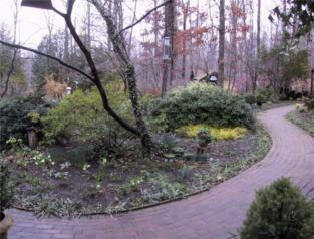 Pine Knot Farms is a wholesale
nursery specializing in plants for shady gardens, with emphasis on
“road hardy southern natives.” Owners Judith and Richard Tyler began
breeding “foreign” hellebores during the winter off-season some years
ago; as with so many gardeners, that pastime has turned into a
full-scale addiction. The greenhouses behind those lovely display
beds are brimming with vigorous, healthy hellebores of all persuasions,
from Ashwood Garden English hybrids in shades of yellow, red, slate
blue and dark purple to hand-crossed seedlings from hellebores grown in
Virginia author and photographer Pam Harper’s garden. Pine Knot,
an easy 90-minute drive from Durham and Chapel Hill, draws big crowds
during its Hellebore Days, an open house on two weekends in late
February and early March (just concluded). From March 15 through
June 30, retail customers may visit on Fridays and Saturdays from
10AM-4PM. Contact: Pine Knot Farms, 681 Rock Church Road,
Clarksville, VA 23927. Telephone: 434-252-1990.
Pine Knot Farms is a wholesale
nursery specializing in plants for shady gardens, with emphasis on
“road hardy southern natives.” Owners Judith and Richard Tyler began
breeding “foreign” hellebores during the winter off-season some years
ago; as with so many gardeners, that pastime has turned into a
full-scale addiction. The greenhouses behind those lovely display
beds are brimming with vigorous, healthy hellebores of all persuasions,
from Ashwood Garden English hybrids in shades of yellow, red, slate
blue and dark purple to hand-crossed seedlings from hellebores grown in
Virginia author and photographer Pam Harper’s garden. Pine Knot,
an easy 90-minute drive from Durham and Chapel Hill, draws big crowds
during its Hellebore Days, an open house on two weekends in late
February and early March (just concluded). From March 15 through
June 30, retail customers may visit on Fridays and Saturdays from
10AM-4PM. Contact: Pine Knot Farms, 681 Rock Church Road,
Clarksville, VA 23927. Telephone: 434-252-1990.
33.
Best Pho in the Triangle
On
gelid winter days we often find ourselves in the car heading
inexorably, like the needle of a compass pointing north, toward Kim
Son, a small Vietnamese restaurant tucked in amongst the fast food
joints on Guess Road in Durham. What we are craving is a steaming
bowl of pho, a robust, vividly flavored beef noodle soup often
eaten for breakfast in Vietnam--but we’ll eat Kim Son’s version any
time of day. As soon as we slide into a booth, we can hardly wait
for owner Ha Guthrie to arrive with pho dac biet: a deep, rich
beef broth, made from a long slow simmer of spare ribs and beef bones,
flavored with star anise and cinnamon, laden with rice noodles and
thinly sliced rare and well done beef, and meatballs. Alongside
is a plate piled high with sprigs of mint, broad-leafed Vietnamese
cilantro, bean sprouts, sliced jalapeno peppers and lime wedges.
The idea is to put lots of the above in your pho, then
add lashings of sriracha, a fiery red hot sauce and the sweeter,
plummy hoisin sauce. Now, the only other thing you need
is a bottle of Danang’s finest, Export 33 beer, or a refreshing glass
of pale coconut juice with a curl of young coconut in the bottom.
Kim Son (which means “Gold Mountain”) is owned by Ha Guthrie, who came to America to marry a Vietnam veteran she had met during the war. A former computer programmer trained in French and Chinese cooking, she opened the restaurant a few years ago; many of the recipes she prepares are from her own family’s repertoire. There are six varieties of pho on the menu; we can also recommend the hu tieu nam vang (dai), a delicious clear rice noodle soup with shrimp, crab, chicken and roast pork, and the spring rolls, delicate rice paper-wrapped shrimp, pork, vermicelli and vegetables with a peanut sauce for dipping. There are probably other good dishes on the menu, but we can’t seem to get past our favorites. Kim Son, 2425 Guess Road, Durham, 27705. Telephone: 919-416-9009.
32.
Best At-Home Bicycle Repair
James Whitaker is an enterprising cyclist who saw a
niche. A former racer and Category 4 State Champion, he was
managing bike shops in Durham and Chapel Hill when he noticed how
awkward it was for customers to load bikes into their cars and bring
them over for repairs. “They got their clothes dirty and
sometimes the bikes were damaged,” he recalls. “So I got the idea
of going to their homes to do the work.” In 1994, he launched
Bicycle Station, an at-home bike-repair service.
When you call Bicycle Station, Whitaker arrives in a red Volvo loaded with tools and bike racks. For us, he has assembled new bikes and reassembled old bikes twice in the last couple of years, and we’ve been pleased with the results. A serious cyclist, he not only does assembly and repair, but can give advice on what type of bike to buy and can custom build a bike from the frame up. What’s his own favorite? He rides a Lite Speed Titanium Vortex, but has an abiding affection for his old Eddie Merckx MX Leader. “It’s heavier,” he notes. “Heavy bikes hold up better after an accident.” Contact: James Whitaker, Bicycle Station. Telephone: Durham: 682-8845.
31. China Summit
This is the best and only Chinese restaurant worth its salt in the
Triangle. Chinese food here, as in most of the U.S., is somewhat
south of Chun King, an assault on civilization. Pao Lim Asian
Bistro and Bar is absolutely first class. Proprietor Craig Chen
comes to us from Calcutta, by way of New York and Winston-Salem.
His Chinese food has Indian accents but roots in his family's Hakka
tradition. First time out, try the Shrimp with Hot Garlic Sauce,
the Curry Fish, or the Chili Chicken. In any event, this
restaurant simply cements Durham's reputation as the food champion of
the Triangle. Pao Lim Asian Bistro and Bar. 2505 Chapel
Hill Blvd., Durham, NC 27707. 919-419-1771. Website: www.paolimasianbistro.com.
30. Best Gourmet Food Stores
c. The Fresh Market. This gourmet store is the place to go for the best meat and vegetables in the Triangle, and decidedly the most pleasant atmosphere, putting Wellspring and the other chains to shame. It's sort of a best-kept secret, without a website, with reluctance to converse with journalists, and with somewhat obtuse locations (nothing in Chapel Hill or Durham, for instance). That said, it has 31 locations across the Southeast, with more due to open soon. Founded by Ray Berry in 1980 after a career at 7-Eleven, the Greensboro chain has expanded carefully and profitably from the start, funding itself out of cash flow. The Fresh Market. 1261 Kildarie Farms Rd., Cary, NC 27511. Telephone: 919-481-2865. Also at 400 Woodburn Rd., Raleigh, NC 27605. Telephone: 919-828-7888. The second Raleigh location is at 6661 Falls of Neuse Rd., Raleigh, NC 27615. Telephone: 676-2939.
b. Fowler's. At its new location and under its new ownership, Fowler's is less a grocery store and wine emporium, more of a pleasant downtown location to have an interesting sandwich or expresso. The pre-made dishes in its case are a little more imaginative and tasty than other prepared-food options in Durham and Chapel Hill. It has a good ambience for relaxed, casual eating, and an occasional pleasant surprise in its cheese case. Fowler's. 112 South Duke Street. Durham, NC 27701. Telephone: 919-683-5555. Website: http://www.fowlersfoodandwine.com.
a. A Southern Season. Open since 1975, this store has a bit of everything, and no dominant position in anything. Drawing upon its ample amount of candy, one can cater to most sweet-tooths. And the wine department has more depth than most in the area; it is probably the store's real money-maker. The Weather Vane, its restaurant, ministers pleasantly to mature citizens in the area, who do not want much adventure in their food. A Southern Season. 1800 East Franklin, Eastgate Shopping Center, Chapel Hill, NC 27514. Telephone: 919-929-7133. Website: www.southernseason.com.
Update: The Café and More. A Southern Season has moved, lock, stock, and barrel, to sumptuous quarters that once housed a department store in University Mall, a key element in the revamp of this store complex. Some things are better; some a lot worse. Many customers do complain about the new digs, finding them confusing and less than charming. But the wine department, certainly the best in the Triangle and even renowned amongst quality distributors in other parts of the country, offers yet more stock and is probably a bit easier to get around. It is clearly the part of the store where the owner makes the most nickels. The deli department seems more ample, though it often can still take a light year to get your prosciutto or Black Forest ham sliced, even if you have ordered in advance.
The best feature of all is not the Weathervane restaurant, which used to be a real treat in the old store, but the café just beside it where you can secure faster service, some intimacy, and usually a minimum of hullabaloo. In January 2005, it opened for breakfast. The menu is poorly conceived, some of the help is a little scattered, and the satellite music may be raucous since store management is not watching over things early in the morning. Apparently it opens at 7AM Monday-Friday. With all its glitches, it’s still the best atmosphere around for breakfast or light lunch, and the expresso turns out to be better than that from Sta’ Bucks and the other chains. Other small improvements would help a lot: for instance, it now serves a low-rent jelly with its breadstuffs that could easily be supplanted with a good brand from the main store. Pick small a la carte items from the menu when having breakfast—a much safer bet.
29. Better
than Average Restaurants
A few of these have already made Best of the Triangle. Acme (#12) is best at stew-type things, while Bon's (#25), not too far away, has the leanest barbecue.
Scott Howells' Nana's (#11) is probably the best
restaurant in the whole region, earning special stars on fish and
vanilla ice cream. But it's time to fill out the list with a few
others, and we'll add more when the spirit moves us. We estimate
there about thirty that make the grade.
n. Four Square Restaurant. This restaurant has been around for half a decade, having opened its doors in 1999. Tucked away above Business 15-501, it is too easy to forget about. Perhaps its biggest distinction is that it clearly has the best website of any restaurant in the Triangle (see www.foursquarerestaurant.com), tastefully selling any and everything that can make this eatery seem like a special experience. It goes into the fact, for instance, that it is housed in the Bartlett Mangum House, now on the Historic Register, which hearkens back to an early merchant in Durham. On an occasion or two, we have met acquaintances there for a short drink, finding this bar a good place to end the day. One friend, who especially likes this restaurant, is able to wangle a sampling plate out of the chef each time, finding out that it is best to try just a bit of everything. At a chance meeting one day, we had wine and desserts with the owners, and found it to be a good way to get through a moody afternoon. In fact, they might add a leisurely dessert room to their restaurant as has one old-time Tampa steakhouse with much success. 2701 Chapel Hill Road, Durham, NC 27707. Telephone: (919) 401-9877.
m. City Ways Cafe. After a hiatus because of all the catering business, Anita Council now serves lunch again. Her sandwiches are just fine, the ambience is restful, and usually she has pleasant light jazz in the background. Homemade ice cream tops it all off. City Ways is also known as Cookie Bear Company (because of the take-out pastry) and Miss Council, from a Chapel Hill family known for restaurants, is also known as Spring. Someday she'll just call it Spring's. City Ways Cafe. 405 West Rosemary St., Chapel Hill, NC. Telephone: 919-942-9929.
l. The Flying Burrito. Sometimes public opinion is dead on. A favorite of town dwellers since it opened about fifteen years ago, this eclectic Chapel Hill locale serves up burritos and other tex-mex standards filled with non-standard ingredients like sweet potatoes. Popular to the point of inspiring fanaticism on the part of some locals, its bar is rarely quiet, as our webmaster--who contributed this entry--can testify to. Be forewarned, though: Around dinner time the wait can be arduous. Once you get a spot, make sure you try the hot salsa and don't forget to inspect the local artwork. The Flying Burrito. 746 Airport Rd., Chapel Hill, NC 27514. Telephone: 919-967-7744.
k. Akai Hana. Now the best Japanese restaurant in Chapel Hill-Durham area, though with a few cautions. On a Friday night, the waits can be long, and there's no place to wait. Foolishly, it has given up preparing take-out food. Pretty much stick to sushi and avoid cooked items that require fat or butter. Order mainstream, high-turnover items like tuna. That said, some of the staff is very willing, occasional music can be fun, and the sushi is generally fresher than that of other establishments. Edaname (soybeans) are good and simple here. A good side bet: if you're afraid of fish and high-cost sushi restaurants, try the vegetarian sushi in the concessions at many Harris Teeters. It is surprisingly good. Akai Hana. 200 West Main St. (opposite Chapel Hill Tire), Carrboro, NC 27510. Telephone: 919-942-6848.
j. Pop's. Two and two does not equal six. Put together by the owners of Magnolia Grill and Nana's, it does not have their virtues. But it's central, more modest price-wise, and somewhat more service-oriented. The simple picks are better; the more complicated dishes deserve a different hand than Pop's. Pop's. 810 West Peabody St. (next to Fowler's and a block away from Brightleaf Square), Durham, NC 27701. Telephone: 919-956-7677.
i. Vespa. The Chapel Hill restaurant has a somewhat fun atmosphere, with lively posters and Italian music. In addition to having the most sparkling atmosphere around, its sorbettos are delicious, standing out in a region that usually offers very average desserts. Vespa. 306-D West Franklin St., Chapel Hill, NC 27516. Telephone: 919-969-6600. Vespa Cary could probably use a little more work, but it's also one of the few alternatives there. 200 South Academy St., Cary, NC 27511. Telephone: 919-319-5656.
h. The Grill at Glen Lennox. Many don't know about this restaurant, but it's a good luncheon spot, and the owner, who formerly had a restaurant in Maine, knows a lot about the business. We like the salad Nicoise, but all the lunch items are decent as well. The Grill at Glen Lennox. 1201 Raleigh Rd. (Rt. 54), Chapel Hill, NC 27514. Telephone: 919-942-1963. Website: http://grillatglenlennox.citysearch.com.
g. Carrburritos Taqueria. Many of the Mexican restaurants in the area have chancy kitchens and struggling food. These folks prepare the food in the open, and it's simple and pretty good. We like putting fish in a tortilla, a pleasurable way to avoid cholesterol. You can get Cokes in a bottle, the Mexican way. Carrburritos. 711 Rosemary St., Carrboro, NC 27510. Telephone: 919-933-8226.
f. Taverna Nikos. Clearly this is the best value restaurant in the Chapel Hill-Durham area with fair pricing and well-prepared Greek fare. One could complain--but we never do--that there's too much to eat. In other words, you get a lot for your money. The proprietor always seems to be in attendance and tries to make one quite happy. Taverna Nikos. Brightleaf Square, 905 West Main St., #49. Durham, NC 27707. Telephone: 919-682-0043. Website: http://tavernanikos.citysearch.com.
e. Fins Restaurant. This is the fusion winner in the Piedmont. In northern Raleigh, it's a little hard to get to, it's a wait before you even get to sit down, and you feel a little fused to those sitting beside you. Fusion here means one brand of Asian or another linked to another linked to some Western motifs. Fins Restaurant. 7713 Lead Mine Rd. Suite 39, Graystone Village, Raleigh, NC 22615. Telephone: 919-847-4119.
d. 411 West. One of a chain of middlebrow restaurants (three in Chapel Hill, one on Raleigh), 411 is clearly the gem of the bunch. It's got the nicest atmosphere by far and a few finds on its menu. Salads are probably its best, followed by occasional fish specials. And Clark the pizza man is obviously dedicated to his craft, more so perhaps than the rest of the kitchen. 411 West. 411 West Franklin St., Chapel Hill, NC 27514. Telephone: 919-942-8757. Website: http://411west.citysearch.com.
c. 518 West. This is a Raleigh knock-off of 411. It's not as warm and much more noisy. It has virtually the same menu. Arrive early for lunch, because the parking is horrendous. 518 West. 518 West Jones St., Raleigh, NC 27605. Telephone: 919-829-2518. Website: http://www.518west.citysearch.com.
b. Fairview Restaurant. Part of Washington Duke Inn. This is probably the most pleasant luncheon spot around, because you get to peer out at the golf course, there's at least the pretense of space around you, and the floors are carpeted. When the company is right, you will want to take a walk around outside afterwards to work off the lunch and take the conversation to a higher level. Fairview Restaurant. 3001 Cameron Blvd. Durham, NC 27706. Telephone: 919-490-0999.
Update: Fair No More. We just went to the Fairview Restaurant at the Washington Duke and find it to be in decline. The hotel has been vastly expanded and now looks like one of those ungainly resorts in the western part of the state that are so gargantuan that management cannot get its arm around them. The restaurant, too, has been remodeled and moved, but bigger does not mean better. It used to be easy to see out on the course, one of the charms of the old Fairview. Now you have to be insistent about your seating to get a decent view. The service ranges from spotty to rude, not because the wait staff is not trying, but simply because it does not know how. The portabellos were simply soggy in one main dish, and the staff needs to learn about crabcakes. Only a steak, not too challenging for the cooks, was satisfactory. Buffet style desserts were simply pathetic. This restaurant used to be one of the Triangle’s best kept secrets—now it should be kept secret. (2/14/07)
a. Carolina Crossroads. Inside the Carolina Inn, this is the best ambience for breakfast in the region. The colors in the dining room are nice to wake up to, and the booths make for good conversation. Parking here is hassle-free, and the Christmas display of ginger-bread houses is larger testimony to the pleasant aura of the inn. Carolina Crossroads. 211 Pittsboro St., Chapel Hill, NC 27516. 919-918-2777. Website: http://crossroads.citysearch.com.
Update: Noise Pollution. Carolina Crossroads is a mixed affair, mostly because of less than adequate management. It and the Carolina Inn could do a much larger business if better engineers were running the railroad. It still remains a wonderful bright place to have a quiet sunny breakfast. In fact, that’s where we were when 9/11 unfolded in New York City.
The bar area has deteriorated, and we would recommend against eating there. It used to be a secret great place to have lunch: it was decorous and there were little adventures on the menu. Now you may find a couple of things that are all right. But there are now not one but two TVs blaring away in the room, with the sound much, much too loud. The new set has defaced the mantelpiece, and the wraparound sound system contributes to the diner’s misery, turning an inn into a backslapping sports bar. This is unlike its counterpart at the Washington Duke, where the sound is often turned off on the one set there. UNC, we gather, has recently mandated that Pepsi become the sole provider of soft drinks to the university, so the carbonated beverages have lost all their fizz and more. We dared to order a Pepsi in the bar recently: it was so watery that it had virtually no taste.
Noise pollution is an increasing problem in many food establishments around the Triangle, where the TV fare or music is often geared to the fancies of the help, and not the clientele. In fact, some owners would be surprised to hear what’s blaring in their establishments. (1/26/05)
28. Utopia, North Carolina
The utopian ideal--a perfect place to live and work--took root in
America almost from the moment the Pilgrims set foot on this continent.
Over the years, the notion has evolved in radically different
ways, from the Amish communities of Pennsylvania to hippie communes of
the sixties and more recently, planned communities such as Disney's
much maligned Celebration. North
Carolina State University in Raleigh took the concept in yet
another direction when it launched the adjacent 1,334-acre Centennial Campus to honor
the school's100th anniversary. With $340 million invested in
facilities and infrastructure to date, the campus is becoming what NCSU
ultimately envisions as a "technopolis": a neighborhood
integrating university, corporate and government R & D facilities
with residential condominia, a magnet school, a conference center,
restaurants and shops, and an 18-hole golf course, all linked by
pedestrian trails. In another decade, a monorail will connect the
campus to Durham and Research Triangle Park.
The project is unique in various ways. An initiative by former Governor Jim Hunt cut through restrictive North Carolina law, enabling local, county and state government bodies to work cooperatively with private enterprises. One of the few public sites in the state that has an integrated architectural plan, the handsome brick campus is said to have been much influenced by noted Canadian architect, Arthur Erickson, a fervent proponent of mixed use communities. (For an interview with Arthur Erickson, see www.hillside.ca/twochairs/twochairs.htm.) Every new building must meet "human scale" standards and must adhere to architectural guidelines laid out in a detailed master plan. The rise of the Centennial campus signals the shift of the state's business center from Charlotte to Raleigh, and, we would add, suggests a development model for other North Carolina towns with university facilities and a hunger for a New Economy.
Already, Centennial has an international patina. Amongst the major global players is ABB, traditionally a manufacturer of heavy electrical equipment, based in Switzerland. Divisions of Lucent, Eastman Kodak, and Analog Devices have become "resident partners," as have a host of small high-tech start ups and various government agencies such as the U.S. Department of Agriculture and the U.S. Forest Service. What these 70 partners see at Centennial is the opportunity to tap into an intellectual gene pool, to collaborate with faculty and graduate students on innovative products and processes. What may keep the partners on campus is a people friendly environment promoting the free exchange of ideas that makes real innovation possible.
27. Best Chapel Hill Auto
Repairs
On a recent occasion, this shop more than made good when a question was
raised about some previous repairs. That's the test of any
businessperson: what do you do when something goes wrong, though
perhaps through no fault of your own? James Spurling has run
Eastgate BP since 1984 and became owner in the 1990s. Being
honorable and conscientious,
he has a very busy establishment. You are wise to carry his AAA
number in your wallet in case of a breakdown, so that you can direct
the car to be taken to his shop. One benefit of doing business
there is that you are likely to run into UNC football and basketball
coaches around the coffeepot. We also have it on good faith that
Mr. Spurling knows a few rather famous musicians. That coffee
pot, it seems, can get pretty crowded at times. Eastgate
BP. Eastgate Shopping Center on 15-501. Telephone:
919-929-3222.
Update: Spurling Retires
We
learn that James Spurling retired on April 1, 2005. Already, we
find, BP Eastgate BP has become a much less responsive vendor, even on
routine inquiries. We would advise potential customers to
approach it with great caution. (6/1/05)
26.
Babette's
In
the Triangle, most of the eating spots worth visiting are clustered
fairly close to town, be it Durham, Chapel Hill, or Raleigh. But
now some of the blank spots are getting filled in, and you have a new
halfway point between Raleigh , the Research Park and Chapel Hill as
you make your way on Interstate 40. At Exit 276, perhaps a mile
past the Rte 54 stoplight on Fayetteville Road, you will find
Babette’s, somewhat lonely in a new set of structures that are having a
hard time finding tenants. That’s all to the good because it
means you will find both quiet and good parking there. Babette’s
is named after the movie Babette’s Feast,
but be assured the connection is in name only. This is a sandwich
place with reasonable prices, but it also has light and very well
prepared luncheon fare that is fairly priced and full of value.
The restaurant is the handiwork of Devon Mills, a local cook who’s been
at the Weathervane, 411, Magnolia, etc., and, because of that
experience, clearly understands the price point this region will
tolerate. We had a small piece of grilled salmon set in quite a
salad bed, and this was surely all the lunch one ever needed.
Somewhat unique in this area, the restaurant has ample tables
(including some outside seating) and an open room amply lit by clear
large windows. For a change one does not feel cramped. As
other places, such as NOFO, that offer a price conscious lunch,
the dinner menu is more ambitious, but still not off the charts.
Saturday nights often include some jazz. Babette’s. 5826
Fayetteville Road. Durham, NC 27713. Telephone: (919)
544-8880. Website: www.babettes.net.
Home - About This Site - Contact Us
© Copyright 2007 GlobalProvince.com