|
122. Bill Gates Promotes Technology to
Better Inform Patients and Doctors
The Wall Street Journal
05 October 2007
|
|
In a recent
Wall Street Journal Opinion piece, Bill Gates put his blueprint, and by
association Microsoft’s, on how to improve our nation’s health-care system
at a time when “knowledge . . . is expand(ing) at a speed that is without
precedent in human history.” He notes that despite the expanding knowledge,
our inability “to deliver consistent, high-quality care” has led to “billions
of dollars spent each year on redundant tests and prolonged illnesses and
avoidable injuries that result from medical errors.”
Pointing to an
Institute of Medicine study “urg(ing) swifter adoption of information
technology and greater reliance on evidence-based medicine,” Mr. Gates sees
an “information-dependant,” “data-rich industry” crying out for information
technology solutions that would make it possible “for your doctor to
assemble a complete picture of your health and make fully informed treatment
decisions.”
|
|
Acknowledging
that informed patients are equally important to informed doctors, Mr. Gates
writes, “What we need is to place people at the very center of the
health-care system and put them in control of all of their health
information.” He further states, “Putting people at the center of health
care means we will have the information we need to make intelligent choices
that will allow us to lead healthy lives -- and to search out providers who
offer care that does as much to help us stay well as it does to help us get
better.”
Health Dialog
is committed to improving the flow of information to patients, including via
the Internet, in order to help them become better, more informed consumers
of the many choices being presented by our advancing health care industry.
|
|
return to top of Briefs
--
return to top of this page
--
return to globalprovince.com
|
|
121. Health Dialog to Provide Care Management
Services to Capital Health Plan of Tallahassee, Florida.
Health Dialog press release
23 August 2007
|
|
Health Dialog will begin providing whole-person care management services to
113,000 commercial and Medicare members and dependents covered by Capital
Health Plan of Tallahassee, Florida. Services include Health Coaches,
“nurses, dieticians, and respiratory therapists, who work with individuals
and their family members telephonically and online to help them manage
chronic conditions, significant medical decisions, and general health and
wellness concerns. Using a Shared Decision-Making® approach, Health Coaches
are available 24/7 to help individuals understand the total picture of their
health, as well as risks, benefits, and outcomes of various treatment
options, so they can gain the skills and self-reliance necessary to work
more effectively with their physicians.” Members will also have “access to
award-winning educational resources in
|
|
print, audio, video, and online. The Dialog CenterSM, Health Dialog’s
member-facing website, provides individuals with a variety of tools,
including detailed health information through the Healthwise® Knowledgebase,
decision aids to support assessment of treatment options, and a suite of
online health & wellness modules that address issues such as back pain,
smoking cessation, nutrition improvement, weight management, fitness and
exercise, and stress management.” Physicians will have access to Health
Dialog’s industry-leading SMART® Registry tool. This reporting component
provides primary care physicians with actionable clinical information.
Reports generated for physicians through the SMART® Registry include patient
reports, practice reports, and peer-comparison reports.”
|
|
return to top of Briefs
--
return to top of this page
--
return to globalprovince.com
|
|
120. RAND and Health Dialog Collaborate On New
Healthcare Quality and Efficiency Tools.
Health Dialog press release
6 August 2007
|
|
Health Dialog has announced that it will be joining forces with the
Rand
Corporation in order to bring to market “a new provider performance
measurement system that will provide best-in-class capabilities for
measuring quality and efficiency in the U.S. healthcare market.” In 2003,
the RAND Corporation published in the New England Journal of Medicine a
landmark “study of the quality of health care provided in the United
States.” Resulting QAScoresTM were derived that essentially found “that
adults in the United States receive only about half of the recommended,
evidence-based care for the leading causes of illness, disability, and
death.” According to the agreement, Health Dialog will be
|
|
licensing the “vast repository of quality measures and the associated
scoring and attribution methodologies developed by RAND.” According to
George Bennett, Health Dialog Chairman and CEO, “This alliance brings
together two organizations that are leading efforts to improve the quality
and efficiency of healthcare in the United States and abroad. The
integration of our respective knowledge, research, and experience will
enhance our best-in-class healthcare-related measurement tools and further
strengthen our ability to continue to bring innovative and differentiated
care management products to our clients.”
|
|
return to top of Briefs
--
return to top of this page
--
return to globalprovince.com
|
|
119. Health Dialog Bolsters Health & Wellness
Offering
Health Dialog press release
1 August 2007
|
|
Health Dialog has announced that the three founding partners of Crimson
Health Solutions and the company’s intellectual property has been
assimilated into Health Dialog’s health and wellness initiative, Healthy
Living Solutions (HLS). HLS uses telephone, online and print resources to
“support behavior change management” in order to “lower the risk of
developing costly medical conditions.”
Dr. Elizabeth Barbeau, Crimson’s CEO, Gary Bennett, PhD, who served as Chief
Scientific Officer, and Cathy Hartman, MS, Crimson’s Chief Operating Officer
founded Crimson Health Solutions based on academic research conducted at the
Harvard School of Public Health and
|
|
Dana-Farber Cancer Institute. They will “bring a wealth of knowledge in the
field of wellness research and behavior change.” George Bennett, Chairman
and CEO of Health Dialog, believes that Crimson's “whole person philosophy
make(s) it a perfect match for Health Dialog.”
Healthy Living Solutions “follows the same basic tenets as (Health Dialog's) total care
management solution - whole person, total population care management
solutions built on the underlying philosophy that informed, motivated
individuals who fully participate in their own health management are
critical to affordable, high-quality healthcare, as well as improved health
status and productivity.”
|
|
return to top of Briefs
--
return to top of this page
--
return to globalprovince.com
|
|
118. New Mexico Public Schools Insurance Authority
Renews Care Management Agreement with Health Dialog
Health Dialog press release
7 May 2007
|
|
The New Mexico Public Schools Insurance Authority (NMPSIA) has decided to continue
offering Health Dialog’s “whole person care management services, including
Health Coaching support, to more than 60,000 employees and dependents.”
Sammy Quintana, Executive Director for NMPSIA comments, “Our employees tell
us they are quite pleased with their health coaching interactions, and
continue to become better educated about taking a proactive role in their
|
|
healthcare. Our continued collaboration with Health Dialog supports our mission to provide quality,
cost-effective benefits to our employees.” Health Coaches use Health
Dialog’s Shared Decision-Making® methodology “to help individuals understand
the total picture of their health, as well as risks, benefits, and outcomes
of various treatment options, so they can gain the skills and self-reliance
necessary to work more effectively with their physicians.”
|
|
return to top of Briefs
--
return to top of this page
--
return to globalprovince.com
|
|
117. Health Dialog Recognized As One Of
Massachusetts’ Fasted Growing Private Companies
Health Dialog press release
19 April 2007
|
|
The Boston Business Journal has named Health Dialog one of the fastest
growing private companies in Massachusetts with an overall seventh place
ranking among companies with more than $100 million in revenues. The award
was based on Health Dialog’s 265% sales growth rate from 2003 to 2006, and
it was the second year in a row Health Dialog was spotlighted. The company’s
Chairman
|
|
and CEO Mr. George Bennett commented, “Our company’s success is based on the
idea that when people are empowered with tools that enable them to actively
participate in their healthcare, they will make educated choices that will
improve their health. This honor is a testament that what we are doing is
working for both our clients and their members.”
|
|
return to top of Briefs
--
return to top of this page
--
return to globalprovince.com
|
|
116. Company Wellness Programs Expand Incentives to
Reach More Employees
The Wall Street Journal; page
D1; by M.P. McQueen
28 March 2007
|
|
Wellness programs are offered by insurance providers as a means of
encouraging healthy behavior and lifestyles. Initially, such programs were
offered to smokers and others who might benefit from noticeable changes, but
programs are expanding to cover those who are already living healthy
lifestyles. Part of the expansion is due to the government getting involved
and formulating a number of guidelines to ensure fairness and
non-discrimination. But the larger driver is economics.
|
|
As M.P. McQueen reports, “More companies are adopting wellness programs as
evidence mounts that the programs can help control overall health-care
costs.” Dr. Brent Pawlecki of Pitney Bowes is quoted, “This is our first
year of doing this. But we have been able to show that for every dollar we
have spent on health-improvement programs we save $2 to $3 in health-care
savings and productivity costs.”
|
|
return to top of Briefs
--
return to top of this page
--
return to globalprovince.com
|
|
115. Wall Street Transcripts Highlights $43 Billion
Worldwide Opportunity of Disease Management
The Wall Street Transcript
28 February 2007
|
|
Wall Street Transcript recently published an in depth analysis of the Health
Facilities and Services industry, including the disease management sector.
In a brief
excerpt from the report, Brooks O’Neil of Dougherty & Company, LLC
comments on the “number of new initiatives in the marketplace that we think
have the potential to drive really substantial changes in the way health
care is delivered in this country.” He offers the overarching perspective
that there’s a general trend toward more individual responsibility
indicative of a “consumer-driven system.” He sees it as a “fundamental
change and it is one that will continue to ripple through the health
services over the next five or 10 years.”
Another major trend is the growing acceptance that something has to be done
about the fact that “a small percentage of the people drive the lion's share
of cost in health care today. Specifically, the data suggests that 5% to 10%
of the people account for 70% of health spending annually. So 5% of the
|
|
people account for a little over $1.4 trillion of spending each year. It is
not always the same people, but the data suggests that the majority of those
people are affected with chronic as opposed to acute illnesses. These are
illnesses such as heart disease, diabetes, cancer and asthma - illnesses
that affect individuals both today and over the rest of their lives.” He
notes that a number of companies are developing new ways to support patients
with chronic conditions, including greater prevention. Mr. Brooks estimates
that the commercial U.S., government U.S. (Medicare/Medicaid) and
international sectors represent annual markets of $8 billion, $12-$15
billion and $20 billion, respectively. He believes that “identifying the
people who are the heaviest health services utilizers and working very
diligently to figure out how to deliver high quality care to them more cost
effectively is necessary. I absolutely believe it is an enormous market
opportunity.”
|
|
return to top of Briefs
--
return to top of this page
--
return to globalprovince.com
|
|
114. Microsoft Acquisition Puts It Deeper in Health
Info Business
The New York Times; by Steve Lohr
27 February 2007
|
|
Steve Lohr of The New York Times considers Microsoft’s acquisition of
Medstory as but the latest evidence of companies trying to capitalize on the
“rising traffic at consumer health sites on the Web.” Medstory is developing
“search software that applies artificial intelligence techniques” in an
effort to pull together pertinent health information. Others in the Internet
healthcare space include WebMD,
RevolutionHealth.com, a start up financed by
Stephen Case of AOL fame, Healthline
Networks, a creator of search sites for Merck, PacifiCare and others,
and Google. They are all seeking to capitalize on what is referred to as
|
|
“consumer driven healthcare.” Mr. Lohr describes consumer driven healthcare as a
trend, driven by “shifts in demographics, economics, technology and policy”
whereby individuals will take an increasingly larger role in their
healthcare decisions. “Aging baby boomers, accustomed to personal choice and
to technology, tend to want a say in their treatment decisions.” The
Internet, already an important resource, will play an increasingly important
role in helping patients with their healthcare decisions. Health Dialog has
integrated the Internet into its service offerings.
|
|
return to top of Briefs
--
return to top of this page
--
return to globalprovince.com
|
|
113. Hospitals Improve Patient Experience with
Education and Outreach
The Wall Street Journal; page
D3; by Laura Landro
07 February 2007
|
|
While much of the debate surrounding healthcare focuses on insurers and doctors,
Laura Landro points out in a recent Wall Street Journal article that hospitals
are also finding the benefits of better educated consumers. While most acknowledge
that Hospitals have given lip service to consumer satisfaction surveys, only
recently have hospitals begun to really implement changes focusing on
consumer satisfaction. Using a “family-centered care” model, hospitals are
seeking ways to better inform patients about treatments and provide
follow-up contact after patients have arrived at home. This model of better
informed patients and active outreach by providers appears to be gaining
|
|
momentum. Ms. Landro
writes, “Increasingly, the survey findings are leading hospitals to adopt
the family-centered-care approach, which advocates building strong
partnerships with patients and their families to improve care.” Some of the
impetus for improvement is coming from a federal government requirement that
requires hospitals for the first time to participate in a patient
satisfaction survey in order to receive full reimbursement from Medicare.
But there is also a simple recognition that the environment is increasingly
competitive and “evidence that recommendations from friends and family
influence health-care choices.”
|
|
return to top of Briefs
--
return to top of this page
--
return to globalprovince.com
|
|
112. The Health Care Blog: Healthcare Trends and
Reform
The
Health Care Blog;
Hosted by Matthew Holt
05 February 2007
|
|
The Health Care Blog (THCB) was
started in October 2003 by Matthew Holt, an experienced healthcare industry
observer who’s garnered a reputation as an insightful industry researcher
and forecaster. According the web site, “The Wall Street Journal calls (THCB)
“among the most widely read insider publications in the field.” WebMD calls
the site “a free-wheeling discussion of the latest healthcare developments.”
Recent entries that have attracted attention include pieces on the Bush and
California health plans. Following is an excerpt from another entry written
for ABCNews titled, “Why
is Fixing American Health Care so Hard?”
Reforming Care Delivery?
Meanwhile, the health care provider industry is currently awash with new
ideas about improving the quality and cost-effectiveness of the care it
delivers. It is well-known within academic health care
|
|
circles that somewhere between one-third and two-thirds of all care
delivered is inefficient and unnecessary.
A huge body of research conducted at Dartmouth under John Wennberg shows
conclusively that patients with similar conditions receive significantly
different treatment depending on which area of the country they live in and
which doctors they see. Even worse, it appears that the more that gets done
to patients, the worse are their outcomes. But, of course, no physician or
hospital believes that it is the one providing the inefficient or
unnecessary care — it's those other guys who are at fault.
Meanwhile, the medical industrial complex continues to invent more and
more high-tech procedures, devices and pharmaceuticals — all of which come
at a higher and higher cost. And why not, as the people who write the checks
keep paying.
|
|
return to top of Briefs
--
return to top of this page
--
return to globalprovince.com
|
|
111. Employers Seek to Tame Healthcare Costs.
The Wall Street Journal;
by David Wessel, Bernard Wysocki Jr. and Barbara Martinez, page A1
29 December 2006
|
|
As healthcare costs have risen to
“16.5% of the nation’s economy,” employers are “urgent . . . to squeeze out
the waste connected with middleman – without squeezing the valuable services
they can provide.” And, indeed, they can provide valuable services,
including combined purchasing power, “harvest(ing) data to uncover” valuable
new procedures and a general expertise beyond employers’ capabilities.
Structural issues also encourage the use of middlemen such as their use by
Medicare and the healthcare industry’s fragmented nature leads to a need to
deal with multiple providers. But some companies are fighting to control
costs with some success.
Contracting directly with
hospitals and doctors is an option for those companies who are sufficiently
|
|
concentrated in and important
enough to the local community. Perdue Farms is one example; they’ve been
able to corral costs by dealing direct, including the offer “to pay bills
within eight days, much quicker than the 60- to 70-day norm in healthcare.”
It also uses “in-house clinics” to help identify employees with chronic
diseases such as Diabetes and high blood pressure. As a result, their
healthcare costs are “rising more slowly than other employers and run(s)
less than half of the national average.” Others are demanding greater
transparency from their middleman; Caterpillar was able to reduce its
spending on pharmaceuticals by over 5% by asking their pharmacy benefits
manager to provide transparent drug costs.
|
|
return to top of Briefs
--
return to top of this page
--
return to globalprovince.com
|
|
110. US Health Benefit Costs Rise 6.1% in 2006.
Mercer Health & Benefits LLC
20 November 2006
|
|
Mercer Health & Benefits recently
reported that a three-year trend that saw the growth rate in employer health
care costs decline came to an end in 2006 when the “total health benefit
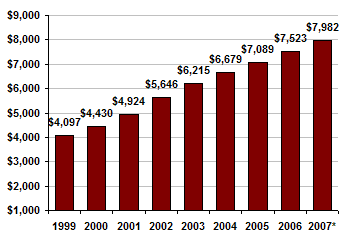
cost rose by 6.1% … to an average of $7,523 per employee.” Employers expect
health care costs to jump an additional 6.1% in 2007. The Annual Mercer
survey, “With nearly 3,000 employer participants,” is the “largest and most
authoritative annual survey(s) on” the cost of healthcare. Among the
highlights, Mercer points out that small employers were hardest hit by a
7.0% rise, and enrollment in “consumer-directed plans triple(d).” Mercer
also spotlights a trend toward “employers … breaking from traditional
cost-shifting (to) focus on tactics to
|
|
improve employee health and make
them better health care consumers.” In 2006, employers increasingly embraced
the use of “health risk assessments, now offered by 22% of all employers and
53% of large employers.” Fully 79% of employers who’ve attempted to measure
their return on investment in care management are “satisfied or very
satisfied.” “Asked to rate the importance of six cost management strategies
to their organization over the next five years, care management and
consumerism were each rated important or very important by 43% of all
employers (and about two-thirds of those with 500 or more employees).”
|
|
return to top of Briefs
--
return to top of this page
--
return to globalprovince.com
|
|
109. Health Dialog to Provide Care Management
Services to Integrated Healthcare.
Health Dialog press release
04 December 2006
|
|
Health Dialog
has agreed to provide care management services to
Integrated Healthcare, a provider
of a “fully
integrated, point & click-based consumer-driven health platform for small to
mid-sized companies.” Health Dialog’s Health Coaches, decision support
videos, Healthwise Knowledgebase, member web site, and audio programs
“will be integrated with other information tools and financial
|
|
incentives
such as health savings accounts, health risk assessments, smoking cessation
programs, and weight management.” Daniel Boisvert, President of Integrated
Healthcare, comments that by combining his firm’s “innovative consumer-driven
healthcare platform” with Health Dialog’s “state-of-the-art care management
services, we’re setting the standard for produce offerings in our industry.”
|
|
return to top of Briefs
--
return to top of this page
--
return to globalprovince.com
|
|
108. Health Dialog Expands Relationships with Blue
Cross Blue Shield of Florida and Begins Trial Study With Massachusetts General Hospital.
Health Dialog Press Releases
November 28, 2006 release: Blue Cross Blue Shield of Florida
November 29, 2006 press release: Massachusetts General Hospital
|
|
November 28, 2006 release:
Blue Cross Blue Shield of Florida
(BCBSF ) has expanded its affiliation with Health Dialog by agreeing to make
Health Dialog’s whole person care management services available to all of
its “two million commercially insured members.” The agreement will increase
the number of participants by 400,000. According to Bill Kerr, MD, Vice
President and Chief Medical Officer of BCBSF, the decision to renew was
based on “clear” evidence that Health Dialog’s Health Coaches, steeped in
the firm’s Shared Decision Making approach, are “effectively support(ing)
our members” with a “multi-cultural outreach strategy (that) effectively
engage(s) individuals within the context of their own culture.” George
Bennett, Chairman and CEO of Health Dialog, is “excited” about building on
the last four years that have seen Health Dialog and BCBSF work together to
improve healthcare quality while reducing costs.
November 29, 2006 press release:
Health Dialog has expanded its
role in demonstration projects sponsored by the Centers
|
|
for Medicare and Medicaid
Services via its agreement to support Massachusetts General Hospital (MGH)
in a project targeting high cost Medicare beneficiaries. “The three-year
demonstration is intended to test the ability of direct-care provider models
to coordinate care for high-cost/high-risk beneficiaries by providing them
with clinical support beyond traditional resources.” In addition to training
MGH’s case managers in Health Dialog’s whole person collaborative care
approach, Health Dialog will also be assisting with data analysis and
reporting. According to Dr. Timothy Ferris of MGH, the focus of this program
is to improve the care and control the costs of addressing a broad spectrum
of healthcare needs, “especially critical when dealing with Medicare
beneficiaries facing multiple, complex medical issues. We hope to make great
progress with these patients through regular communication with nurse case
managers to ensure that their many needs are being met. The ability to
collect, organize, analyze, and report the information will be essential to
determine the impact of this effort.”
|
|
return to top of Briefs
--
return to top of this page
--
return to globalprovince.com
|
|
107. NIH Funded Study Examines Patient Benefit to
24/7 Doctor/Nurse Access.
The Wall Street Journal;
by Andrew Lavallee, page D1
28 November 2006
|
|
In a review of a “clinical study
at the University of Pittsburgh
School of Nursing, funded by the National
Institutes of Health,” Wall Street Journal reporter Andrew
Lavallee speaks to the potential advantages of better informed patients; in
this case, by patients availing themselves of private message boards via the
Internet to stay in touch with doctors and nurses. The study is focusing on
patients with ovarian cancer due to its lower survival rate than more
prevalent cancers such as breast or cervical cancer, and it has a high level
of recurrence and multiple symptoms. As a result, ovarian-cancer
|
|
patients stand to benefit from
having 24/7 access to qualified nurses who are ready to go beyond the
“typical 15-minute clinic appointment” where doctors are more focused on the
diagnosis and treatment of the actual cancer. Issues of fatigue, mouth
soreness, hair loss and general issues relating to quality of life can be
more fully pursued via the online communications. Heidi Donovan, an
assistant professor at the school and head of the study also suggests that
there might be cost savings should fewer and more productive “calls and
appointments with doctors” result.
|
|
return to top of Briefs
--
return to top of this page
--
return to globalprovince.com
|
|
106. Disease Risk Calculator.
The Wall Street Journal;
by Tara Parker-Pope, page D1
31 October 2006
|
|
For The Wall Street Journal’s
Health Journal section, Tara Parker-Pope reviews a diagnostic, healthcare
web site created by the Harvard Center for Cancer Prevention;
www.yourdiseaserisk.com. She
writes that in addition to providing the generalized disease information of
many web sites, the Harvard site, “has found a way to provide customized
information to help patients better understand their personal health and
risk for disease.” Furthermore, it generates “a tailored action plan on ways
to lower risk for health problems.”
The American Heart Association and the
National Cancer Institute
offer risk calculators, but they fall short of the scope of the Harvard site
|
|
that extends to “healthful
behaviors like exercise, fruit and vegetable intake, and regular wine
consumption.” Ms. Parker-Pope notes that, “The Harvard Web site allows users
to calculate their risk for developing 12 different cancers, as well as
heart disease, stroke, diabetes and osteoporosis.” She concludes with the
“best thing” about the site, it provides “a customized action plan showing
how you can alter your risk through lifestyle changes, such as increasing
vegetable consumption, exercising more, taking calcium supplements or a
multivitamin, stopping smoking or changing alcohol habits.”
|
|
return to top of Briefs
--
return to top of this page
--
return to globalprovince.com
|
|
105. Hospitals and Uninsured Benefit from
Preventive Care.
The New York Times;
by Erik Eckholm
25 October 2006
|
|
Erik Eckholm writes in the New York Times on the emerging trend in hospitals
toward preventive care. Hospital administrators, seeking ways to slash the
costs of providing treatment to the uninsured, are beginning to embrace the
quality improvement and cost savings that accompany preventive care,
particularly when there is active outreach to help patients understand and
implement their course of treatment. The Seton Family of Hospitals, for
example, was able to reduce one patient’s medical bill by more than 45% or
$86,580 over an 18-month period by providing preventive care,
|
|
including an insulin pump and “access to an endocrinologist and home
counseling …” In a Seton program to “educate 631 asthma patients, (they)
saved the plan $475,000 in one year.” The Denver public hospital system has
found “that
for every dollar they spend on prenatal care for uninsured women, they save
more than $7 in newborn and child care (costs).” Health Dialog provides a
wide range of tools, including experienced Health Coaches, that facilitate
collaboration between patients and doctors that leads to improved outcomes
and cost savings.
|
|
return to top of Briefs
--
return to top of this page
--
return to globalprovince.com
|
|
104. Care Management Services for The New Mexico
Public Schools Insurance Authority.
Health Dialog press release
16 October 2006
|
|
The New Mexico
Public Schools Insurance Authority (NMPSIA)
has chosen to make Health Dialog’s “whole person care management services,
including Health Coaching support across a broad spectrum of healthcare
needs,” available to its more than 60,000 members and dependents. According
to Sammy J. Quintana, Executive Director of NMPSIA, “Health Dialog is
providing us with a truly
|
|
impressive
program. Employees and dependents covered by the program can benefit from a
broad array of care management resources, designed to motivate and educate
them to take a proactive role in their healthcare. Our collaboration with
Health Dialog supports our mission to provide quality employee benefits in
the most cost-effective manner.”
|
|
return to top of Briefs
--
return to top of this page
--
return to globalprovince.com
|
|
103. Health Dialog’s Medicare Pilot Program Hits
One-Year Milestone
Health Dialog press release
11 September 2006
|
|
On August 15,
Health Dialog celebrated the one-year anniversary of its participation in a
Medicare pilot program being offered to more than 20,000 Medicare
beneficiaries living in western Pennsylvania. According to Mark McClellan,
Administrator of the Centers for Medicare and Medicaid Services, “This
program is designed to help the chronically ill stay on a healthy path to
managing their diseases effectively. By providing them with regular
one-on-one interactions with nurses, beneficiaries can prevent many ill
effects that may result from not managing their health. This, in turn, saves
on healthcare costs by keeping the chronically ill healthier and out of the
hospitals.” The program, expected to go for three years, is already meeting
with encouraging results. According to
|
|
George
Bennett, Chairman and CEO of Health Dialog, “We are more than pleased with
what we have seen in the first year and are confident this trend will prove
even stronger as we continue our focus of strengthening patient-physician
communication and improving beneficiaries’ understanding of chronic
conditions and treatment regimens.” And according to one beneficiary’s
spouse, "Since the start of the program my wife's Health Coach has helped
her understand and comply with her physician's plan better. Every little
thing you do matters. Her Health Coach helps her know what she has to
accomplish and if you have a goal to reach, you can reach it! It is
excellent that Medicare offers this program."
|
|
return to top of Briefs
--
return to top of this page
--
return to globalprovince.com
|
|
102. Health Dialog Offers Whole-Person Care
Services Through State Health Plan of North Carolina
Health Dialog press release
06 August 2006
|
|
Health Dialog will begin offering its Health Coaching and support services
to nearly 500,000 members covered by the
State Health Plan of North Carolina. Health Dialog’s whole-person,
care-management services, according to Nancy Henley, MD, Medical Director
for the State Health Plan, “gives our members the support they need to
understand all of their conditions, including how they may interrelate, so
that they can become more
|
|
skilled and confident in managing their healthcare.” Whole-person services
include access to trained Health Coaches – nurses, dieticians, and
respiratory therapists – as well as online, print, audio/video, and DVD
educational resources. George Bennett, Health Dialog Chairman and CEO,
observes, “With the amount of information available today about conditions
and treatment options, healthcare consumers can easily become overwhelmed.”
|
|
return to top of Briefs
--
return to top of this page
--
return to globalprovince.com
|
|
101. Health Dialog and American Re HealthCare Enter
into Strategic Alliance
Health Dialog press release
05 June 2006
|
|
Health Dialog has agreed to begin offering “a range of customized innovative
risk-based care management products to health plans, self-insured employers,
Medicare and Medicaid plans, and Section 646 plan providers” of American Re
HealthCare, “a division of American Re-Insurance Company, a member of the
Munich Re Group
|
|
(and) one of the world’s largest reinsurance organizations.” As part of the
alliance, American Re will insure/reinsure Health Dialog’s clients that
promised levels of medical cost and quality outcomes will be achieved, thus
providing “additional assurance to Health Dialog’s clients that targeted
performance savings will be realized.”
|
|
return to top of Briefs
--
return to top of this page
--
return to globalprovince.com
|
|
100. Health Dialog Recognized by Forrester Research
as Leader in Integrated Health Management
Forrester Research; by Jennifer Gaudet with Bradford J. Holmes and
Will McEnroe
07 June 2006
|
|
In a recent report on changing healthcare standards, Forrester Research has
highlighted new metrics being used to evaluate patient care; particularly as
relates to the evolution from Disease Management (DM) to Integrated Health
Management. The report contrasts a “one-person, one-illness paradigm” of DM
with a broader program that “integrate(s) data from disparate sources,
coordinate(s) communications across health, wellness, and lifestyle
programs, and deliver(s) interventions that address members' whole health
needs.” The report highlights the contributions of Health Dialog, commenting
that the company has set a “high bar … with its innovative practices.”
Health Dialog’s peers have identified the company as one that is well along
the “learning curve.” Specific capabilities/techniques that help Health
Dialog differentiate itself include a whole-patient approach that engages
patients via coaches that “deliver interventions on members’ most pressing
health and lifestyle issues, regardless of what
|
|
disease bucket they fall into. Another is the ability of members to track
their care treatment programs, in what Forrester refers to as “visibility,”
by being able to exchange data files with plans and/or other partners and by
facilitating client access via a health coach dashboard. Health Dialog plans
on rolling out new visibility capabilities in the fall of 2006. Coordinating
with other, third-party providers is a third area of differentiation.
“Health Dialog uploads partner files directly into its system and uses this
data to help determine member inclusion, exclusion, and priority outreach.”
Forrester also highlights Health Dialog’s ability to use real-time data in
order to improve “timeliness” and its relationship with
HealthMedia to better target high-
and low-risk members for better “cost effectiveness.” Generally speaking,
prospective healthcare partners need to be open to sharing data and be
capable of leveraging the data to better effect healthcare outcomes.
|
|
return to top of Briefs
--
return to top of this page
--
return to globalprovince.com
|
|
99. More Medicine Does Not Equal Better Care
BusinessWeek online; by John Carey
29 May 2006
|
|
In one of several articles that BusinessWeek online recently
published on the state of the nation’s healthcare system, John Carey
summarizes the findings of The Dartmouth Medical School’s and Dr. Elliot S.
Fisher’s research into the “paradoxical conclusion” that more medical care
does not correlate with better patient outcomes. In fact, Dr. Fisher states
“it looks like there is a substantially increased risk of death if cared for
in high-cost systems.” According to Mr. Carey, George Bennett, CEO of Health
Dialog, a company that helps individuals better understand their medical
issues and become more engaged in managing their healthcare with their
physicians, suggests a supply-driven problem by commenting, “A large portion
of those extra costs are due just to proximity to health
|
|
care.” Dr. Jack Paradise, a professor of pediatrics and otolaryngology at
the Pittsburgh School of Medicine and Children's Hospital of Pittsburgh,
suggests, in addition, that one cannot rule out the inherent conflict of
interest created by “enormous financial incentives to provide more and more
care.”
According to Mr. Carey:
“Researchers at the Center for the Evaluative
Clinical Sciences at Dartmouth Medical School have looked in detail at what
happens in the last six months of life at 77 top hospitals in the U.S. The
results were startling: The average number of days spent in the hospital
during the last six months of life was 10.1 days at Stanford University
hospital compared to 27.1 days at New York University Medical Center. The
average number of doctors visits ranged from 17.6 to 76.2, with NYU at the
top.”
|
|
return to top of Briefs
--
return to top of this page
--
return to globalprovince.com
|
|
98. Health Dialog Among Massachusetts' Largest and
Fastest Growing Private Companies
Health Dialog press release
10 April 2006
|
|
Health Dialog’s rapid growth, sales growing 179% for the two years 2003 to
2005, placed the company 18th on the Boston Business Journal’s
annual list of the fastest-growing, private Massachusetts companies. Health
Dialog’s 2005 revenue of $136 million also earned it a position on the
Journal’s list of the states 100 largest private companies. “Founded in
1997, Health Dialog provides customers, such as health plans and self-
|
|
insured employers, with innovative care management solutions, including
telephonic Health Coaching and population analytics. Health Dialog’s whole
person services -- meaning they address the total picture of a member’s
health rather than addressing one discrete issue at a time -- are designed
to improve clinical outcomes, contain rising healthcare costs, and achieve
high member satisfaction.”
|
|
return to top of Briefs
--
return to top of this page
--
return to globalprovince.com
|
|
97. Health Dialog Provides Care Management to Fallon
Community Health Plan
Health Dialog press release
27 February 2006
|
|
Health Dialog will begin providing care management services, including
access to its Health Coaches, to members of Fallon Community Health Plan. In
addition to having telephone access to Health Dialog’s Coaches – nurses,
dieticians, and respiratory therapists steeped in the firm’s Shared
Decision-Making approach – Fallon members will be able to interact
online through Health Dialog’s
|
|
secure website, Dialog Center. Members will also “have access to
award-winning educational resources online, in print, and through audio and
videotape.” All these resources are designed to encourage members to become “more engaged in
their care,” resulting in “improved satisfaction, better outcomes, and
cost-savings.”
|
|
return to top of Briefs
--
return to top of this page
--
return to globalprovince.com
|
|
96. Managing Healthcare Conflicts Through Care Coordinators
The Wall Street Journal's Informed Patient, page D5, by Ms.
Laura Landro
08 February 2006
|
|
According to the
Centers for Medicare and Medicaid Services, “patients with five or more
chronic conditions account for 23% of its beneficiaries but 68% of its
spending, seeing an average of 13 different doctors and filling 50
prescriptions a year.” Ms. Laura Landro points out that the elderly are most
at risk, but she also reminds us that the baby boom generation is
increasingly at risk. She reports studies suggest that “by the year 2020,
25% of the American population will be living with multiple chronic
conditions, and costs for managing them will reach $1.07 trillion.” The
opportunity for mistakes, overlaps, and conflicting procedures and
medications is substantial.
While some health plans and large employers are inducing greater doctor
oversight via financial
|
|
incentives, the
Centers for Medicare and Medicaid Services has a pilot program that utilizes
care coordinators such as Health Dialog’s Health Coaches. Health Dialog,
along with seven others, will be participating in the pilot program that
will coordinate care for 100,000 beneficiaries. The programs will be
targeting what Ms. Landro relates as the root of the problem, “a
reimbursement system that pays doctors to treat illness and perform
procedures, but provides no incentives for better preventive care or keeping
patients out of the hospital.” According to Herbert Kuhn, the director of
the Center for Medicare Management, the Medicare program will seek to cut
costs by $30 billion by “reorient(ing) the way Medicare looks at care, and
focus on prevention and the coordination of care.”
|
|
return to top of Briefs
--
return to top of this page
--
return to globalprovince.com
|
|
95. Health Dialog to Serve 75,000 More Medicaid
Recipients in Massachusetts
Health Dialog press release
21 February 2006
|
|
Health Dialog
has expanded its coverage of Medicaid patients by contracting to provide
access to the company’s Health Coaching services to Network Health’s MassHealth
recipients. “Health Dialog’s whole person Health Coaching offering will
inform and support Network Health members telephonically and online so they
can understand and manage the total picture of their health and engage in
more productive dialogs with their physicians.” Health Dialog’s Chairman and
CEO George Bennett comments, “Health Dialog has served this population for
some time and this new initiative with Network Health speaks to the value
|
|
we are able to deliver to
this population
in particular.” Health Dialog’s ability to predicatively model a patient
universe in order to identify those who’ll most benefit from active outreach
and guidance through the healthcare system was an important element in
closing the deal. According to Pano M. Yeracaris, MD, MPH, Network Health’s
Chief Medical Officer, “When Network Health members are more aware of their
health care conditions, and more informed about their health care options,
they are more apt to understand the issues they are dealing with and make
decisions that are right for them.”
|
|
return to top of Briefs
--
return to top of this page
--
return to globalprovince.com
|
|
94. Health Dialog Partners with HealthMedia
Health Dialog press release
23 January 2006
|
|
Health Dialog
announced that it has partnered with
HealthMedia, a developer of online services designed to help enhance the
effect of counselors in managing patients’ lifestyles. Via the partnership,
“Health Dialog’s whole-person care-management offering, which includes
telephonic Health Coaching across the spectrum of healthcare needs, will be
enhanced with HealthMedia’s online health-management modules, equipping
individuals with a greater depth of information and support throughout the
healthcare process.” Health Dialog’s Chairman and CEO, George Bennett,
comments, “Our
|
|
whole-person,
whole-family
Health Coaching model of engaging, educating and motivating individuals to
“get smart” about their health is complemented by HealthMedia’s
behavior-focused online health management programs.” Ted Dacko, President
and CEO of HealthMedia, believes that the partnership “provides an
opportunity to partner our solid suite of online behavior change programs
with their proven Health Coaching success. The combined result is a more
seamless member experience and improved client usability.”
|
|
return to top of Briefs
--
return to top of this page
--
return to globalprovince.com
|
|
93. Health Dialog Recapitalizes with $170 million of
New Funding
Health Dialog press release
18 January 2006
|
|
Health Dialog
has recapitalized its financial structure with the infusion of $170 million
from a number of existing investors, “including the
British United Provident Association (BUPA),
HarbourVest Partners,
Arcadia Partners, and
Spencer Trask investors,” and
“funding from new investors, including venture capital firm
Oak Investment Partners and
American Re, a member of the MunichRe
Group and one of the leading providers of reinsurance in the United States.”
This new financing, allowing some early investors a return on their
investment, is recognition of Health Dialog’s
|
|
rapid growth and
provides the financial underpinnings for its “next phase of growth and
expansion,” according to George Bennett, Health Dialog Chairman and CEO.
Andrew Vallance-Owen, Group Medical Director, BUPA, remarks, “By addressing
the whole person, Health Dialog is able to uncover multiple opportunities
for positive impact. We fully support such a patient-centered approach and
as an international healthcare organization, we envision further successes
using this approach both in the U.S. and abroad.”
|
|
return to top of Briefs
--
return to top of this page
--
return to globalprovince.com
|
|
92. Health Dialog Receives Full NCQA Accreditation
Health Dialog press release
10 January 2006
|
|
The National
Committee for Quality Assurance (NCQA)
– an independent accreditation organization that has come to be recognized
as a trusted source about healthcare quality – has afforded Health Dialog
with “full patient and practitioner-oriented accreditation.” “Health
Dialog’s high scores in this voluntary review process have earned the
company three-year, renewed accreditation of its asthma, coronary artery
disease, chronic obstructive pulmonary disease, congestive heart failure,
and diabetes programs, which were initially accredited by
|
|
NCQA in 2002.”
“The reaccreditation requires effective performance in six major areas,
including program content, patient services, practitioner services, clinical
systems, measurement of quality improvement and program operations.” Health
Dialog CEO George Bennett comments that the “accreditation validates our
efforts to deliver industry-leading results for individuals with chronic
illnesses such as asthma, diabetes and heart disease.”
|
|
return to top of Briefs
--
return to top of this page
--
return to globalprovince.com
|
|
91. Health First Health Plans Selects Health
Dialog’s Collaborative Care Services.
Health Dialog press release
04 January 2006
|
|
Health Dialog will begin offering its Collaborative Care program to
eligible participants in Health First Health Plans' Commercial, Medicare, and
Self-Insured Employer populations.
Collaborative Care is a whole-person, care-management program that
“includes
Health Coaching support for chronic conditions, significant medical
decisions, and general health and wellness needs. Health Dialog Health
Coaches are specially trained healthcare professionals, such as nurses and
dieticians, who educate and work with individuals to help them become more
active and effective participants in the management of their health.”
|
|
using a
Shared Decision-Making approach. Health Dialog’s Chairman and CEO
George Bennett commented, “By implementing this program, Health First Health
Plans has made a commitment to helping members sift through all of the
available information so they can make the healthcare decisions that are
most appropriate for them.” Health First Health Plans’ Vice President and
Medical Director Joseph Collins, MD, adds, “Through this offering we will be
able to provide individuals with access to a service that has been shown to
have a real impact on quality of care, satisfaction, and costs.”
|
|
return to top of Briefs
--
return to top of this page
--
return to globalprovince.com
|
|
90. Health Dialog delivers Collaborative Care to
36,000 members of FELRA & UFCW Health and Welfare Fund
Health Dialog press release
20 December 2005
|
|
Health Dialog
announced today that it will begin delivering its
Collaborative Care health services to 36,000 members of the FELRA &
UFCW Health and Welfare Fund, “a multiemployer fund that provides health and
welfare benefits to grocery store employees primarily in the Baltimore and
Washington, DC metropolitan areas, but also in regions of Virginia,
Pennsylvania, North Carolina, and West Virginia.” An integral component of
Collaborative Care is the use of Health Coaches,
|
|
specially
trained professionals that follow Health Dialog’s
Shared Decision Making framework to “encourage individuals to learn
about their conditions, consider their treatment options in the context of
their values and preferences, and engage in more constructive dialogs with
their physicians.” Mr. George Bennett, Health Dialog Chairman and CEO,
comments, “To be selected by such a multi-employer fund demonstrates that
our model can deliver value to a broad variety of organizations.”
|
|
return to top of Briefs
--
return to top of this page
--
return to globalprovince.com
|
|
89. Health Dialog To Deliver Care Management
Services To Capital Districts Physicians’ Health Plan
Health Dialog press release
12 December 2005
|
|
Health Dialog has announced that it will begin providing whole-person
care-management services to 212,000 members of the Capital District
Physician’s Health Plan. In addition to accessing Health Dialog’s Health
Coaches to support a range of chronic conditions, “including coronary artery
disease, congestive heart failure, chronic obstructive pulmonary disease,
and diabetes,” participants will be able to “obtain information and support
across
|
|
the spectrum of healthcare needs, including support for significant medical
decisions and general health and wellness concerns.” Health Dialog’s Shared
Decision-Making framework of encouraging participants to become “more active
and effective participants in the management of their healthcare” was
“developed in collaboration with the Foundation for Informed Medical
Decision-Making.”
|
|
return to top of Briefs
--
return to top of this page
--
return to globalprovince.com
|
|
88. Health Dialog named to Inc. Magazine’s 500 Fastest-Growing Private American Companies.
Health Dialog press release
27 October 2005
|
|
Health Dialog announced that its 327.6% three-year growth rate of sales led to its being
named to Inc. Magazines’ list of 500 fastest growing private
companies for the third year in a row. Mr. George Bennett, Health Dialog
Chairman and CEO, comments, “Health Dialog’s placement on the Inc. 500
for three consecutive years is largely a result of our ability to reduce healthcare
costs and improve healthcare quality for health plans and self-insured employers.”
The full list can be found in Inc.'s
|
|
November issue. According to the release, “This year, Inc.com
is offering readers an expanded series of online features to supplement the print edition of the
Inc. 500.
Launching October 19, the website will feature:
• Interactive maps allowing for quick insight into regional and industry trends
• A complete, sortable list of this year’s winners
• Slide shows of Inc. 500 CEOs past and present"
|
|
return to top of Briefs
--
return to top of this page
--
return to globalprovince.com
|
|
87. GE’s William Castell Tells Why an Ounce of
Prevention is Worth More Than a Ton of Cures.
The Wall Street Journal's Manager's Journal, page B2, by Sir William Castell
12 July 2005
|
|
Sir William
Castell is President and Chief Executive Officer of GE Healthcare and Vice
Chairman of the Board. According to
GE, “Prior to its acquisition by GE in April 2004, Sir William was Chief
Executive of Amersham plc. During his tenure with Amersham, he successfully
oversaw a major expansion of the business through organic growth and
acquisitions, culminating in 1997 with the mergers of Amersham International
with Pharmacia Biotech and Nycomed asa. The resulting business, Amersham
plc, was a world leader in in vivo medical diagnostics and life sciences
research technologies.”
William Dunk Partners writes,
“GE, by and large, grows its own top managers internally, and this is
another departure on the part of Jeffrey Immelt, who is now chairman and who
is putting heavy emphasis on innovation. … Already Castell has charged his
executives to think bigger and longer, going beyond GE’s 3-to-5 year
planning timeframe, and looking out 10 to 15 years. … This will amount to
moving GE more fully into the biotech revolution |
|
that is now
underway. We
turn now to a July 12 Manager's Journal article in The Wall Street Journal
written by Sir William Castell wherein he provides an eminently sensible
recommendation on the long-term outlook for the nation’s healthcare system.
There is little question that great strides have been made in
pharmaceuticals, therapies, and medical devices and instrumentation that
“have saved, improved and extended the lives of hundreds of millions of
people.” But, "Today, our model is based on allowing ourselves, through
lifestyle, environment, and latent genetic predisposition or simple
ignorance, to develop serious disease.” He terms it a “Late Disease” model.
To move forward in the 21st century, he postulates that “The key is to adopt
a holistic view of the individual’s health and to act early, before
symptomatic disease is allowed to gain the upper hand,” a process he calls
“Early Health.” He argues that biology, bytes, and broadband will facilitate
Early Health, a model that “may actually be less expensive.” |
|
return to top of Briefs
--
return to top of this page
--
return to globalprovince.com
|
|
86. Evidence supports better quality care at lower
cost
Barron's, page 52, by David Adler
01 August 2005
|
|
Though most
everyone knows that healthcare costs continue to escalate, consuming ever
increasing portions of our incomes, most obvious solutions seem “to involve
painful tradeoffs.” But as Mr. Adler points out, that needn’t be the case.
He shows that, “Increasing the efficiency of the health-care system could
reduce costs while at the same time maintaining or even improving quality.”
This “free lunch” is supported by data dating back to the 1970s when John
Wennberg, Jonathan Skinner, Elliott Fisher and others at Dartmouth Medical
School began documenting the variations in medical care in different parts
of the country, even among “the best U.S. hospitals.” They also noted a huge
disparity in per-capita spending. As recently as 2001, “Costs for a Medicare
patient in Miami … are more than twice as high than those for a similar
patient in Minneapolis.” And, most discouragingly, those in Miami suffered
statistically worse outcomes. The primary cause: supply. If an area has a
resource – specialists, hospital beds, etc. – they |
|
tend to use
them. Patients also suffered a lack of collaboration with doctors on
procedures, such as lower back pain surgery, where it is important for
patients to be involved in the decision making process.
Noting “huge impediments to change,” Mr. Adler asks, “Is it actually
feasible to get rid of these inefficiencies?” Many are struggling to define
quality and provide incentives, but measuring quality is quite difficult.
Mark McClellan, administrator of the Centers for Medicare and Medicaid
Services which controls 40% of total health-care spending in the U.S.,
“believes that we can identify and get rid of some of the inefficiencies in
the U.S. health system.” In addition to developing evidence to support
standards of care, Mr. McClellan is “giving Medicare a more preventive
focus.” He’s high expectations, in part due to the belief “that 30% of
Medicare spending is wasted.” But beyond saving money, it can be argued
that, “We will also save lives.” |
|
return to top of Briefs
--
return to top of this page
--
return to globalprovince.com
|
|
85. Experts debate the efficacy of invasive heart
treatments
BusinessWeek, pgs 32-36
01 August 2005
|
|
If you’ve
clogged arteries, stents are called for; and if you’ve serious blockage,
bypass surgery is the ticket, right? Well, according to a July 18
BusinessWeek article perhaps it may not be so. Though 400,000 bypass
surgeries and some one million angioplasties are performed annually, there
is actually quite a bit of disagreement among professionals as to the
efficacy of invasive procedures. Experts can be found on both sides of the
debate, but evidence suggests that “except in a minority of patients with
sever disease, bypass operations don’t prolong life or prevent future heart
attacks.” Those
questioning the usefulness of invasive procedures run up against cultural
norms that suggest most any aliment should be treated aggressively; and the
press, ever looking for a story, is sometimes, according to Dr. Nortin M.
Hadler, professor of medicine at the University of North Carolina at Chapel
Hill, “too quick to talk about the latest widget and gizmo without asking
what it is and does it work.”
Dr. Elliot S. Fisher, professor of medicine at Dartmouth Medical School, has
demonstrated that, by examining variations in regional expenditures on
healthcare, more is not always better. Dr. Fisher concludes, “My data
suggest that we are wasting 30% of healthcare spending on stuff with no
benefit and perhaps causing harm.” International studies have corroborated
Dr. Fisher’s findings. Those paying the nation’s healthcare bill are taking
notice. |
|
The latest
debate centers around the difference between the effects of plaque
accumulation on narrowing passages versus unstable plaque that breaks off
and causes clots. Fundamentally, how one perceives the greatest risk can
determine the course of treatment. Invasive surgeries are shown to reduce
angina pain and shortness of breath, but a recent study using a control
group who had a sham operation showed as much pain reduction and improved
heart function as those undergoing invasive procedures. There are also
questions being raised about drug-coated stents. “What worries some doctors
is that people getting the new stents might have higher risk of clots.”
Substantial studies are ongoing that may eventually revolve outstanding
debates. But advancing technology is likely to keep the debate alive for
some time to come.
BusinessWeek points out that “Some scientists argue that the rational
solution is to let patients decide for themselves.” They show that “In
trials where one group gets the information and the other group receives no
special attention, the well-informed patients opt for more invasive,
aggressive approaches 23% less often, on average, than the other group.” Dr.
Hadler argues that too many jump to conclusions about the benefits of
uncertain treatments. According to BusinessWeek, he “hopes that enlightening
people about the limitations of medicine will help them worry less and stay
well longer. It also could help cure an ailing healthcare system, making it
more rational.”
|
|
return to top of Briefs
--
return to top of this page
--
return to globalprovince.com
|
|
84.Health Dialog enters groundbreaking Medicare Pilot Program in Western
Pennsylvania
Health Dialog press release
01 August 2005
|
|
While more
than 600,000 Medicare beneficiaries already have access to Health Dialog’s
services through commercial health plans, the company today announced that,
via a three-year pilot program in western Pennsylvania, it will provide
direct assistance to 20,000 Medicare fee-for-service beneficiaries in
cooperation with the Centers for Medicare and Medicaid Services. It “is a
watershed moment for the nation’s Medicare system,” according to George
Bennett, Chairman and CEO of Health Dialog. By “collaborat(ing) with
patients and their care providers to help strengthen |
|
patient-physician communication and improve the understanding of chronic
conditions and treatment regimens . . . patients become more active
participants in their healthcare with their doctors, leading to
improvements in overall quality, and ultimately, lower healthcare costs.”
Based on the success of the program – assessed by quality and satisfaction
standards as well as spending levels – the Secretary of Health and Human
Services “may expand programs or program components that prove to be
successful beginning two to three and a half years after the programs are
implemented.”
|
|
return to top of Briefs
--
return to top of this page
--
return to globalprovince.com
|
|
83. Health dialog chosen for UK project modeling
chronic care conditions
Health Dialog press release
25 July 2005
|
|
Health Dialog
announced that a proposal it jointly submitted with Kings Fund and New York
University was chosen by England’s National Health Service for developing
“predictive modeling algorithms that will be used to identify patients at
high risk of emergency hospital admission . . . in order to ensure that case
management services are targeted most effectively, and individuals receive
an appropriate healthcare intervention at the right time.”
The basis of Health Dialog’s contribution to the project is “grounded in the
research of Drs. John and David Wennberg” that “focuses on the overuse, |
|
underuse, and misuse of healthcare services.” In addition to having
developed “predictive modeling and provider performance measurement”
capabilities, Health Dialog’s “distinctive experience working with
disparate sources of data is a critical component of the UK-based
initiative.” George Bennett, Health Dialog’s Chairman and CEO, comments,
“Health Dialog’s entry into the UK market reflects the broad acceptance of
care management as an effective strategy, and as a solution that can be
applied across various healthcare systems.”
|
|
return to top of Briefs
--
return to top of this page
--
return to globalprovince.com
|
|
82. Hospital data shows regional variation in
quality of care
The Wall Street Journal, pg D1; by Keith J. Winstein
21 July 2005
|
|
Researchers
have analyzed data collected as part of a directive of the 2003 Medicare
prescription drug benefit bill that reveals “significant differences in
quality of care across American hospitals,” thus adding to a number of
existing studies showing regional variation in healthcare quality. Harvard
University’s School of Public Health analyzed how well 3,500 hospitals
followed 10 treatment guidelines for heart attacks, congestive heart
failure, and pneumonia. And not only were differences revealed, “the study
found that compliance with the |
|
10 quality indicators was disappointing.” Cautioning that consumers
shouldn’t come to hasty conclusions about particular hospitals, summary
data on individual hospitals can be found at
www.hospitalcompare.hhs.gov.
The Joint Commission on Accreditation of Healthcare Organizations publishes
additional hospital information at
http://www.qualitycheck.org. There is reason for optimism, as the Joint
Commission suggests “hospitals that have been reporting data since 2002
have, on average, improved over time.”
|
|
return to top of Briefs
--
return to top of this page
--
return to globalprovince.com
|
|
81. Excellus BlueCross BlueShield expands alliance
with Health Dialog
Health Dialog press release
06 June 2005
|
|
Following the
successful rollout of Health Dialog’s Health Coaching services to its
Medicare and self-insured populations, Excellus BlueCross BlueShield has
decided to offer Health Coaching services to its insured HMO and POS
customers. The flexibility of Health Dialog’s Coaching services – specially
trained professionals implementing a “Shared Decision-Making” approach to
help patients more effectively engage in the healthcare process – allowed
Excellus to seamlessly expand its overall |
|
patient services. Kathleen Converse, Director of Case and Disease
management at Excellus, comments, “Health Dialog’s targeted reach and
engage strategy allows us to engage members at the right time with Health
Coaching services that are personalized to individual needs.” George
Bennett, Health Dialog Chairman and CEO, adds, “Excellus BCBS has achieved
a high level of program integration that also simplifies administration for
employers and enhances ease-of-use for members.”
|
|
return to top of Briefs
--
return to top of this page
--
return to globalprovince.com
|
|
80. Health Dialog’s HD Connect to foster integrated
care management
Health Dialog press release
16 May 2005
|
|
Health Dialog
has unveiled HD Connect, the firm’s latest addition to its care-management
suite of products. HD Connect allows clinical staffs to obtain real-time
information in a secure, web-based format “about member interactions with
Health Coaches.” Health Dialog’s CEO George Bennett |
|
believes that HD Connect will “foster integration in the care
management process” by making it easier for both clinical staffs and
patients to work with Health Dialog’s Health Coaches thus providing for “a
more seamless member experience and improved usability for our clients.”
|
|
return to top of Briefs
--
return to top of this page
--
return to globalprovince.com
|
|
79. Pay-for-performance gains momentum in clinics and hospitals.
The Wall Street Journal, pg D5; by Sarah Lueck and Gintautas Dumcius
04 May 2005
|
|
Journal reporters Lueck and Dumcius report on the developing momentum
behind the trend “to pay hospitals and physicians for medical services
based on their performance.” On the physician front, groups of clinicians
and private and public program administrators “agreed on 26 quality
measures for physicians' offices that could help insurers set up
performance-based payments as soon as next year.”
Providing further momentum to the pay-for-
|
|
performance trend are comments from Dr. McClellan, a Medicare
administrator, who relates that the agency has seen improvements “across
the board” as a result of rewarding quality improvement. He reports that
gains have been made both in improving quality and reducing costs. In a
Medicare experiment, “hospitals can receive bonuses in Medicare payments
based on how they meet 34 national standards.”
|
|
return to top of Briefs
--
return to top of this page
--
return to globalprovince.com
|
|
78. Health Dialog to support Dartmouth-Hitchcock in
program to evaluate paying doctors for performance.
Health Dialog press release
02 May 2005
|
|
The Dartmouth-Hitchcock Clinic will rely on Health Dialog’s care-management
services as it participates in the Centers for Medicare & Medicaid
Services’ first program designed to evaluate paying doctors based on
performance instead of simply haven provided a service. The three-year
program will reach 25,000 patients through five clinical sites. David Wennberg, Health Dialog Data Service’s President and COO, comments, “The
shift from a fee-for-service system to a pay-for-performance-based system
has begun.”
Health Dialog’s patient-centric or whole-person
|
|
approach to care management uses the principles of Shared Decision
Making that were developed in conjunction with the Foundation for
Informed Medical Decision Making. The practices call for reaching out to
patients in a “proactive manner” that facilitates getting them more
involved in making informed decisions about their healthcare. Evidence
suggests that such proactive involvement can reduce costs as well as
improve the quality of care. A whole range of healthcare issues will be
addressed, “including disease management, decision-support, and general
health and wellness needs.”
|
|
return to top of Briefs
--
return to top of this page
--
return to globalprovince.com
|
|
77. Health Dialog extends Highmark alliance and
establishes new alliance with Blue Cross Blue Shield of North Dakota.
Health Dialog press releases
March 30, 2005;
Highmark contract extension
April 4, 2005;
New North Dakota contract
|
|
Commenting that Health Dialog’s “Shared Decision Making truly supports (a)
member-centric approach” to delivering healthcare, Don Fischer, Chief
Medical Officer at Highmark – an independent licensee of the Blue Cross and
Blue Shield Association – provided the rational for Highmark’s extending
its relationship with Health Dialog until 2011. He also references Health
Dialog’s willingness to “customize the program to meet the specific and
evolving needs of our member and employer groups.” As a result of the
extension, Highmark’s more than three million members will continue to have
access to Health Dialog’s Health Coaches to help them to prepare for
physicians’ visits and generally help “develop treatment plans that are
consistent with their values and preferences.” Specifically, “Health
coaches can help an individual develop skills for managing a chronic
condition such as diabetes, learn how to get objective evidence-based
information on treatment
|
|
options for a condition such as prostate cancer, and learn how to get and
assess information on an urgent need such as a 2:00 am fever.”
In a separate release, Health Dialog announced that its Health Coaching
services will be made available to the self-ensured employer and dependents
who’ve purchased the coverage through Blue Cross Blue Shield of North
Dakota (BCBSND). Dr. Jon Rice, Vice President of Medical Management at
BCBSND, comments that, “After an extensive evaluation process, we chose to
work with Health Dialog based on the company’s unique approach to care
management. The Health Dialog program addresses a broad spectrum of
healthcare needs and encourages self-reliance,” thus supporting the goal of
helping “individuals play a more active role in the management of their
health and healthcare and to help individuals and their physicians have
more effective conversations.”
|
|
return to top of Briefs
--
return to top of this page
--
return to globalprovince.com
|
|
76. Dartmouth Medical School discloses patient success rates.
The Wall Street Journal, pg D4; by Laura Landro
06 April 2005
|
|
Dartmouth Medical School, building on its reputation as having “pioneered
the concept of ‘shared decision making’ between patients and doctors,” is
taking steps to further inform patients by fully revealing how well
patients fare under various medical treatments. Describing the effort as a
“radical new concept,” Ms. Landro reports that “most hospitals are still
loath to publicly report any statistics that might make them look bad, or
increase their liability risk . . .” Nevertheless, “a small but growing
number of hospitals and health- care groups” are following Dartmouth’s
lead. There are barriers to overcome for many hospitals. Less than superior
results and the need for allocating resources are two concerns; as is
skepticism from both doctors and hospital administrators. Clearly,
|
|
publishing data that is sub par can be “daunting,” but as
Dartmouth-Hitchcock Executive Vice President Paul B. Gardent points out
such disclosure can provide “an additional stimulus for improving quality.”
From a user’s perspective, Dartmouth-Hitchcock’s Melanie P. Mastanduno
reports that research is showing the one “common theme has been trust. Just
the fact that we gave all the information to the public and were not
ashamed or embarrassed gave confidence.”
Ms. Landro lists the following web sites for hospital-performance data:
Dartmouth-Hitchcock Medical Center
The Cleveland Clinic
Colorado Hospital Quality
New York State Hospital Report Card
|
|
return to top of Briefs
--
return to top of this page
--
return to globalprovince.com
|
|
75. Health Dialog to provide Coaching services to
Partners HealthCare's Medicaid patients.
Health Dialog press release
14 March 2005
|
|
Health Dialog will begin providing Health Coaching to 1,000 of Partners
HealthCare’s Medicaid and uncompensated care patients suffering from
complex or chronic diseases. Dr. Timothy Ferris of Partner HealthCare has
been “. . . incredibly impressed with Health Dialog’s level of innovation
in creating a totally new service within their organization as well as
their terrific capacity to do the challenging day-to-day work of calling
our patients and coaching them in their health needs.”
|
|
Health Dialog works with the “whole person,” to better equip them to
“navigate through the healthcare system.” In this 3-year pilot program,
Health Dialog’s Health Coaches’ experience with the Medicaid system is
clearly a plus. Coaches will be available on a 24/7 basis to meet patient
needs, including, for example, preparing for doctors visits. Partners
HealthCare provides healthcare services to over 100,000 patients.
|
|
return to top of Briefs
--
return to top of this page
--
return to globalprovince.com
|
|
74. Ottawa Health Research Institute champions
Shared Decision Making.
The Patient Decision Aids program
14 March 2005
|
|
In November 1995, the Ottawa Health Decision Center, part of the Ottawa Health Research
Institute and affiliated with the Ottawa Hospital and The University of
Ottawa, established The Patient Decision Aids program. It is a program
designed “to help patients and their health practitioners make ‘tough’
healthcare decisions. ‘Tough’ healthcare decisions may have many options,
uncertain outcomes or benefits and harms that people value
|
|
differently.” The Patient Decision Aids program provides a range of tools, including
college credit courses at the
University of Ottawa and
Dartmouth College, New
Hampshire. In the A to Z Global Inventory of Patient Decision Aids
sections, you can search by broad topic or specific condition, ranging from
Acne and ADHD (Attention Deficit Hyperactivity Disorder) to Heart Disease
and Wrist/Hand Injuries & Problems.
|
|
Important links that can be found at The Patient Decision Aids program site include:
Ottawa Personal Decision Guide
An online tool for any "tough" decision.
Ottawa Decision Aids
An online tool for any "tough" decision.
A to Z Global Inventory
of Patient Decision Aids
A global inventory of Available patient decision aids.
Cochrane Systematic Review
About the Cochrane Systematic Review of patient decision aids; an inventory of ALL decision aids,
including those under development.
Training in Decision
Support
An auto-tutorial for developing health practitioners' skills in decision
support.
Evaluation Measures
Research tools for evaluating decision support including the Decisional Conflict Scale.
Resources
Frameworks, annotated bibliographies, workbooks and links.
|
|
return to top of Briefs
--
return to top of this page
--
return to globalprovince.com
|
|
73. Medicare experiments with pay for performance.
The Wall Street Journal, pg A2; by David Wessel
03 February 2005
|
|
David Wessel reports that while the insurance industry has taken steps to
encourage quality-of- care metrics, the movement called P4P – pay for
performance – is really getting a boost from the federal government’s
involvement. After all, "About 46 cents of every dollar spent on health
care in the U.S. comes from the government, the bulk of it from the
Medicare and Medicaid health-insurance programs . . . the government pays
nearly 60% of the hospital bills and 20% of the doctor bills."
The government’s latest program engages “10 big physician group practices
that care for 200,000 Medicare beneficiaries.” Physician fee
schedules will remain the same, but there will be bonus money available to
those demonstrating that their costs are rising more slowly than
non-participant Medicare patients. And "They get a bigger bonus if
they
|
|
improve their performance in 32 quality measures, such
as regular blood-testing of diabetes patients to be sure their blood sugar
is under control."
Bruce Hamory, chief medical officer of Geisinger Health System, believes
that the program will allow them to contact patients with severe illnesses
"by mail or phone or maybe even send a visiting nurse." But as Elliott
Fisher, a Dartmouth College physician, cautions, "The stuff that’s easiest
to measure may not be the stuff that’s most important to the health of the
population." Mr. Wessel concludes that while doctors might not like the new
initiative, "tweaking the way the government and private insurers pay
doctors may be the only way to avoid much more painful and disruptive
approaches to restraining costs in health care."
|
|
return to top of Briefs
--
return to top of this page
--
return to globalprovince.com
|
|
72. Medicare to reward better care as well as lower
costs.
The Wall Street Journal, pg A2; by Sarah Lueck
01 February 2005
|
|
In what is
being referred to as a ‘demonstration project,’ Medicare officials have
launched an experiment designed to pay physicians' bonuses if they
demonstrate an ability to not only reduce costs, but, more importantly,
improve the quality of patient care. The Centers for Medicare and Medicaid
Services administrator, Mark McClellan, comments, “That’s the way payments
ought to work – we ought to be doing more to reward good performance.” He
further acknowledges that actions are “under way right now to develop
quality measures in virtually all settings of care.” But the
|
|
American
Medical Association (AMA) is resisting the trend toward performance-based
pay. AMA secretary, John Armstrong, believes, “We think it’s too early, and
that’s why these demonstration projects seem to be the right process.” The
designated clinics will rely on a variety of measures, including “more
actively monitoring patients with serious illnesses. For example, Dartmouth
Hitchcock Clinic in Bedford, N.H., will concentrate on educating patients
with diseases such as congestive heart failure and diabetes about how to
manage their conditions.”
|
|
return to top of Briefs
--
return to top of this page
--
return to globalprovince.com
|
|
71. Health Dialog expands senior management team
Health Dialog press release
10 January 2005
|
|
Health Dialog recently bolstered its senior management team with the
addition of Craig S. Russell, “a 22-year veteran of the healthcare
industry.” In his role as National Practice leader, Mr. Russell will be
working “directly with benefit consultants, employers, and health plans to
develop and launch new products that reflect the needs of the care
management marketplace.”
Co-founder of Health Decisions International and Traveler’s Center for
Corporate Health, both acquired, Mr. Russell’s most recent accomplishment
was to triple membership to nine million members at CareWise prior to its
being sold
|
|
to SHPS. Mr. Russell went on to “successfully (lead) the company’s
healthcare strategy, and additionally managed marketing and business
development.”
For his part, Russell believes, “This is an exciting time in the healthcare
industry and Health Dialog is uniquely positioned to bring further
innovation to this rapidly expanding market.” “Craig’s tenure in the
industry and broad health management perspective are what we need to see
more of in the vendor landscape," comments Sue Willette of Mercer Human
Resource Consulting.
|
|
return to top of Briefs
--
return to top of this page
--
return to globalprovince.com
|
|
70. Health-care spending surpasses 15% of GDP, consumers increasingly picking up the burden.
The New York Times; by Robert Pear
03 January 2005
http://www.nytimes.com/2005/01/11/politics/11health.html?ex=1106458404&ei=1&en=776781f7bc59f65b
|
|
The U.S. government recently reported that while the overall growth rate of
health-care spending slowed from prior years, it continued to grow more
quickly than the overall economy. As a result, for the first time,
health-care spending in the U.S. surpassed 15% of Gross Domestic Product,
outpacing all other industrial economies. Outlays for Medicaid and Medicare
continued to grow, albeit at slower rates. For example, Medicaid spending
grew 7.1% versus 12.1% the prior year. Among services, prescription drug
spending showed the largest decline in its growth rate.
One area that stands out in the government’s report is the private sector.
Overall, the private-sector’s 8.6% increase outpaced public spending, thus
reversing a decade-long trend. “Consumers dipped
|
|
into their own pockets to pay 30% of prescription drug costs.”
The only major source of spending that increased faster over the prior year
was out-of-pocket payments. This trend has been fueled, in part, by
employers' increasing willingness to pass cost increases on to the
employee/consumer in the form of increased co-payments for physician visits
and drugs and higher deductibles. Paul B. Ginsburg, the president of Center
for Studying Health System Change, believes that the trends toward
accelerating private sector payments and continued rising costs of overall
health-care could pose long-term problems, as individuals' earnings and
federal revenues are growing more slowly than their respective burden of
rising health-care costs.
|
|
return to top of Briefs
--
return to top of this page
--
return to globalprovince.com
|
|
69. Physician-led Martin’s Point Health Care selects Health Dialog’s care management services.
Health Dialog press release
03 January 2005
http://www.healthdialog.com/MP.pdf
|
|
Health Dialog announced that Martin’s
Point Health Care of Portland, Maine has decided to offer its plan
members Health Dialog’s “proven disease management capabilities.” David M.
Howes, M.D., President of Martin’s Point Health Care, comments that the
decision to grant members access to Health Dialog’s “disease management,
decision-support, and general health and wellness services” was based on
Martin’s Point's desire to provide “ever increasing value” and “the best
care possible.” George Bennett, Chairman and CEO of Health Dialog,
believes, “The fact that Health Dialog has
|
|
been selected by a physician-led organization speaks to the clinical value
of our program and its focus on supporting the relationship between
physician and patient.”
Martin’s Point’s US Family
Health Plan “provides healthcare services and plan administration to
more than 22,000 military retirees, their dependents, and active-duty
families throughout Maine and southern New Hampshire.” Over 20 percent of
Plan “members live with a chronic condition that could improve with more
focused care management.”
|
|
return to top of Briefs
--
return to top of this page
--
return to globalprovince.com
|
|
68. Health Dialog to head Medicare pilot program in
Pennsylvania studying chronic care
Health Dialog press release
08 December 2004
http://www.healthdialog.com/CCIP_Pilot.pdf
|
|
Health Dialog announced that its Health Dialog Services subsidiary has been
chosen by the Department of Health and Human Services (HHS) “to conduct a
three-year pilot program in Pennsylvania that will help HHS evaluate
various options for providing chronic care management services to
fee-for-service Medicare beneficiaries on a broad scale.” The study is part
of the federal government’s effort under the Medicare Modernization Act to
determine the best way to proceed in providing healthcare to patients
suffering chronic conditions; in this study, 20,000 patients that have been
diagnosed with congestive heart failure or complex diabetes will be
evaluated over
|
|
three years.
George Bennett, Chairman and CEO of Health Dialog, is looking forward to
working on the project believing, “The Voluntary Chronic Care Improvement
Program will change the face of the disease management industry and, over
time, could significantly influence how healthcare is practiced in the
United States.”
Other three-year programs will be initiated around the country with
successful programs -- based on quality, satisfaction and achieving
expenditure targets -- potentially being expanded beginning two to
three-and-a-half years after being implemented.
|
|
return to top of Briefs
--
return to top of this page
--
return to globalprovince.com
|
|
67. Health Dialog's new service measures quality of healthcare networks
Health Dialog press release
08 November 2004
http://www.healthdialog.com/BCBSMA.pdf
|
|
Health Dialog has launched a new service designed to assess the quality of
care delivered by health care providers. The new product, Provider
Measurement Service, is being launched with Blue Cross Blue Shield of
Massachusetts (BCBSM). The new service’s “analytical underpinnings are
built on the landmark research by Drs. John and David Wennberg on the
effects of practice pattern variation across multiple healthcare delivery
dimensions.” The evaluation service will be available via a new wholly
owned subsidiary, Health Dialog
|
|
Data Service. The new division’s President and COO, Dr. David Wennberg,
comments, “We believe our unique method of analysis is the next major
opportunity for cost and quality improvement across the healthcare system.”
Dr. John Fallon of BCBSM expects, “that this approach will help to identify
treatment pattern variation so that we can improve quality and efficiencies
across (their) network” of provider groups by providing “more accurate and
actionable metrics of healthcare services.”
|
|
return to top of Briefs
--
return to top of this page
--
return to globalprovince.com
|
|
66. Inc. Magazine recognizes Health Dialog as one of nation's fastest growing
private companies
Health Dialog press release
28 October 2004
http://www.healthdialog.com/Inc-500-2004.pdf
|
|
Health Dialog has once again received recognition as being a rapidly
growing private company by its recent inclusion on Inc. Magazine's
annual Inc. 500 ranking of fastest-growing companies. John Koten,
Inc.'s editor-in-chief, gives special recognition to this year's
entrepreneurs by commenting that, "When people
were practically giving away funding in the late 1990s, these companies
didn’t overextend, and when everyone hit the panic button a few years
later, they stayed calm and seized opportunity." Mr. George Bennett,
Chairman and CEO of Health Dialog, goes on to say "Health Dialog's
phenomenal growth is rooted in our ability to identify meaningful
opportunities to reduce Unwarranted Variation in healthcare. We have a
proven ability to translate these insights into cost- |
|
effective, scalable, and replicable business
practices. Health Dialog is poised for future growth as healthcare
purchasers increasingly embrace our tested philosophy that cost and quality
improvements can be achieved by transferring skills and knowledge to the
right individuals at the right time."
To be eligible for this year's Inc. 500 , companies had to be independent and
privately held through their fiscal year 2003, have had at least $200,000 in
net sales in the base year of 1999 for Inc. 500 alumni and 2000 for new applicants, and
$2 million in net sales for 2003. In addition, their 2003 sales had to
exceed 2002 sales. Companies are ranked on averaged year-over-year sales
growth. Health Dialog place 114th on the list.
|
|
return to top of Briefs
--
return to top of this page
--
return to globalprovince.com
|
|
65. Disease Management Evaluated
The Wall Street Journal, pg D4; by Laura Landro
20 October 2004
|
|
The effort by health-care providers to reach out and proactively help those
afflicted by chronic disease has come to be known as disease management. It
seems to make inherent sense that if chronic-disease patients who are
widely recognized as accounting "for more than two-thirds of the nation's
$1.6 billion medical bill" would more effectively manage their diseases,
dramatic savings could be achieved at the same time as improving the
quality of patients' lives. And that is the generally accepted conclusion
as evidenced by, "The percentage of employer-sponsored health plans
offering disease-management programs grew to 58% last year from 41% the
year before, according to Mercer Human Resources Consulting." Ms. Landro
writes, "Typically, chronically ill patients are monitored over the phone
via nurse call centers, which work with information provided by labs,
doctors and pharmacies. Disease-management programs are now expanding to
include depression, cancer, kidney disease, obesity and lower-back pain."
But there are some who've raised questions about the efficacy of disease-management practices. Dr. Wagner, director of the MacColl Institute for
Healthcare Innovation, particularly brings into
|
|
question those programs that "use automated response systems" over those
that employ more hands-on efforts. The Congressional Budget Office has
entered the fray by releasing a report that rather directly concludes that
there is "insufficient evidence" of the benefits of disease-management
programs. A recently launched Medicare program designed to study the issue
will no doubt shed light. But even before those results are available, Christobel Selecky, president of the Disease Management Association of
America, feels that the CBO report doesn't appropriately take into account
more recent studies showing "clear cost benefits." And David Cutler, a
professor of economics at Harvard University, also takes the CBO report to
task, suggesting that it should have taken additional factors into account,
including increased productivity and fewer work absences. Ms. Landro quotes
Mr. Cutler, "from the societal level, comprehensive disease-management
programs are clearly worth the investment," says Mr. Cutler. "What we care
about is being healthy and having a higher quality of life, and if we can
get there at no net long-term cost, that is undoubtedly a good thing."
|
|
return to top of Briefs
--
return to top of this page
--
return to globalprovince.com
|
|
64. Informed patients benefit from reporter's battle with Leukemia
The Wall Street Journal, pg R10; by Laura Landro
11 October 2004
|
|
The Wall Street Journal Reporter Laura Landro writes revealingly and
compassionately of her ordeal with Leukemia. Cancer survivorship statistics
show dramatic improvement; the five-year survival rate has improved from
50% in the mid-1970s to about two-thirds today. Nevertheless, Ms. Landro
clearly considers herself fortunate to have survived. She talks about the
certainty of some medications/treatments and the tenuous/experimental
nature of others, at one point having to simply put her faith in her
doctor's hands. She also addresses her struggles to evaluate alternate
courses of action. Along the way, Ms. |
|
Landro launched "into what would become a whole new phase of my journalism
career, writing about health care and the issues consumers face in making
informed decisions as patients." She writes, "Thanks to the wealth of
information online, it has never been easier for cancer patients to keep
abreast of new treatments and get involved in research studies . . . " The
web has also "enabled cancer patients to connect with each other as never
before, providing much-needed support and inside information." Other
citations reflecting Ms. Landro's work toward informing patients, and
doctors as well, include 52, 48,
46, 42, and 23. |
|
return to top of Briefs
--
return to top of this page
--
return to globalprovince.com
|
|
63. Quality of health care improves, study says
The Wall Street Journal, pg D3; by Rhonda L. Rundle
23 September 2004
|
|
In its eighth annual report on the quality of the nation's
health care, the National Committee for Quality Assurance (NCQA) reported
that "the quality of care delivered by the nation's managed health plans
improved for a fifth straight year." The report didn't gloss over results,
pointing out that "quality gaps" exist that account for as many as 79,000
preventable deaths each year and that some $1.8 billion was wasted "on
missed opportunities to provide care that medical science has shown to be
effective." The report concludes, however, that the |
|
overall performance showed the best annual gain in the eight years of the
study.
Harvard Pilgrim Health Care took top honors on both of the studies two top-ten
lists. The New England health plan is benefiting from focusing "on
prevention programs, patient outreach and physician-reminder programs." The
NCQA also "applauded the plan's investment in a sophisticated information
system for doctors as well as a five-year-old program that rewards
physicians with pay-for-performance." |
|
return to top of Briefs
--
return to top of this page
--
return to globalprovince.com
|
|
62. Health Dialog video recognized for excellence by annual media awards program
Health Dialog press release
22 September 2004
http://www.healthdialog.com/MatureMedia.pdf
|
|
Health Dialog announced that its video "Is a PSA Test Right for You?" was
recently recognized for overall excellence at the 11th Annual National
Mature Media Awards, a program acknowledging "the nation's best
educational, marketing, and advertising materials for adults who are 50 or
older." The video, an important component of Health Dialog's Shared
Decision-Making program, "presents both physician and patient perspectives
on the pros and cons of having a PSA blood test to screen for prostate
cancer." It was developed in |
|
conjunction with the Foundation for Informed Medical Decision Making. Bill
Brennan, Senior VP of Media Production at Health Dialog, was "honored" that
the company would be so recognized. He commented, "Health Dialog strives to
develop informative and compassionate educational materials to help
individuals better understand their treatment options and work with their
physicians to make healthcare decisions that are right for them."
|
|
return to top of Briefs
--
return to top of this page
--
return to globalprovince.com
|
|
61. Health Dialog's educational videos win National Health Information Awards
Health Dialog press release
31 August 2004
http://www.healthdialog.com/NHIA.pdf
|
|
Health Dialog announced that two of its videos earned
awards at the 11th Annual National Health Information Awards
program, "one of the most comprehensive of its kind and recognizes the
nation's best consumer health information programs." There were more than
1,100 submissions. The two videos are "Breast Reconstruction: Is it Right
for You?" and "Chronic Low Back Pain: Managing Your Pain and Your Life."
Health Dialog developed the videos for use by its
|
|
Shared Decision Making
program that uses highly trained Health Coaches to support "individuals to
help them make more informed decisions with their physicians." The videos
help people "better understand their treatment options when facing a
significant medical decision." Bill Brennan, Senior Vice President of Media
Production for Health Dialog, comments, "Both patients and physicians
appreciate a tool that enables them to work together most effectively for
the best possible outcome."
|
|
return to top of Briefs
--
return to top of this page
--
return to globalprovince.com
|
|
60. Chronic care drives healthcare inflation
The Wall Street Journal, pg D3; by Paul Davies
25 August 2004
|
|
Mr. Davies reports that the key finding of a major healthcare study based
on data provided by the U.S. Department of Health and Human Services is
that just "15 medical conditions accounted for half of the
inflation-adjusted growth of $200 billion in health spending between 1987
and 2000." The lead author of the study, Kenneth E. Thorpe of Emory
University, comments, "Most of the growth in spending is among people who
are very ill with chronic diseases that are expensive to treat."
|
|
Illnesses leading to the lion's share of the cost increases were heart
disease/diabetes, asthma, mental disorders, cancer and hypertension. Mr.
Davies concludes that the study "suggest(s) that more proactive treatment
or prevention of chronic diseases could help rein in costs."
We suspect the study is based on Medicare data which has significant
variance from that arising in data from commercially insured populations.
|
|
return to top of Briefs
--
return to top of this page
--
return to globalprovince.com
|
|
59. Highmark to contain escalating imaging costs with quality standards
The Wall Street Journal, pg B1; by Vanessa Fuhrmans
19 August 2004
|
|
Highmark, a non-profit health insurer, is seeking to stem the tide of
rapidly escalating medical-imaging costs. In each of the last three years,
Highmark's outpatient imaging expenses have grown by more than 20% to above
$500 million on an annual rate. The company reported that 134 of every
1,000 plan participants in western Pennsylvania last year had a computed
tomography -- CT -- scan, nearly twice the average of other health plans
that had employed benefits managers to control such costs. One of the
causes for the higher usage is the simple number of imaging centers.
Vanessa Fuhrmans reports that "there are more than 160 MRI scanners in the
greater Pittsburgh area -- a figure that exceeds all such machines found in
Canada."
In order to reign in excessive use of imaging machines, Highmark has
notified more than 1,000
|
|
medical groups and imaging centers that it would soon begin adhering to
"new, rigorous quality standards." The company will be restricting the type
of imaging center that can be used -- generally larger and professionally
staffed -- and will require prior authorization. The changes will appear
first in western Pennsylvania and then be expanded into central
Pennsylvania.
Ms. Fuhrmans writes that while "Highmark isn't the first insurer to bring
hard-knuckled managed-care measures to radiology costs, . . . (it) is among
the first to impose such a strict program on an imaging market already
brimming with machines and runaway costs." With the annual cost of
diagnostic scans reaching $100 billion, other insurers are likely to follow
Highmark's lead.
|
|
return to top of Briefs
--
return to top of this page
--
return to globalprovince.com
|
|
58. Health Dialog among first to receive certification of compliance with Federal privacy and security regulations
Health Dialog press release
19 July 2004
http://www.healthdialog.com/HIPAA715.pdf
|
|
Health Dialog announced today that it is
among the first to receive certification from the Privacy Certification Program for Business
Associates (PCBA) due to the company having "demonstrated compliance with
national standards to safeguard personal health-related information." The
Joint Commission on Accreditation of Healthcare Organizations (JCAHO) and
the National Committee for Quality Assurance (NCQA) established the PCBA in
2003 in order to establish a certification process for companies covered
under
|
|
the 1996 federal Health Insurance Portability and Accountability Act (HIPAA).
Certification "eliminates the need for due diligence around HIPAA privacy
and security regulations" and "helps to facilitate easier implementation and
lowers costs for covered entities and business associates." Commenting on
the certification, Health Dialog CEO, George Bennett, stated, "This
certification validates the stringent internal standards Health Dialog has
always followed to protect members."
|
|
return to top of Briefs
--
return to top of this page
--
return to globalprovince.com
|
|
57. New Hampshire signs interstate compact helping
nurses work in many states
Health Dialog press release
16 June 2004
http://www.healthdialog.com/NHEvent.pdf
|
|
Health Dialog's CEO George Bennett commented today that New Hampshire
Governor Craig Benson evidenced his commitment "to working with businesses
and the healthcare community to increase access to healthcare services" by
signing Senate Bill #153, the Interstate Nurse License Compact. The new
legislation makes New Hampshire the 22nd state to join in
providing "mutual recognition of licensing between compact
|
|
states, enabling nurses
licensed in New Hampshire to also practice in other participating states."
Other states include Maine, Texas, North Carolina, Arkansas, and North and
South Dakota.
Health Dialog, a provider of access to Health Coaching services to more
than 12 million people, was a leading advocate of the bill. The signing was
marked by a ceremony in the firm's Manchester offices.
|
|
return to top of Briefs
--
return to top of this page
--
return to globalprovince.com
|
|
56. Health Dialog adds Blue Cross Northeast
Pennsylvania's 350,000 members
Health Dialog press release
24 May 2004
http://www.healthdialog.com/NEPApr.pdf
|
|
From the Blue Cross Blue Shield National Marketing Conference, Health
Dialog reported that Blue Cross of Northeastern Pennsylvania will offer
Health Dialog's Collaborative Care program to the association's
350,000 members. Using a "whole person" approach and incorporating Health
Coaches that are available around the clock, Health Dialog's services
improve healthcare quality while
|
|
reducing costs. Health Dialog's program "teaches individuals self-reliance
rather than fostering dependency on others . . . (thus allowing) members to
better manage their chronic conditions and make more informed healthcare
decisions."
For information on Blue Cross of Northeastern Pennsylvania, visit www.bcnepa.com |
|
return to top of Briefs
--
return to top of this page
--
return to globalprovince.com
|
|
55. Healthcare executives urge doctors to use evidenced-based preventive care
Associated Press at
GrandForksHerald.com, and
Minot Daily News, by Jill Schramm
19 May 2004
|
|
In these related articles, the authors review recent comments by Dr. John
Wennberg that were delivered at a seminar for health care administrators
that was organized by Blue Cross Blue Shield of North Dakota. Dr. Wennberg reviewed how his research as director of the Center for
Evaluative Clinical Science at Dartmouth Medical School suggests that the
nation's healthcare system has over delivered specialist and hospital care
but has under delivered preventive medicine and disease management. Larry Gauper of Noridian
Mutual
|
|
Insurance expressed hope that the seminar would "stimulate
discussion on reality-based health care delivery" so as to avoid creating
or sustaining the type of environment that in the past led to a rash of
unneeded tonsillectomies. Doctors will not lose their position as the ultimate
decision maker, but Dr. Roger Allen of Minot's Trinity health center
commented that doctors will need to increasingly acknowledge
evidence-based, best-practice standards of treatment. |
|
return to top of Briefs
--
return to top of this page
--
return to globalprovince.com
|
|
54. Pitney Bowes eschews conventional wisdom to lower medical costs
The Wall Street Journal, pg R3; by Vanessa Fuhrmans
06 May 2004
|
|
As the manager of a corporate health-care plan facing rising costs, you
logically promote a program shifting an increased share of the burden to
the employee. Right? After all, conventional wisdom would suggest that
employees faced with a greater financial interest will evolve into more
discerning consumers and thus lessen the financial burden on the company
all the while improving the quality of patient care. Well, maybe not! Ms.
Vanessa Fuhrmans chronicles the outcome of an experiment at Pitney Bowes
that turned conventional wisdom upside down.
Most everyone recognizes that the existence of a chronic condition such as
asthma or diabetes leads to higher employee health-care costs. But more
importantly, predictive modeling techniques revealed that the real cause of
higher medical costs was not the existence of the chronic condition but
that patients weren't taking all their prescribed
|
|
medicine. So the company took a one-million-dollar-a-year gamble, the
annual cost of implementing an across-the-board reduction in all asthma and
diabetes co-insurance rates. The company lowered rates to 10%.
While the company noticed a shift in some cases to more expensive
medications, they also noticed employees refilled their prescriptions at
higher rates. Overall, employees experienced better health and the company
incurred lower costs through fewer emergency room and doctor's office
visits and fewer hospital admissions. The company also noticed "it was
spending significantly less on rescue medications" such as might be used by
one suffering a severe asthma attack. Since 2001, Pitney Bowes has seen its
median medical costs for diabetic and asthmatic employees fall by 12% and
15%, respectively. The company expects "it will save at least $1 million in
2004."
|
|
return to top of Briefs
--
return to top of this page
--
return to globalprovince.com
|
|
53. Health Dialog expands client roster with National Rural Electric Cooperative Association
Health Dialog press release
06 May 2004
http://www.healthdialog.com/NRECA.pdf
|
|
Health Dialog announced that its Health Coaches
and analytical services will become available to 116,000 members of the
National Rural Electric Cooperative Association's (NRECA) health plan. "The
Health Dialog program provides both information and support to help
employees be more active participants in their health care and make better
medical decisions in collaboration with their doctors." Health Dialog's
Collaborative Care solution, already available to 12 million people
across the U.S., uses a "whole person" perspective
|
|
that includes Health Coaches that are available around the clock. The
Coaches are trained in the firm's Shared Decision-Making techniques that foster greater patient
self-reliance. Scott Spencer, NRECA Senior Vice President of Insurance &
Financial Services, comments, "Health Dialog has developed breakthrough
methodologies that can change the way patients participate in their care
and interact with their physicians. Our hope is that members will benefit
substantially by this approach."
|
|
return to top of Briefs
--
return to top of this page
--
return to globalprovince.com
|
|
52. Incentives to encourage doctor and patient use of evidenced-based
guidelines
The Wall Street Journal, pg D3; by Laura Landro
6 May 2004
|
|
Ms Laura Landro reports on industry efforts to bridge the gap between
evidence that patients aren't always receiving appropriate medical care
with the "more than 100 evidenced-based guidelines that have been
developed" for ailments ranging from asthma and cancer to surgery.
Evidence-based is "the buzz phrase for care that's based on rigorous
clinical studies and scientific research." The Rand Corp. finds that
patients get appropriate care only half the time, including lack of blood
monitoring for Diabetics, lack of needed medications and vaccines, and
failure to implement appropriate screening tests.
|
|
Health-care providers are turning to financial incentives to bring patients
and doctors together with evidenced-based guidelines. Doctors can expect
higher reimbursement rates, while patients will be encouraged into a
'shared decision making' role via lowered co-payments. To be sure, there
are concerns, particularly from doctors about implement best-practices
methodology. Even so, But BlueCross BlueShield of Tennessee plans to move
forward with "a yearlong pilot program with Vanderbilt (University),
stress(ing) that doctors won't be penalized for not following guidelines if
it isn't the best course for a specific patient."
|
|
return to top of Briefs
--
return to top of this page
--
return to globalprovince.com
|
|
51. Informed parents could save Medicaid billions
The Wall Street Journal, pg D4; by Josee Rose
27 April 2004
|
|
Three years ago, Johnson & Johnson teamed up with the University of
California Los Angeles to see if educating parents on basic children's
health care could save money. The results suggest that, "Medicaid could
save billions of dollars annually if low-income parents are trained how to
better handle minor childhood ailments such as sore throats, fevers and
runny noses." Training, including the use of a book entitled "What to Do
When Your Child Gets Sick" as a medical reference guide, was conducted for
a few hours over a couple of weeks.
|
|
Parents were found to reduce their use of a clinic or emergency room as a
first choice response to their children's ailments from 69% to 32%. "The
goal is to educate 12,000 families by the end of 2005. With each
emergency-room visit costing an average $200 and clinic visits costing $30,
the program could potentially save an average $198 a year per family for a
total of $2.38 billion." There is an ancillary benefit of parents having to
take less time off work.
|
|
return to top of Briefs
--
return to top of this page
--
return to globalprovince.com
|
|
50. Health Dialog's coaches merge disease
management and decision support for Independence Blue Cross Connections program
Disease Management Advisor, published by
National Health Information, LLC
March 2004
http://www.healthdialog.com/dma304.pdf
|
|
The March issue of Disease Management Advisor reports that when
Philadelphia-based Independence Blue Cross (IBC) sought to combine its
'chronic care management' and 'decision support' project teams, it turned
to Health Dialog's coaches. Health Dialog's coaches -- licensed clinicians
-- are uniquely prepared to meet the support needs of both those in need of
chronic care as well as those facing "a significant medical event or
decision." Coaches, available around the clock, council chronic-care
patients on tests and procedures that are "recommended by consensus
guideline." And they "overcome (the) barrier" of busy physicians unable to
"fully discuss the pros and cons of various treatments options" with
patients facing important medical decisions. IBC refers to this ability to
bridge the needs of the chronically ill and those facing important medical
decisions as "cross
|
|
pollenization." IBC's Connections program provides physicians with
feedback in the form of a Smart Registry that helps them more effectively
monitor their patients.
Some early results of the Connections program "are just now being
rolled out." Evaluation criteria "include clinical targets, operational
performance targets, engagement rates, financial outcomes, and
utilization." One clear benefit is a reduced "burden on IBC's case
managers." While IBC expects an increased number of office visits as a
result of the coaching, Ester Nash, IBC's senior medical director,
comments, "We would rather have them in the doctor's office than in the
hospital." She further states that, thus far, patient "reaction has been
positive to neutral," and that "I have not heard a single complaint from a
treating provider."
|
|
return to top of Briefs
--
return to top of this page
--
return to globalprovince.com
|
|
49. Database for clinical practice guidelines
The National Guideline Clearinghouse
22 March 2004
|
|
The Agency for Health Care Research and Quality was formed as a result of
the Healthcare Research and Quality Act of 1999. The Agency is overseen by
the U.S. Department of Health and Human Services. The Agency, in
partnership with the American Medical Association
and the American Association of Health
Plans-Health Insurance Association of America, has compile a database
of clinical practice guidelines. They state their mission as providing
"physicians, nurses, and other health professionals, health care providers,
health plans,
|
|
integrated delivery systems, purchasers and others an accessible mechanism
for obtaining objective, detailed information on clinical practice
guidelines and to further their dissemination, implementation and use."
Features include a utility program that allows users to compare differing
guideline recommendations, search capabilities to quickly focus on a
condition of interest, and a weekly update that includes electronic mailing
(emailing) of new and updated guidelines. The site is located at
www.guideline.gov.
|
|
return to top of Briefs
--
return to top of this page
--
return to globalprovince.com
|
|
48. Prospective Medicine with health coaches gets aggressive
The Wall Street Journal, pg D1; by Laura Landro
12 February 2004
|
|
Doctors, patients, and health plans, each for their own reasons, have not
effectively embraced "preventive care." But, as Ms. Landro reports,
"epidemics of diabetes, cardiovascular disease and other chronic ailments
are bringing new urgency to the concept of preventive care -- and taking it
to a much more aggressive level" that is being referred to as "prospective
care." Prospective care goes beyond managing a disease once its diagnosed.
It calls for taking "steps to intervene early to prevent their onset." Ms.
Landro reports that patient involvement is a critical component to
effectively implementing prospective care. Health coaches are playing an
important role in the success of prospective-care programs such as that
being offered by Duke University. The trend toward
|
|
"shared decision making" between patients and doctors, particularly giving
consideration to patients' goals and desires, is getting a push from an
article published by researchers at Yale University in the American Journal
of Medicine. Ms. Landro writes that, "The paper argues that doctors must
shift their focus from treating disease alone to tailoring treatments to
individual patient needs." Gathering momentum for more effective
health-care regimens and results from programs such as Duke's are providing
rational for health-care providers to incur the up-front costs of
implementing prospective-care programs, knowing that they'll ultimately
reduce costs. Evidence is mounting that there are measurable improvements
in "quality-of-life issues" as well.
|
|
return to top of Briefs
--
return to top of this page
--
return to globalprovince.com
|
|
47. Consumer access to Internet tools and Health Coaches spurring change in private health care.
The Wall Street Journal, Editorial page A12; by Daniel Henninger
30 January 2004
|
|
While much of the debate surrounding the U.S. heath-care system focuses on
the federally managed Medicare and Medicaid programs, Daniel Henninger
reminds us that a vast population of heath-care consumers find coverage
through the private markets. He surmises that, "This is where the real
action, excitement and potential for improving health-care delivery in the
U.S. lies." At a recent private-sector health-care conference, much
attention was given to the challenge to business leaders to manage the
pass-through of rapidly rising costs to their employees, the health-care
consumer. Mr. Henninger points to the potential of "patient rage" as
employers raise premiums for essentially stagnant coverage.
Several employers are cited as having some success in providing
"consumer-directed" plans. Such plans put "more responsibility for
financial control and health decisions onto employees." Many such plans
|
|
have higher deductibles, but "money put into employee accounts can be
rolled forward annually." He goes on to say, "All of the new plans
provide(d) tools that let employees access health information of a sort
they'd never seen before," including access to Internet-based tools and
human "coaches." Coaches provide added value especially to sufferers of
chronic conditions and those facing complex medical problems.
While Mr. Henninger gives recognition to reasons for pessimism, he surmises
that most add "up to an excuse for doing nothing." He concludes that while
nearly all interested parties recognize the advances in medical knowledge
and technology over the last 25 years, "Personal autonomy, however, is a
newer and ultimately more powerful force. Consumers are now at the gates of
the American health-care system."
|
|
return to top of Briefs
--
return to top of this page
--
return to globalprovince.com
|
|
46. Quality standards are coming to health care
The Wall Street Journal, pg D3; by Laura Landro
29 January 2004
|
|
Studies consistently reveal the substandard quality that our health-care
system delivers, but Laura Landro reports on the building momentum for more
and better resources to be made available to health-care consumers, both
for evaluating the quality of care they're receiving and that they should
expect to receive. At a recent health-care conference, one speaker
commented, "Consumers are miserably armed right now to make judgments on
quality." Industry observers have repeatedly reported on substandard
treatments. The National Committee for Quality Assurance reports that
improved quality considerations could save up to 57,000 lives each year.
New resources are becoming available, including
|
|
the Agency for Health Care Research & Quality's
www.qualitytools.ahrq.gov and the Foundation for Accountability's
www.compareyourcare.org. The
former is a federal agency that acts "as a clearinghouse for practical
advice on evaluating care and improving quality." The latter is a
non-profit organization that helps "consumers compare their own doctor's
care to national benchmarks for depression, heart disease, asthma, diabetes
and general heath care." Hurdles remain, but the new Medicare law and
private industry initiatives along with consumers being increasingly
responsible for more of their health-care expenditures should keep up the
pressure for developing health-care quality standards.
|
|
return to top of Briefs
--
return to top of this page
--
return to globalprovince.com
|
|
45. Health Dialog reaches 12 million members; expects Landmark year in 2004
Health Dialog press release
27 January 2004
http://www.healthdialog.com/Banner%20Year%20PRv52.pdf
|
|
Health Dialog has reported that when combining several new partnerships
with a 2-million member expansion of existing relationships, a total of 12 million people now have access to the firm's
Collaborative Care program. The company also expects to close several
additional contracts with health-plan providers and self-insured employers
in coming weeks while it also explores opportunities in the international
and
government markets.
|
|
Health Dialog's Collaborative Care program brings together "proven
medical research and industry-leading analytics" with a desire by consumers
to take a more active role in making healthcare decisions to create a
"whole person approach." The ability to "work effectively with their
physicians" results "in far greater clinical and financial results than
traditional silo programs."
|
|
return to top of Briefs
--
return to top of this page
--
return to globalprovince.com
|
|
44. Dr. Berwick recommends revolutionary changes to
save health care system
The Boston Globe; by Neil Swidey
4 January 2004
http://www.boston.com/news/globe/magazine/articles/2004/01/04/the_revolutionary/
|
|
Lately, Mr. Neil Swidey writes, health-care pundits around the world cannot
get enough of Dr. Donald Berwick, professor at the Harvard Medical School
and the Harvard School of Public Health and CEO of the
Institute for Health
Care Improvement. Modern
Healthcare, a weekly trade publication, described Dr. Berwick in
2002 as being the third most powerful person in American health care behind
only the Secretary of Health and Human Services and the head of the
Medicare/Medicaid system. But it appears that wasn't always the case.
Dr. Berwick has been championing the cause of health-care reform since the
mid-1980s. While initially focusing on the quality of health care,
interactions with the likes of NASA, Gillette, Sheraton, and Bell Labs led
him "to focus on improvement rather than measurement." The need for change
is clear. "Every year, up to 98,000 people are believed to die in American
hospitals because of medical mistakes," such as acquiring infections,
mixing blood during transfusions, allergic reactions to medications,
pulmonary embolisms, respirator-associated pneumonia, and the placing of an endotracheal tube in the esophagus.
Dr. Berwick suggests a somewhat radical course to improving the health-care
system, "it first needs to be blown up." He bristles at proponents who
suggest the system needs more money, arguing that
|
|
there's already too much. He embraces "systems-improvement" strategies that focus
"on eliminating the danger, waste, confusion, and arrogance that are
pulling medicine down." His vision would create a system with quick and
timely access, patient control of records, noticeable customer service
orientation, medication error elimination, communication and patient
advocacy systems, elimination of waste, and standardized courses of medical
action.
Dr. Berwick's quest appears to have taken on a new sense of urgency in
1999. That was when he acquired first-hand experience with medication
errors and delays in urgently recommended care as some 100 doctors searched
for the cause and cure of a mysterious loss of mobility in his wife's legs.
A 1999 speech of the experience has come to be seen as a far-reaching
event. "Videotaped copies have even become a standard part of some medical
training programs."
Setbacks have been encountered, but there are
increasing numbers of real world successes. And as Mr. Swidey reports, "The
fact is, Berwick's proselytizing has produced so much more awareness about
safety and quality problems in hospitals that most health-care leaders no
longer argue with his diagnosis, even if many still take issue with his
prescription."
|
|
return to top of Briefs
--
return to top of this page
--
return to globalprovince.com
|
|
43. Government reports key findings on state of U.S. Healthcare
U.S. Department of Health and Human Services
22 December 2003
|
|
In fulfillment of the Healthcare Research and Quality Act of 1999, the U.S.
Department of Health and Human Services issued a
press
release to announce the completion of two reports dealing with the
state of healthcare in the United States. The National Healthcare
Quality Report and the National Healthcare Disparities Report
provide "data on the quality of, and differences in the access to, services
for seven clinical conditions, including cancer, diabetes, end-stage renal
disease, heart disease, HIV and AIDS, mental health, and respiratory
disease."
The key findings of each report are as follows:
National Healthcare Quality Report:
-- High quality health care is
not yet a universal reality.
|
|
-- Opportunities for preventive care are frequently missed.
-- Management of chronic diseases presents unique quality challenges.
-- There is more to learn.
-- Greater improvement is possible.
National Healthcare Disparities Report:
-- Americans have experienced quality of health care; but some
socioeconomic, racial, ethnic, and geographic differences exist.
-- Some "priority populations" do as well or better than the general
population in some aspects of health care.
-- Opportunities to provide preventive care are frequently missed.
-- Management of chronic diseases presents unique challenges.
-- There is still a lot to learn.
-- Greater improvement is possible.
|
|
return to top of Briefs
--
return to top of this page
--
return to globalprovince.com
|
|
42. Prescriptions for Fixing Healthcare System
The Wall Street Journal, pg A1; by Laura Landro
22 December 2003
|
|
Ms. Laura Landro provides a road map for improving the "famously
inefficient world of hospitals" and the healthcare industry that
has effectively resulted in a system of rationing. The case is made that a
"drive to improve quality and efficiency that has swept through
corporations" is increasingly being embraced by the hospital industry. The
implications for cost savings are substantial. Donald M. Berwick of the
Institute for Healthcare Improvement "estimates that the U.S. could cut 15%
to 30% of its $1.4 trillion health-care tab," and Dr. David Wennberg of the
Center for Outcomes Research and Evaluation at the Maine Medical Center
believes "Medicare could trim 30% of its $285 billion budget."
Methods for measuring and rewarding improvements in quality and efficiency have
alluded professionals, but it appears that a core group of strategies is
beginning to emerge. Ms. Landro expounds on six such prescriptions,
including:
Wiring the Health System . . . One practitioner reduced prescription
error rates by 55% over eight months by embracing computerized order entry,
while another saved 9,000 pieces of paper the day it activated a clinical
information system.
Evidence-based Medicine . . . This is the process of ensuring "that
a doctor's opinion is backed by published evidence of a treatment's
effectiveness." Dr. Wennberg's data suggests that between 17% and 32% of
Medicare surgeries are unnecessary.
Fixing Reimbursement . . . Tom Scully, former
|
|
director for the Centers for Medicare and Medicaid Services, observes "the best hospital in
town and the worst hospital in town get paid exactly the same thing for a
heart bypass or a hip replacement . . . you have zero economic penalty for
being inefficient."
Disease Management . . . "Many experts agree the best opportunity to
improve care and stave off costly complications is disease management --
the strategy of monitoring people with chronic conditions such as diabetes,
congestive heart failure and coronary artery disease." Practitioners are
demonstrating that such preventive care substantively improves outcomes
while reducing costs.
Redesigning the ICU . . . By deploying a new eICU software system,
Dr. Hochman of Sentara Hospitals "says two of his hospitals reduced ICU
mortality rates, adjusted by the severity of patient illness, 27%, and cut
hospital costs for ICU patients 25% over the last two years." He further
comments that "the $2 million it spent to buy the software and get it up
and running has already paid for itself with $3.5 million in saved costs
and new revenue."
Getting Patients Involved . . . And lastly, Ms. Landro addresses the
"final barrier;" the need to get patients to take a more proactive role in
evaluating treatment alternatives, a trend being spurred by Americans being
asked to shoulder more of the costs of their healthcare.
|
|
return to top of Briefs
--
return to top of this page
--
return to globalprovince.com
|
|
41. Doctors too busy to provide preventive care
The New York Times; by Sandeep Jauhar, M.D.
02 December 2003
http://www.nytimes.com/2003/12/02/health/policy/02CASE.html
|
|
Dr. Sandeep Jauhar combines the results of several studies to demonstrate
the untenable position that doctors find themselves in when
it comes to providing preventive care. One study shows "that it would take
over four hours a day for a general internist to provide the preventive
care that is recommended for an average-size panel of adult patients."
Another study shows that only 3% of the women and 5% of the men studied in
a family practice setting in Michigan "had completed age-appropriate cancer
screening tests." Yet another study revealed that the care prescribed for
a range of disorders "met national guidelines only slightly
|
|
more than half the time."
Primary care physicians appear simply to be "overstretched." In fact,
there has been a sharp decline in the percentage of medical school
graduates choosing to go into family practice due, importantly according to Dr. Jauhar,
to "medical students increasingly view(ing) primary care doctors as
harried and overworked."
They are looking for ways to get help, including nurse practitioners,
physician assistants, e-mail communications, and group visits. But the
doctor thinks "medical schools and organizations should take notice."
|
|
return to top of Briefs
--
return to top of this page
--
return to globalprovince.com
|
|
40. More is not better when it comes to healthcare
The New York Times
01 December 2003
http://www.nytimes.com/2003/12/01/opinion/01FISH.html
|
|
While pundits proclaim uncertain consequences of recently approved
Medicare legislation, Elliott S. Fisher -- professor of medicine at
Dartmouth -- amplifies on the point that the long-held belief that more
medicine is better medicine is simply wrong. Research that he and his
colleagues published earlier this year corroborate other studies that show
a significant regional variation in Medicare spending. For example,
Medicare enrollees spend more than twice as much in Manhattan than in
Portland. And there is evidence that what holds true for Medicare patients
is true for non-Medicare patients. Mr. Fisher comments, "We could be
wasting hundreds of billions of dollars each year."
Importantly, patients in higher spending regions are actually deemed to
receive somewhat worse care and experience slightly higher mortality
rates. That may sound counterintuitive until one considers that risks rise
when more doctors are involved due to the increased danger of
miscommunication; and
|
|
"almost all interventions involve some risk, unnecessary tests,
treatments and time in the hospital can be harmful."
Getting beyond the "deeply entrenched" belief that more care is better
care will require more informed patients, including as to the incentives
by which their healthcare providers are paid. The incentives themselves
will have to be examined as well. Mr. Fisher observes, "If health care
organizations were held accountable for improving the quality and
efficiency of care, patients might believe that excellent care and lower
costs are compatible." The savings -- his study showing about one third of
spending goes to services that don't appear to improve health or the
quality of care -- would be more than enough to provide healthcare to the
nation's uninsured. He concludes, "The debate over Medicare underscores
the challenge: how to pay for better care, not just more care."
|
|
return to top of Briefs
--
return to top of this page
--
return to globalprovince.com
|
|
39. Health Dialog's osteoarthritis video wins international award.
Health Dialog press release
20 November 2003
http://www.healthdialog.com/Freddie.pdf
|
|
Health Dialog's "Treatment Choices for Knee Osteoarthritis" video has won
the 2003 International Health and Medical Media award in the category of
Arthritis and Inflammatory Diseases. Developed in conjunction with the
Foundation for Informed Medical Decision Making, the film is one of many
tools that Health Dialog and the Foundation have developed for encouraging
individuals to be fully informed about and take a
|
|
key role in healthcare decisions. Mr. George B. Bennett, Health Dialog
Chairman and CEO, comments, "Individuals often receive care that is more
influenced by geography, economics, and their physicians' training than by
their own preferences and conditions." The video also won the Silver Award
in the 2003 National Mature Media Awards in the Health care Video category.
|
|
return to top of Briefs
--
return to top of this page
--
return to globalprovince.com
|
|
38. Health Dialog wins "Best Enabling Tool For Disease Management" award.
Health Dialog press release
05 November 2003
http://www.healthdialog.com/FinalDMAA.pdf
|
|
The Disease Management Association of America (DMAA) has awarded Health
Dialog's SMART Registry its Best Enabling Tool for Disease
Management award. SMART Registry, a component of Health Dialog's
NCQA
accredited Collaborative Care program, "facilitates the caregiving process
by helping physicians identifying and eliminate gaps in care," according
to George B. Bennett, Health Dialog's Chairman and CEO.
|
|
SMART Registry won due to its ability to meet the DMAA's award
criterion, including innovation, industry impact, and measurable value.
Warren Todd of the DMAA comments, "Health Dialog's ability to design and
implement a successful strategy for engaging physicians and improving the
quality of care for chronically ill individuals is an achievement that
merits industry-wide recognition."
|
|
return to top of Briefs
--
return to top of this page
--
return to globalprovince.com
|
|
37. Health Dialog holds five NCQA accreditations
National Committee for Quality Assurance
03 November 2003
http://www.ncqa.org
|
|
The National Committee for Quality Assurance (NCQA), an independent,
501(c)(3) non-profit organization, began
accrediting and measuring the performance of managed care organizations in
1991. Accreditation is voluntary. NCQA states that, "Employers, consumers,
regulators and health plans themselves turn to NCQA Accreditation as the
gold standard in evaluating health plan quality." They provide
accreditation programs for
|
|
organizations ranging from Managed Care and Preferred Provider Organizations to Disease Management companies.
Health Dialog received full Patient & Practitioner Oriented accreditation for its
Diabetes, Cardiovascular Disease, and Congestive Heart Failure offerings
on 10/15/2002 and for its Asthma and Chronic Obstructive Pulmonary Disease
offerings on 5/6/2003.
|
|
return to top of Briefs
--
return to top of this page
--
return to globalprovince.com
|
|
36. Health Dialog's views on improving healthcare
Health Dialog web site
27 October 2003
http://www.healthdialog.com
|
|
While there is much debate in the halls of Congress and the healthcare
industry, Health Dialog makes clear its views on how to improve six key
elements of the nation's healthcare system.
1. A care system that doesn't treat patients like numbers tends to
yield better numbers . . .
2. The decision to operate should be made by the patient, not
geography . . .
3. Having access to the right medical information is no match for
actually understanding it . . .
|
|
4. 80/20 is really 50/20 . . .
5. When people with diabetes are diagnosed with heart disease,
they don't stop having diabetes . . .
6. You never know when a person will be ready to talk. Which is
why you need to be ready to listen at all times . . .
For details, click on the What We Do link at the company's
home web site and follow the pull down
menu to Perspectives.
|
|
return to top of Briefs
--
return to top of this page
--
return to globalprovince.com
|
|
35. Health Dialog named to Inc. magazine's list of 500
fastest-growing private companies in U.S.
Health Dialog press release
06 October 2003
http://www.healthdialog.com/Inc500-2003.pdf
|
|
Health Dialog has been named to Inc. magazine's list of the 500
fastest-growing private companies in the U.S. based on the firm's ability
to achieve a five-year, 860% sales growth rate. Health Dialog's CEO,
George B. Bennett, comments that, "We do not see any barriers to very
quickly becoming a several hundred-million-dollar business.
The key to the company's success is its ability to offer health plans and
self-insured employers a way to improve healthcare outcomes while
reducing costs. It does so through an "innovative approach" that combines
Health Coaches and sophisticated
|
|
analytical services. Health Coaches provide guidance to patients as they
engage the health-care system. They help patients to be more informed,
motivated, and prepared for productive dialog with their doctors.
Available around the clock, Health Coaches are found to become "a trusted
point of contact for individuals."
Mr. Bennett goes on to say, "We have developed a Health Coaching model
that delivers the value of the traditional disease management programs
and adds impact where they miss."
|
|
return to top of Briefs
--
return to top of this page
--
return to globalprovince.com
|
|
34. 2003 annual survey of employer-sponsored health benefits
Kaiser Family Foundation and Health Research and Educational Trust
September 2003
summary of report
entire report
|
|
The Kaiser Family Foundation, in conjunction with the
Health Research and
Educational Trust, recently released their annual national survey of
employer health plans. A principal finding was that premiums for
employer-sponsored health insurance rose at an annual rate of 13.9%. This was the highest rate
since 1990. There is also a perceptible trend that employers are seeking
ways to pass through some of the costs to employees and that they are
seeking alternatives for the future. The good news for consumers is that
many employers, especially large ones, do not expect to reduce eligibility
or drop coverage.
Large insurers particularly appear to be taking an interest in
higher-deductible plans, "defined as a plan with a deductible of more than
$1,000 for single coverage." These plans appear to be more likely to
include health savings accounts that provide employees with monies to
cover routine expenses.
|
|
Whatever its form, deductible, copayment, or tiered cost sharing, consumers are sharing an increasing portion of the costs of
health care. But the researchers observe, "Although worker contributions
and cost sharing continue to grow, the changes in 2003 were relatively
modest given the continued weak job market and magnitude of premium
increases."
Looking forward, the strategy most identified by employers to reduce
future costs was disease management. About one quarter of
employers appear to believe that disease management is "very effective in
addressing cost increases." Other approaches identified include
consumer-driven health plans, higher cost sharing, and tighter managed
care networks. Overall, the researchers conclude that employers appear to
be searching for solutions with no clear strategy dominating the
landscape.
|
|
return to top of Briefs
--
return to top of this page
--
return to globalprovince.com
|
|
33.
Collaborative Care could save Medicare 30% annually
The Dallas Morning News; by Scott Burns
10 August 2003
http://www.dallasnews.com/business/scottburns/columns/2003/stories/081003dnbusburns.9cc45.html
|
|
Scott Burns reports that economists are now projecting Medicare to have
unfunded liabilities, liabilities that it doesn't have the money
to meet, of $35.5 Trillion. That is equal to about five times the
unfunded obligations of Social Security. And it appears to be growing
rapidly; another trillion by election time in 2004 and another $5
trillion by 2008.
An interview with Mr. George Bennett suggests there are possible
solutions to this enormous problem. Whereas 'managed care' has proven to
be a method only to force discounts and deny care, Mr. Bennett believes
that 'collaborative care' that encompasses 'information therapy' will
transform the health-care system. In fact, Mr. Bennett believes that
'information therapy' will rank right up there with surgery and
pharmaceuticals.
The basis of the argument lies in data found within Dartmouth Medical
School's health-care database developed by Dr. John E. Wennberg. Data
shows
|
|
that where you live plays a greater role in the course of treatment than
your malady; wide disparities of treatments and costs around the country
indicate that "medical practices are idiosyncratic rather than
scientific." How else might one explain per-capita Medicare
reimbursements of $3,074 and $9,033 in Lynchburg, Virginia, and McAllen,
Texas, respectively?
Mr. Bennett comments, "The new idea is to make sure the family has access
to the information that is used to make the rules." Such information will
be disseminated by patients collaborating with trained nurses instead of
managed-care agents of cost control." He goes further to suggest that
fully informed consumers of health care would make decisions that, in the
process of eliminating unwarranted regional variations, could lower
Medicare expenditures by 30%. That is rather eye opening when considering
the $35.5 trillion in unfunded liabilities.
|
|
return to top of Briefs
--
return to top of this page
--
return to globalprovince.com
|
|
32.
Experts believe eliminating regional variation in Medicare spending
could save it
Miami Herald; by John Dorschner
21 July 2003
http://www.miami.com/mld/miamiherald/business/6336462.htm
|
|
Writing for the Miami Herald, John Dorschner explores why, as reported by
researchers at Dartmouth, lifetime Medicare spending on a typical 65-year
old living in Miami is $50,000 more than for someone living in
Minneapolis. Healthcare insurance premiums in Miami are also noticeably
out of whack with other regions of the nation. If the added expenses led
to better care and mortality rates that would be one thing, but
researchers at Dartmouth suggest that isn't the case. And given evidence
that savings upward of 30% could be achieved in Medicare spending, the
implications for Medicare solvency, drug benefits, and affordable health
insurance are clear.
Bruce Shanefield of Aon Consulting suggests that South Floridians "tend
to over-utilize," that is they make greater use of, for example,
emergency rooms, x-rays, and magnetic resonance imaging. And doctors are
likely to write three prescriptions versus one in other areas.
Furthermore, greater numbers of experts contributes to patients averaging
a greater number of doctors "poking at them." Elliot Fisher of Dartmouth
believes that a culture of
|
|
expectations develops that might not be warranted by the facts, and that
heavy use of facilities and physicians is 'directly linked to a large
supply of physicians and hospital beds.'
Physicians are driven to provide care without concern for the "public
purse" and avoidance of lawsuits, while insurers are more concerned with
costs. Megan Cooper of the Dartmouth Atlas of Healthcare states a
different approach, commenting, "We tried to figure out how to empower
patients." Mr. Dorschner reports, however, that it is difficult to get
around the fear of litigation. The Dartmouth data does suggest that the
$2,000 spent annually on Medicare lab tests in Miami is twice the
national average and three times the level in Minneapolis.
Mr. Dorschner concludes by suggesting that patients in other areas of the
country might not be to happy to learn of what amounts to a transfer of
payments to those living in south Florida, especially when, as reported
by the Medicare Payment Advisory Commission, 'geographical disparities
didn't improve care and should perhaps be eliminated.'
|
|
return to top of Briefs
--
return to top of this page
--
return to globalprovince.com
|
|
31. Independence Blue Cross to offer Health Dialog's Collaborative Care
to its 2.3 million members
Health Dialog press release
07 July 2003
http://biz.yahoo.com/prnews/030707/nem015_1.html
|
|
Health Dialog announced that as Independence Blue Cross (IBC) expands its
health-care program, the provider's more than 2.3 million members will
gain access to Health Dialog's Collaborative Care Program. A
four-year agreement, considered by Health Dialog's chairman, George
Bennett, to be "one of the largest in the history of the industry," will
provide IBC's members access to Health Dialog's Health Coaches. Health
Coaches "are registered nurses, registered dieticians, and certified
respiratory therapists who are certified in Shared
|
|
Decision-Making." Health Dialog's Collaborative Care Program
covers both patients suffering chronic conditions and those facing
critical "medical decisions related to conditions such as back pain,
breast cancer, and prostate cancer." Participating plan members generally
experience better doctor/patient communication and are more involved in
the overall process. Health Dialog will also provided services that will
help IBC 's efforts to reach out to its plan members with the greatest
needs.
|
|
return to top of Briefs
--
return to top of this page
--
return to globalprovince.com
|
|
30.
Avoid unnecessary surgery through Informed Decisions
BusinessWeekOnline; by Kate Murphy
07 July 2003
http://www.businessweek.com/magazine/content/03_27/b3840112_mz025.htm
|
|
The bottom line is that most surgeries are at the discretion of the
patient; a particularly important point when considering that researchers
at Dartmouth College have demonstrated that many surgeries are not as
"needed" as you might think. But avoiding unnecessary operations is not
easy. Patients can be too passive, and the nation's health-care system
rewards doctors for taking action, not consulting through various
options. Kate Murphy reports that the keys to successfully negotiating a
course of action are getting multiple opinions and self-education.
The guidelines for seeking additional opinions include consulting with a
doctor outside the practice of the original physician, don't reveal the
diagnosis
|
|
or recommended course of action to a new doctor, and, if possible, seek
an opinion from a teaching hospital. The ideal solution is to get three
doctors in agreement.
As to education, make use of Internet sites such as
YourSurgery.com,
"which exhaustively details various procedures." And check out the
Dartmouth Atlas project's Web site
www.dartmouthatlas.org to see if a procedure might be overused
in your area. Click on "Custom Reports" and then enter your state at
"Community Profile Reports." Medical School libraries are another source
of up-to-date information on procedures and outcomes.
In the final analysis, any decision to undergo surgery "should be your
informed decision."
|
|
return to top of Briefs
--
return to top of this page
--
return to globalprovince.com
|
|
29.
Blue Cross Blue Shield of Florida partners with Health Dialog
Blue Cross Blue Shield of Florida press release
28 May 2003
http://www.healthdialog.com/bcbsfl.pdf
|
|
Blue Cross Blue
Shield of Florida has partnered with Health Dialog in order to expand
the service offerings of a new line of health plans. In addition to
providing for greater choice of doctors and hospitals, plan members will
no longer have to undergo preauthorization for services. By partnering
with Health Dialog, they will be able "to provide
|
|
members with personal health coaches." Plan
members now have around-the-clock access to "licensed, health care
professionals, including registered nurses, dietitians and respiratory therapists
who can offer relevant on-the-spot information on health issues and help
members with health-related decisions."
|
|
return to top of Briefs
--
return to top of this page
--
return to globalprovince.com
|
|
28. Patients
accepting Disease Management
CBS.MarketWatch.com
15 May 2003
Vital Signs / By Kristen Gerencher
|
|
Ms. Gerencher reports that data from the Centers for Disease Control and
Prevention shows that three fourths of health-care spending relates to
chronic diseases. Similarly, a senior consultant with Watson Wyatt
comments, "Less than five percent of people in any employer's health plan
are spending 40 percent of the dollars. It can be very cost-effective to
have a coach there weekly even by phone." The coaches referred to are
those available through disease-management programs. While
|
|
some patients are slow to accept the pre-emptive intervention of coaches,
evidence is accumulating that they are "warming up to disease
management." Employers are benefiting as well as patients; Watson Wyatt
estimates that employers are getting back between $1.50 and $2.00 for
every dollar spent. Even so, Hewitt Associates reports that only 37
percent of employers are offering disease-management programs.
|
|
return to top of Briefs
--
return to top of this page
--
return to globalprovince.com
|
|
27.
Health Dialog's support of Health Coaches leads to Hew Hampshire nursing award
Health Dialog press release
07 May 2003
http://www.healthdialog.com/nhnurses.pdf |
|
Health Dialog has won the New Hampshire Nurses Association's 2003
"Supportive Nursing Environment" award in recognition of the firm's
policies that support the nursing profession. Since 1997, experienced
nurses have served as Health Coaches in support of the firm's
Collaborative Care program. Health Coaches provide assistance to
program members via the telephone and Internet on a 24-hour-a-day,
seven-day-a week basis. Health Coaches go beyond the traditional disease-management
and nurse call-line models to offer "whole person care." A diabetic, for
example, might engage a Health Coach on "mammogram results and concerns
about (a) son's asthma condition."
Health Dialog's Health Coaches are certified in Shared Decision-Making,
the firm's proprietary methodology that helps patients understand the
ramifications of treatments, incorporate their values
|
|
and preferences into the decision-making process, and prepare to
engage their doctors in a more meaningful way. Mr. George Bennett, CEO of
Health Dialog, believes the Health Coaches to be "the core strength of
our organization."
Health Dialog's Collaborative Care program has two elements.
Chronic Condition Management covers five chronic conditions -- asthma,
diabetes, congestive heart failure, chronic obstructive pulmonary
disease, and coronary artery disease -- and the co-morbid conditions of
renal failure, hypertension, and depression. Decision Support services
range from significant medical conditions such as back pain and prostrate
and breast cancer to minor events like bee stings. Patients can also pose
general health questions such as screening for possible drug
interactions.
|
|
return to top of Briefs
--
return to top of this page
--
return to globalprovince.com
|
|
26.
Informed patients can avoid unneeded(wanted) surgeries
Newsweek; page 63
28 April 2003
The Tip Sheet -- Health / by Julie Halpert
|
|
Julie Halpert recounts her first-hand experience with a nearly
regrettably ill-informed decision to endure a complicated breast
reconstruction procedure. As her surgeon was diagramming incision
points, she asked if he really needed to graft a muscle from her back.
She was surprised when he said "no."
Miscommunication played a part in the near mishap; but so did the fact
that Julie was simply not well informed of her options. As she writes
"far too many patients consent to surgery without understanding all their
options." Patients are partly to blame, but so are doctors who fail to
fully explore patient preferences. That's how Dartmouth Medical School's
Atlas of Health Care helps explain why you're five times more likely to
undergo back surgery in Boise, Idaho, than if you live in
|
|
Terre Haute, Indiana.
Ms. Halpert suggests seeking information as is available from The
Foundation for Informed Medical Decision Making at
www.fimdm.org
who partners with Health Dialog to provide "support through a team of
nurses." Through
www.collaborativecare.net, you can link to over
20 other resources. She also recommends the American Medical Association
(www.ama-assn.org),
the National Institutes of Health (www.nih.gov),
the American Cancer Society (www.cancer.org),
and the Centers for Disease Control (www.cdc.gov).
Finally, she suggests making a list of questions to be asked, don't
hesitate to get a second opinion, and even have "a trusted relative or
friend" assist you, even accompanying you at your doctor's visits.
|
|
return to top of Briefs
--
return to top of this page
--
return to globalprovince.com
|
|
25.
Health Dialog projects exceptional growth for both 2003 and 2004
bostonherald.com
21 April 2003
BUSINESSNEWS; By Jennifer Heldt Powell
|
|
Jennifer Powell reports on why insurers wanting to hold a line on
premiums, managed-care companies trying to reduce costs, and HMOs looking
to outsource the oversight of patients with chronic diseases are turning
to disease management companies. They are drawn to the prospect that
preventative care, such as ensuring that patients are, indeed, taking
their medication, actually saves money.
Not all disease management companies are likely to survive; there are
economies of scale that accrue to larger concerns capable of covering a
range of
|
|
conditions. And getting into the
market is a costly proposition.
Ms Powell reports that Health Dialog's revenues
have jumped from $3 million in 1999 to about $50 million this year, with the
prospect of reaching $100 million next year. George Bennett, Health Dialog's chief
executive, highlights a study suggesting his company saves its customers
$2 for every $1 they pay Health Dialog. He goes on to comment that one of Health Dialog's
advantages is its ability to work on multiple conditions
simultaneously.
|
|
return to top of Briefs
--
return to top of this page
--
return to globalprovince.com
|
|
24.
Research brings into question need for many common surgeries
The Wall
Street Journal; page D2
21 April 2003
YOUR HEALTH
/ by Amy Dockser Marcus
|
|
Amy Marcus reports, "Many surgeons are thinking twice before picking up
the scalpel." In view of "startling" results from recent studies,
surgeons are more cautiously jumping into surgical gowns to treat liver
or kidney injuries, arthritic knees, hernias, back pain, sinusitis,
tonsilitis, and periodontal disease. Better technology is improving
monitoring capabilities, but, just as importantly, "a growing number of
studies . . . show patients who don't get surgery often fare just as
well, if not better, than
|
|
those who do."
While some patients may still prefer surgery and some doctors may be
concerned about liability related to delaying it, experts suggest that
informed patients coming to agreement with their doctors is sufficient
to protect all parties. Despite concerns, surgeons appear to be
embracing the trend, and health-care insurers are factoring the new
evidence into their policies.
|
|
return to top of Briefs
--
return to top of this page
--
return to globalprovince.com
|
|
23.
GE, Ford, and others to reward doctors and patients for informed,
preventative care
The Wall Street Journal; page D1
10 April 2003
THE INFORMED PATIENT / By Laura Landro
|
|
"It may sound strange," Ms. Landro reports, "to have to essentially
bribe doctors and patients to do what they should be doing anyway." But
that is exactly what some large employers are doing. General Electric,
Ford, Verizon Communications, United Parcel Service, and Proctor &
Gamble have set up a pilot program whereby doctors and patients,
particularly those suffering chronic conditions like diabetes and heart
disease, will be rewarded with bonuses and CareRewards points
|
|
for documenting appropriate preventative care. Such emphasis contrasts
with the traditional health-care model whereby doctors are rewarded for
the number of patients they see, not on the quality of care they
administer. Patients will be called upon to take more responsibility for
managing their long-term care needs. It is expected that the increased
up-front costs of such a program will more than be made up in "fewer
absentees and serious medical complications."
|
|
return to top of Briefs
--
return to top of this page
--
return to globalprovince.com
|
|
22.
Despite increased access, most Americans don't seek additional
health-care information
Center for Studying Health System Change
16 March 2003
Press Release / by Alwyn Cassil and Richard Sorian
|
|
Though it would appear to make sense that more and more people might be
availing themselves of health-care information over the Internet, a
recent national study suggests that there may well be a long way to go
in educating patients "about the trade-offs among the cost, quality and
accessibility of care," according the Center's president, Paul B.
Ginsburg, Ph.D. The overall results of the Center's study showed that
about two-thirds of American adults sought no information beyond their
doctor's advice and that only about 16% turned to the Internet for
health information. Generally, poorer, less educated, and older patients
were less likely to seek health-care information.
|
|
It is noteworthy that half of the 78 million Americans living with
chronic-care conditions, such as diabetes, heart disease, and asthma,
sought out no health information. Commenting on the results, Ron
Pollack, executive director of
Families USA, said "most health-care consumers could benefit from
information, counseling and assistance through direct person-to-person
contact." And Helen Darling, president of the
Washington Business Group on Health,
states, "This important study raises many challenges for employers who
want to support their employees, retirees and family members with
information and decision-support tools."
|
|
return to top of Briefs
--
return to top of this page
--
return to globalprovince.com
|
|
21.
Regional Variations in Medicare Treatments and Outcomes Show Need for New Healthcare Strategy
Annals of Internal Medicine published by American College of Physicians
18 February 2003
Part 1 of 2: Volume 138; number 4; pages 273 - 287 / by Elliott S. Fisher, MD, MPH;
David E. Wennberg, MD, MPH, et el.
Part 2 of 2: Volume 138; number 4; pages 288 - 299 / by Elliott S. Fisher, MD, MPH;
David E. Wennberg, MD, MPH, et el.
http://www.annals.org/issues/v138n4/full/200302180-00006.html |
|
If you live for dichotomous dependent variables, linear regressions, or
Poisson regressions, then this is the article for you. But not to worry,
this article, presented in two parts, is summarized quite well. The
authors begin by noting a lack of consideration by policy makers of
notable differences in Medicare spending around the country. While
studies have examined regional spending variations for some 30 years,
policy makers have not fully explored the implications despite the
potential of Medicare to save upwards of 30%.
Perhaps some of the hesitancy results from criticisms of recent studies
relating to designs, controls, details, and limited outcomes. The
authors designed this research project to address these criticisms.
Their findings are laid out in two articles. The first addressing "the
differences in the content, quality, and accessibility of care across
U.S. regions that differ in per-capita Medicare spending." The second
addresses whether "regions with higher Medicare spending achieve better
health outcomes and improved patient satisfaction."
While observing that regional differences in spending are due almost
entirely to the supply of physicians and hospital resources, there is no
|
|
evidence that the higher spending regions provide "improved access to
care, better quality care, or better health outcomes or satisfaction."
As played out more in part 2, the researchers "found no evidence to
suggest that the pattern of practice observed in higher-spending regions
led to improved survival, slower decline in functional status, or
improved satisfaction with care." The authors note, "These findings call
into question the notion that additional growth in health care spending
is primarily driven by advances in science and technology and that
spending more will inevitably result in improved quality of care." In
other words, the authors state that policy-makers' assumptions that "any
constraints on growth are likely to be harmful" are brought into
question. They underscore "the need to determine how to safely reduce
spending levels" so as to achieve the 30% savings, thus freeing up "resources to fund important new benefits."
Requests for single reprints may be obtained by contacting Elliott S.
Fisher, MD, MPH, Strasenburgh Hall, HB 7251, Dartmouth Medical School,
Hanover, NH 03755 or by email at
elliott.s.fisher@dartmouth.edu.
|
|
return to top of Briefs
--
return to top of this page
--
return to globalprovince.com
|
|
20. Videotape
examines pros and cons of PSA testing
NewsHour with Jim Lehrer on PBS
13 February 2003
http://www.pbs.org/newshour/bb/health/jan-june03/prostate_2-13.html |
|
With television evangelist Pat Robertson and Democratic Senator John
Kerry having recently revealed encounters with prostrate cancer, the
usefulness of PSA tests has received renewed scrutiny. Jim Lehrer's PBS
NewsHour program looked into prostrate cancer with the help of
Susan Dentzer. In interviews with leading experts in the field, Ms.
Dentzer delves into the variations of prostrate cancer and leading
screening tests, including the PSA test. Interestingly, leading experts
are in some measure of disagreement on how and
|
|
when it is best to use a PSA test. For additional information on PSA testing, you might click on
this related PBS NewsHour Health Unit
link. Another resource available from PBS-related links is a
videotape titled 'Is A PSA Test Right For You?' that is put
together by The Foundation for Informed Medical Decision Making. The
latest edition of the videotape can be obtained by visiting
http://www.fimdm.org/psa_tape.php or
http://www.collaborativecare.net.
|
|
return to top of Briefs
--
return to top of this page
--
return to globalprovince.com
|
|
19. Dr. Wennberg prescribes solutions for unwarranted variation in health care
Managed Healthcare Executive
February 2003
Executive Profile; By Michael T. McCue
http://www.healthdialog.com/variation.pdf |
|
It all began in 1967 when Dr. John E. Wennberg, working with a $350,000 federal
grant, unearthed findings that challenged conventional wisdom about the
delivery of health care. He found that rural areas were not undeserved
and that "tremendous" variation in care occurred in communities with
advanced academic medical centers. It was determined that doctors and
science were less prominent in the process than were the suppliers of
health care. Contrary to economic theory, an oversupply of a particular
type of provider service didn't drive the price down, it just increased
the likelihood of its use, thus leading to what Dr. Wennberg refers to
as unwarranted variation. He identifies several variations, including
differences in preference-sensitive treatments where "not all informed
patients choose the same way." Quite frequently, the decision reveals
the doctor's preference, not the patients.
|
|
But how to change the system so as doctors might be willing to take more
time educating and involving patients in a shared decision making
environment. Dr. Wennberg's preferred solution is for buyers of health
care to more carefully choose providers who embrace "proven strategies"
and who are willing to submit to oversight. Buyers should, in turn, be
willing to change their payment protocols so as to not punish doctors
financially who would experience a drop off in procedures.
Dr. Wennberg and his colleagues at Dartmouth's Center for The Evaluative
Clinical Sciences have proposed a national demonstration project for
Medicare. He is also "hopeful that the recent movement among
private-sector payers to make quality part of their contracting processes
will grow."
|
|
return to top of Briefs
--
return to top of this page
--
return to globalprovince.com
|
|
18.
When experts disagree, patients play "pivotal role."
www.consumerreports.org
February 2003
http://www.consumerreports.org/static/0302prs0.html
|
|
What are health-care consumers suppose to do when various "experts"
recommend conflicting courses of action? While taking a regular,
early-detection prostate cancer test -- a prostate-specific antigen (PSA)
test -- appears on the surface to make obvious sense, "experts" disagree.
While there are clearly valid reasons to suggest deferring a regular
screening process, ConsumerReports.org reports that "mounting evidence
seems to undercut arguments against the PSA test." Several studies and
ongoing clinical trials support the efficacy of PSA testing, though, even
now, the "evidence is not definitive."
While researchers cannot be conclusive, they do
|
|
"encourage consumer involvement in making the
decision about testing." John Wennberg, M.D., director of the
Center for
Evaluative Clinical Sciences at Dartmouth Medical School and cofounder of
the Foundation for Informed Medical Decision Making, comments, "A
patient's preferences are always important, but in equivocal or
controversial circumstances they should play the pivotal role." Dr. Wennberg's Foundation has produced a 30-minute videotape available for
$19.95 at
www.collaborativecare.net/psadecision that will help men make the
"decision about whether to undergo prostate-cancer screening."
|
|
return to top of Briefs
--
return to top of this page
--
return to globalprovince.com
|
|
17.
Does more health care always lead to "better" health care?
The Atlantic Monthly: by Shannon Brownlee
January/February 2003
http://www.theatlantic.com/issues/2003/01/brownlee.htm
|
|
While a reasonable amount of attention is given to conflicting diagnoses
and treatments, Shannon Brownlee writes upon the question of whether it
is possible to get simply too much health care? She reports that
Americans annually spend $1.2 trillion on health care, and that costs are
rising "10 to 12 percent a year." Demand for health care is driven, at
least in part, by "an implicit assumption that more health care means
better health." But is the assumption true?
Dr. John Wennberg, director of the
Center for Evaluative Clinical Sciences at Dartmouth Medical
School, suggests that while "there is a certain level of care that helps
you live as long and as well as
|
|
possible," it's possible to get too much, or excessive, care. Estimates by the
Center suggest that upwards of 20 to 30 percent of health-care spending does "absolutely
nothing" for our nation's well being. Wennberg and his researchers have shown that a
major reason Miami residents pay $50,000 more than residents of Minneapolis over the balance
of their lives after age 65 is a higher level of hospital resources and greater numbers of doctors.
Reducing "supply-sensitive" health care and helping doctors to deliver
"evidenced-based" medicine are two broad themes Ms. Brownlee suggests
will help reform American's health-care system.
|
|
return to top of Briefs
--
return to top of this page
--
return to globalprovince.com
|
|
16. Definity Health to offer 'next generation' health care services by
including Health Dialog's Health Coaches and other decision-making
support tools
Definity Health press release
11 February 2003
http://www.healthdialog.com/definity.pdf
|
|
Definity Health announced today that it would begin
offering Health Dialog's Health Coaching program and other decision-support services
to its more than 55 organizational members, including
many Fortune 500 companies. Tomas Valdivia, Chief Medical Officer for Definity, comments that Health Dialog's program will strengthen its
program enabling Definity to "continue to set the standard of excellence
in consumer-driven health care."
The release states, "Extensive peer
reviewed research has shown that increased consumer involvement in
medical decisions using the Health Dialog model results in improved
medical outcomes, greater patient satisfaction and the more efficient use
of health care services." Health Coaches play an integral role in
the improved outcomes. Available by phone or online, 24-hours a day, 7-days
a week, Health Coaches help patients
|
|
"identify their particular concerns,
values, and preferences; they educate members about their treatment
alternatives, and the pros and cons of each; and they coach members on
how to communicate better with their doctors." They also
help transcend the geographical bias that is evidenced in health care
protocols to help each patient get the standard of care most appropriate
for their circumstances.
Definity and Health Dialog have also partnered in an outreach program
to "proactively identify and engage members" who can be helped in a
preventative manner. Through predictive modeling, claims-based detection,
and the monitoring of inbound calls, the new program will seek to
identify patients who might have poorly controlled chronic conditions or other
significant medical conditions.
|
|
return to top of Briefs
--
return to top of this page
--
return to globalprovince.com
|
|
15. LifeLink partnering with
Health Dialog to provide telemonitoring services to congestive heart failure patients
LifeLink Monitoring Corp. press release
10 February 2003
http://www.healthdialog.com/lifelink.pdf
|
|
LifeLink Monitoring Corp. announced today that it had
initiated a pilot program to provide telemonitoring services to Health
Dialog members with congestive heart failure. The program will allow
Health Dialog members "monitor their weight and symptoms at home and send
this information by telephone to Health Dialog's Health Coaches." The
Health Coaches are experienced registered nurses |
|
who
will help patients to manage their condition "in accordance with their
physician's treatment plan."
LifeLink will handle the technological and administrative
aspects of providing a "steady stream of biometric and symptom data" to
the Health Coaches who "will use this information to better focus the
timing and content of interventions for members."
|
|
return to top of Briefs
--
return to top of this page
--
return to globalprovince.com
|
|
14.
Coaching popular in Executive Suites and Health Plans
Letters from the Global Province
05 February 2003
http://www.globalprovince.com/letters.htm
|
|
This week's Global Province (GP) newsletter turns its attention to
coaches. In the wake of major corporate disasters, such as AOL, United
Airlines, and ABB Group, chief executives are increasingly turning to
coaches. Michelle Conlin writes in "CEO Coaches," Business Week,
November 11, 2002, pp. 98-104, that the job of CEO has become to large an
endeavor for any one person. The GP points out that many smarter
companies already have co-chief executives. While Ms. Conlin observes
that top executives benefit from the more honest feedback coming from a
coach, GP adds, "The best thing harried executives get out of these
|
|
coaching conversations is new thinking."
The concept of coaching is moving beyond the boardroom. "Nowhere is this
more evident than in health coaching, which is now blossoming throughout
America." Healthcare providers are employing companies to "prompt (their
members) to take care of themselves in a more rational way." While some
are capable of reducing health costs by 5% or 10%, Health Dialog has,
through the "principles of Shared Decision Making," been able to achieve
savings up to 20% while improving members' health.
|
|
return to top of Briefs
--
return to top of this page
--
return to globalprovince.com
|
|
13. "Barriers" to
treatment guidelines are "beginning to soften;" good news for chronic
disease sufferers
Wall Street Journal; by Ron Winslow
03 February 2003
article available via online subscription
at www.wsj.com
|
|
Wall Street Journal reporter Ron Winslow reports that "a spike in
health-care costs" is fueling a search for newer solutions. We are
reminded of a decade-old study that demonstrated a wide variation in
treatment recommendations. And despite efforts to improve standards of
care over the last ten years, a new study by Dr. Lawrence Casalino, a
University of Chicago researcher, shows room for improvement remains,
especially for "patients with conditions that require close monitoring,
such as diabetes, depression and heart failure." When 1,040 medical
practices with a minimum of 20 doctors were examined, Dr. Casalino found:
> The average practice used only five of 16 care-management tools; 16% didn't use any,
|
|
> Only 40% reported bonuses were based on "quality" scores; less than 25%
linked "quality" with better contracts, and
> One-half incorporated none of seven different data-systems features asked about.
"Money, technology, and culture" are the culprits holding back change.
But Mr. Winslow reports, "There are signs that barriers are beginning to
soften." He reports that a new survey by the Center for Studying Health
Systems Change (www.hschange.org)
shows over half of physicians are affected by guidelines and two-thirds
thought it was good for their practice and their patients.
|
|
return to top of Briefs
--
return to top of this page
--
return to globalprovince.com
|
|
12.
Evidence shows that prospective health care cuts costs and improves
outcomes
Duke University: by Dr. Ralph Anyderman
article originally appeared in Washington Times
29 January 2003
http://www.dukenews.duke.edu/news/opinion.asp?p=all&id=1371&catid=45
|
|
Expensive technologies, an aging population, and a large number of
uninsured are combining to fuel double-digit healthcare inflation,
according to Dr. Ralph Snyderman. Compounding the challenge is a
delivery and reimbursement system that is geared toward "late-stage"
chronic disease. "We are currently spending more than 75 cents of each
health-care dollar for the treatment of late-stage chronic disease";
and, "Chronic diseases account for $1 trillion in health-care
expenditures annually."
The road to improvement lies in embracing the "disease-prevention
approach, known as prospective health care;" evidence emerging from
programs such as being conducted at Duke University suggests that
outcomes can be improved
|
|
and costs reduced "with diseases as diverse as diabetes and heart
failure." In a way, "We need to help patients take far more
responsibility for their own health, much like the level of
responsibility we each accept for planning our retirement and managing
our financial wellbeing. Additionally, we need to organize health-care
providers into teams to offer patients the information they need, as well
as the right treatment at the right time."
The author concludes by calling for a "coalition of providers, interested
parties and payers" to come together and "develop prospective health-care
models" that would outline "the best-practice care for common, chronic
diseases such as diabetes and cardiovascular disease."
|
|
return to top of Briefs
--
return to top of this page
--
return to globalprovince.com
|
|
11. Kaiser Permanente publishes treatment guidelines
The New York Times on the web: By Milt Freudenheim
24 January 2003
http://www.nytimes.com/2003/01/24/business/24CARE.html?ex=1044420851&ei=1&enn=58525bfe2eb80d69
free registration may be required to access this article
|
|
In a move described by Milt Freudenheim as "the latest
example of efforts to help consumers have more informed discussions with
their doctors," Kaiser Permanente will begin disclosing via its web site
guidelines that Kaiser's doctors follow for treating hundreds of
diseases. While Kaiser, America's largest HMO, is responding to
consumer-groups' lawsuits, the publishing of the guidelines appears to go
further than required.
Dr. John Wennberg, "a health policy scholar,"
embraces the move, commenting, "This sets a new
|
|
standard for the competition and the doctors." Dr. Carolyn Clancy, acting director of the
federal Agency for Healthcare Research and Quality, adds, "The more
stakeholders are engaged in evidence-based medicine, the better." Dr.
Clancy went on to reveal that more than 500,000 people access the
National Guidelines Clearinghouse, a web site sponsored by her agency in
conjunction with the American Medical Association and the American
Association of Health Plans. It can be found at
http://www.guideline.gov/index.asp.
|
|
return to top of Briefs
--
return to top of this page
--
return to globalprovince.com
|
|
10. Disease Management catches on as way to lower health costs
of chronic-care conditions
BusinessWeek Online: By Howard Gleckman
and John Carey
14 October 2002
http://www.businessweek.com/@@cxNnnYUQAC1BWRAA/magazine/content/02_41/b3803103.htm
free registration may be required
to access this article
|
|
Citing the particular case of City of Ashville, N.C., worker Patricia
Leckey, a diabetes sufferer, authors Gleckman and Carey discuss how
employers are increasingly embracing "Disease Management " programs that
"throw lots of early medical attention at chronically ill workers . . .
who absorb about 60% of all health dollars."
The impetus for new solutions is "roaring" medical inflation. Those embracing
earlier and better care of chronic conditions expect "greater savings will come from
reducing absenteeism and increasing productivity." Hewett Associates
believes that 19% of large companies have embraced Disease Management
practices. They expect the number to
|
|
"approach 30% next year."
Insurers are stepping up their efforts to deliver Disease Management services. And smaller
firms, such as CorSolutions Medical, "are popping up to provide the expertise and
staffing required."
Providers will have to implement programs with care; doctors might be
concerned about being circumvented, and patients may have privacy
concerns. And though "there are no large-scale national studies
"demonstrating the bottom-line benefits, General Motor's director for
Health-Plan Strategy, Bruce E. Bradley, states, "We are not able to
prove [that the idea saves money], but we believe it does."
|
|
return to top of Briefs
--
return to top of this page
--
return to globalprovince.com
|
|
9. University of Minnesota researcher, Gary Schwitzer,
reports on Web sites offering guides for treatment decisions
Pioneer Press: by Tom Majeski
Twincities.com
07 October
2002
http://www.twincities.com/mld/twincities/living/health/5148653.htm
|
|
Tom Majeski reports for Pioneer Press on the general findings of
University of Minnesota assistant professor Gary Schwitzer's research
into the developing use of the Internet for delivering
"treatment-decision support tools" to health-care consumers. Mr.
Schwitzer's research suggests that while the Internet has been able to
offer "mountains of general information," a few Web sites have begun to
present more focused and user-friendly materials that help "patients make
more informed and better treatment decisions." Offerings include video
clips, community sessions and chat rooms, and "detailed information on
various treatment options and outcomes."
Mr. Schwitzer was formerly in charge of CNN's TV medical news and worked
on health-care Web
|
|
sites at Dartmouth College and the Mayo Clinic. As
part of his work with the University of Minnesota, Mr. Schwitzer
"analyzed five of the leading Web sites that offer patients multiple
treatment-decision support tools."
The five sites include:
> The Mayo Clinics' new Health Decision Guides at
www.mayoclinic.com
> The Database of Individual Patient Experiences at
www.dipex.org
> NexCura's "treatment profilers" site at
www.nexcura.com
> The Foundation for Informed Medical Decision Making and Health
Dialog's decision-making tools at
www.healthdialog.com, and
> University of Wisconsin-based Comprehensive Health Enhancement
Support System at
http://chess.chsra.wisc.edu/Chess/chessmod.htm |
|
return to top of Briefs
--
return to top of this page
--
return to globalprovince.com
|
|
8. Events converge to
empower health-care consumers
www.businessweek.com: by Carol Cropper
26 August 2002
http://www.businessweek.com/@@rLUFroUQ*yxBWRAA/magazine/content/02_34/b3796654.htm
free registration may be required
to access article
|
|
Carol Cropper chronicles in this BusinessWeek online article the
evolution of events that have come together in recent years to foster an
environment of closer patient-doctor interactions and better health-care
outcomes.
At the same time that health-care consumers were facing a
blistering array of new drugs and procedures, they've had to survive the
maze of managed care. Their awareness of a need to make choices has also
been raised by the efforts of drug makers to market their drugs directly
to the consumer and health-care plans looking "to shift more costs to
employees."
Meanwhile, expanding computer power and, particularly, the build out of
the Internet has played a key role in facilitating the ability to get
information to consumers.
|
|
But decision making is still complicated. As
summarized by Dr. Albert G. Mulley Jr., chief of General medicine at
Massachusetts General Hospital, "only the patient can decide" whether it
is worth undergoing surgery to treat a . . . benign prostatic hyperplasia
-- an enlarged prostate -- (that) will probably relieve his need to make
late-night trips to the bathroom, but might leave him incontinent or with
a sexual dysfunction.
To further highlight the need for patient involvement, researchers,
led by Dr. John Wennberg, at the Dartmouth Atlas have shown that the
course of recommended treatment can vary not only by the patient's
geographical location but also his doctor's specialty. Clearly, there is
a need for empowered patients.
|
|
return to top of Briefs
--
return to top of this page
--
return to globalprovince.com
|
|
7. CIGNA HealthCare of Arizona to use
Health Dialog's program to improve patient outcomes
CIGNA HealthCare press release
14 May 2002
http://www.healthdialog.com/cigna.pdf
|
|
CIGNA HealthCare of Arizona, one of the oldest and
largest managed care organizations providing coverage to more than
600,000 participants, has announced that it will be implementing Health
Dialog's Shared Decision Making program. The program, designed to
facilitate a more dynamic interaction between patient and doctor, will
address nine medical conditions: back pain, heart disease, prostate
problems, prostate and breast cancer, uterine problems, gallstones, and
hip and knee replacements.
Jeff Terrill, general manager of CIGNA
HealthCare of Arizona, comments, "It may be surprising but studies show
that the treatment provided to Medicare patients nationwide for various
conditions may differ depending on where they live." The press release
points out, for example, that prostrate cancer patients are nine times
more likely to have surgery in Baton Rouge, LA than in Binghamton, NY.
A central part of the program is the "Health
|
|
Coaches" that are available at all times to help
patients wade through information relating to treatment options. Health
Coaches are health care professionals with "access to current,
evidence-based medical information." Specifically, the Health Coaches
will:
> Educate members about their
condition in a thorough and unhurried manner;
> Explain the treatment
options available, using current health care information (videotapes,
written materials and Internet-based educational tools)
> Help patients sort through
and evaluate the advantages and disadvantages of each option that may be available and how it
may impact their lifestyle;
> Answer patients’ questions
and address their concerns;
> Help patients prepare for
more constructive visits with their physicians and provide assistance in compiling and prioritizing
questions to ask; and
> Provide information and
support between doctor visits.
|
|
return to top of Briefs
--
return to top of this page
--
return to globalprovince.com
|
|
6. "Shared Decision
Making" is the ounce of prevention that is needed by chronic-care
patients
GlobalProvince.com
07 January
2002
www.globalprovince.com/letters2002.htm
|
|
"Craftsman" doctors operate in a structural environment that is more
conducive to acute illness than treating chronic disease. But "by some
estimates, chronic disease now accounts for 75% of direct medical
expenditures and affects at least 100 million Americans." And chronic
illnesses, including heart disease, cancer, Alzheimer's, and AIDS, are in
need of a system that can interact with patients over long periods of
time.
GlobalProvince reports that "shared decision making" is a key
step toward structural change of the health-care system, enabling "people
to take care of themselves, with the medical profession becoming a health
catalyst rather than an autocratic director of patient care."
|
|
Health Dialog, organized as an outgrowth of work done at the
Dartmouth
Atlas and the Foundation for Informed Decision-Making, is, "The most
interesting commercial proponent of patient self-involvement today."
Together, they're proponents of the belief "that informed people will
pick rational treatments." In the vein of "an ounce of prevention, . . .
the real place to spend big dollars is preventive medicine,"
particularly as it pertains to chronic care.
Businesses need to take heed. They "need to understand the true size of their health-related
costs and to engage in broad health planning that deals with issues not
on the agenda of the nation's healthcare providers."
|
|
return to top of Briefs
--
return to top of this page
--
return to globalprovince.com
|
|
5. Health Dialog and
CorSolutions collaborate with Highmark Blue Cross Blue Shield to launch
integrated condition management program; Blues On Call
Company
press release
02 January 2002
www.healthdialog.com/news01.htm
|
|
Health
Dialog and
CorSolutions announced today that, in collaboration with
Highmark Blue
Cross Blue Shield, they have implemented "the nation's first
integrated condition management program, Blues On Call." Blues
On Call "is an integrated Shared Decision Making program"
covering more than 20 health conditions that will help Highmark's "members work with their physicians" to more
effectively manage their health care, particularly those "who are
managing multiple chronic |
|
conditions." With this new program, Highmark has moved its 50,000
members into "one comprehensive program, thus eliminating the need to
manage relationships with multiple disease management companies. The
plans "patient-centered" approach reflects the move away from the
healthcare industry's "unpopular traditional managed care practices,"
according to George Bennett, Chief Executive Officer of Health Dialog. |
|
return to top of Briefs
--
return to top of this page
--
return to globalprovince.com
|
|
4. Two groups seeking leadership role in setting
accreditation standards for emerging disease-management industry
Managed Care Magazine: by John Carroll
May 2001
www.managedcaremag.com/archives/0105/0105.accredit_dm.html
|
|
When two agencies, the National Committee for Quality Assurance and the
American Accreditation HealthCare Commission, vying for a leadership
role in establishing accreditation standards complete their work,
"pioneers in the disease management (DM) business" may find the process
of winning new contracts a bit easier. Industry insiders see
standardization leading to widespread acceptance. It should also help
differentiate between companies who simply seek certification in
'communications work' and those desiring 'full accreditation.' Companies
will be looking to see if the evolving standards "meet or exceed their
own internal inspection standards." Linda Ruhl,
director of quality management of Pittsburgh-based
Highmark Blue
Cross Blue Shield, expects the key to the |
|
worth of accreditation as being its
ability to potentially eliminate some oversight, though the provider
will "have ultimate accountability." Mr. Carroll reports that, "Like
many other managed care organizations, Highmark had contracted for
disease management services with a variety of DM companies, each
covering a specific ailment." But Highmark has decided to roll "its
alliances into one contract shared by two companies -- Health Dialog and CorSolutions." He goes on to report that Highmark sees the new
relationship as a "simple way to deliver programs for patients who are
likely to suffer from a variety of comorbidities -- a common complaint
about the limitations of many DM programs."
|
|
return to top of Briefs
--
return to top of this page
--
return to globalprovince.com
|
|
3. Highmark to begin
program helping people make informed medical decisions
By Christopher Snowbeck, Post-Gazette Staff Writer
07
December 1999
|
|
Many medical decisions are rather straightforward, but,
as highlighted by Christopher Snowbeck, many "involve value
judgments
that differ from person to person." To help patients better make these
value decisions, Highmark Blue Cross Blue Shield plans to introduce a
new patient-education program marketed by Health Dialog, Inc.
Mr. George Bennett, CEO of Health Dialog, comments, "What we want to do is
educate people that there is variation and if patients, in active
dialogue with their doctor, will understand the various risks and
benefits of the options and impose their own values on the treatment,
they will get health care more compatible with what they want."
The program's materials are produced by the
Foundation for Informed
Medical Decision Making (FIMDM), a non-profit physician group. Patients
receive free video tapes and literature as well as access to "nurse
coaches." While being able to make patient referrals, a point of
potential contention for doctors, "nurse coaches" are primarily
interested in educating patients. In particular, they are concerned with
helping identify
|
|
the most critical questions for consideration. Mr. Bennett says there is evidence that time-constrained doctors come
to embrace the program as it compliments their efforts to "fully present
complicated issues to patients." Health care plans seem to be embracing
the outreach as it boosts patient satisfaction while at the same time
reducing demands on system resources.
The need for such patient interaction was identified by work done by
Drs. John E. Wennberg and Albert E. Mulley, co-directors of FIMDM, that
documented that the standard of care a patient might receive was, in
part, dependent simply upon where a patient lived. In the early 1960s,
Dr. Wennberg's work questioned why the rates of hysterectomies among
women age 75 were 70% and 25% in two nearby towns. He found the
difference lied in training and habits. Clearly, there was room for an
educated patient, particularly at important value-oriented crossroads in
the decision-making process.
Highmark is expected to roll out the new program in early 2000.
|
|
return to top of Briefs
--
return to top of this page
--
return to globalprovince.com
|
|
2. Mr. George Bennett on
the founding of Health Dialog
The Wall Street Journal: By Hal Lancaster
03 August 1999
|
|
Mr. Lancaster chronicles George Bennett's journey from Boston
strategist, to serial entrepreneur, to founder of Health Dialog. A
desire to help patients navigate their way through the health-care
system combined with a penchant for volunteer work led Mr. Bennett to
form a business venture that created meaningful benefits to
patients.
Mr. Bennett was no newcomer to starting
one's own business. Having started his career with Boston Consulting
Group, he co-founded Bain & Co. in 1976 along with some colleagues; he then
started another firm that was sold to what is a now Deloitte & Touche.
In 1986, he founded Symmetrix, a Boston-based management and technology
consulting company. He then sold most of his Symmetrix holdings and
started Fairview Medical Services. The thrust of Fairview's activities
were to revolve around software that Mr. Bennett
|
|
had helped develop designed to help process paperwork
through multiple departments. But his fate was turned when coming to
know Dr. Albert Mulley while doing volunteer work at Trinity Church in
Boston.
Dr. Mulley, a physician at Massachusetts General Hospital, had been
conducting research with John Wennberg of Dartmouth through the
Foundation for Informed Decision-Making. Together, they'd built
"substantial evidence that there's a huge variation in how doctors
interpret their science through their own values and preferences." Mr.
Bennett "couldn't resist getting involved" in helping the process of
enabling patients become a part of the decision-making process. As
stated by Mr. Bennett, "It was one of life's strange twists, where they
had something that was morally right, medically right, politically right
and it saved money."
|
|
return to top of Briefs
--
return to top of this page
--
return to globalprovince.com
|
|
1. New videos improve
outcomes by better informing patients to make key decisions
The Wall Street Journal: By Carol Gentry
22 April
1998
|
|
In this Wall Street Journal article, Carol Gentry
weaves together the journeys of two medical groups that through fortune
and opportunity came together to provide patients with a way to improve
their experiences with the nation's medical system.
In the late 1960s, Dr. John E. Wennberg, a professor at Dartmouth Medical School, set out
to discover what appeared to be a disparity of treatments between groups
of women living just 20 miles apart. He was joined in the 1980s by Dr.
Albert G. Mulley, an associate professor at Harvard Medical School and
chief of general internal medicine at Massachusetts General Hospital.
Together, they formed the Foundation for Informed Medical
Decision-Making in 1989.
Through their work, they showed there were differences in treatments
based solely on a patient's geographic location and their doctor's
schooling. In a quest to provide sound information to patients in order
that they might be better informed and become a more integral part of
the decision-making process, Dr. Wennberg and Mulley spent $6 million
and ten years developing video tapes that "provide clinically accurate
but easy-to-understand medical information and testimonials from
patients who have chosen different paths."
|
|
Meanwhile, Mr. George Bennett, having successfully founded several
Boston-area consulting companies had founded Fairview Medical Services
Corp. with $6.8 million from wealthy investors, the American Hospital
Association, and the British United Provident Association. Mr. Bennett
founded Fairview "to promote patient education."
The doctors had spent nine years trying to bring their product to
patients with minimal success. But times were changing, and when the
foundation approached Mr. Bennett, he set up Health Dialog, Inc. as a
subsidiary of Fairview Medical. In May 1997, the Foundation and Fairview
agreed to an arrangement providing distribution rights to a three-tier
program, including a handbook, a nurse-staffed support line, and the
treatment decision videos.
The benefits to patients are showing to be substantial. Patients
better understand their options and are able to ask better questions.
Through animation, the videos are able to go beyond what can be conveyed
in a simple discussion. It has been shown that the time from diagnosis
to treatment is reduced. And as Mr. Bennett comments, "it's not only the
right thing to do but also a good business decision because it raises
patient satisfaction and employee loyalty." |
|
return to top of Briefs
--
return to top of this page
--
return to globalprovince.com
|